
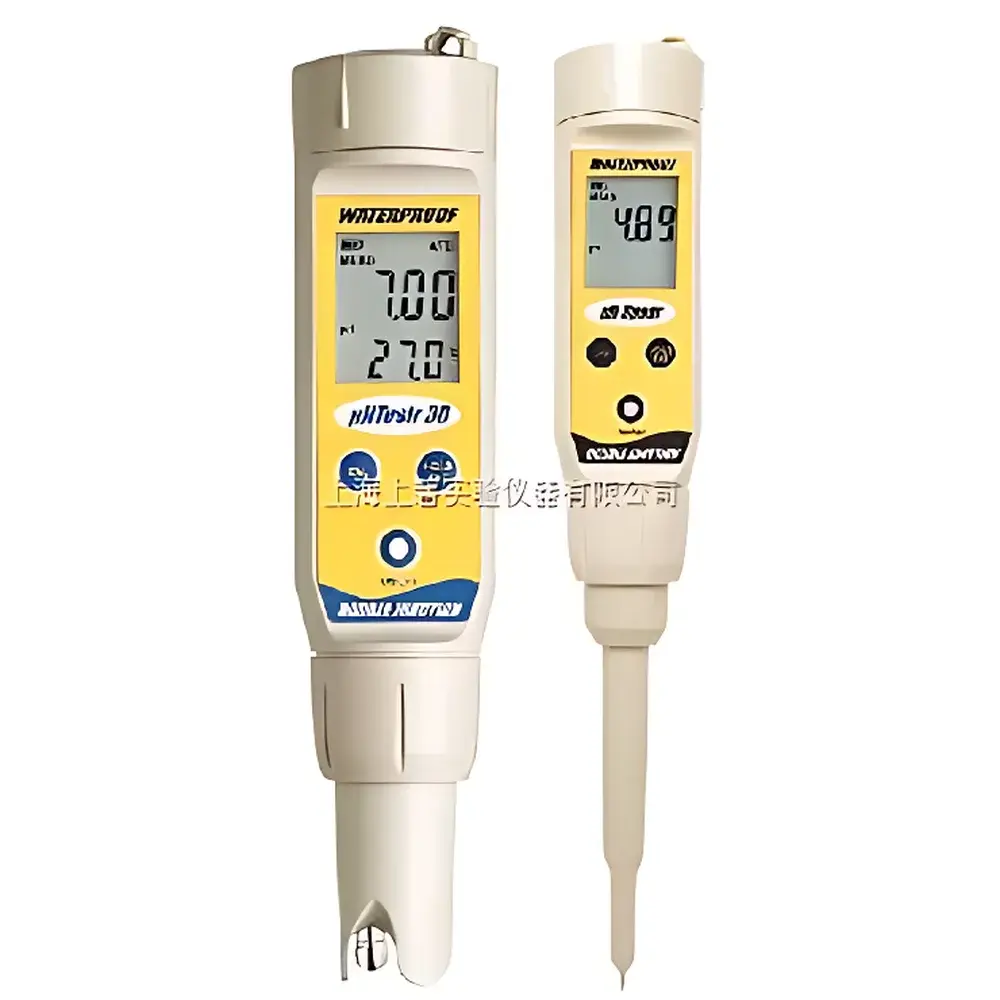
Oakton PTTestr35 Portable pH/Conductivity/TDS/Salinity Meter
| Origin | USA |
|---|---|
| Manufacturer Type | Authorized Distributor |
| Product Origin | Imported |
| Model | 35425-05 |
| Price Range | USD 70–700 (FOB) |
| Measured Parameters | pH, Conductivity, TDS, Salinity, Temperature |
| Portability | Handheld / Pen-style |
| Conductivity Range | 0–200 µS/cm |
| TDS Range | 0–100 ppm |
| Resistivity Range | 0–100 kΩ·cm |
| Salinity Range | 0–100 ppm (NaCl equivalent) |
| Temperature Range | 10–110 °C |
| Accuracy | ±0.2% of reading |
| Minimum Resolution | 0.001 unit (context-dependent per parameter) |
Overview
The Oakton PTTestr35 Portable pH/Conductivity/TDS/Salinity Meter (Model 35425-05) is a field-deployable, multi-parameter electrochemical analyzer engineered for rapid, reliable measurements in environmental monitoring, aquaculture, wastewater treatment, food & beverage quality control, and educational laboratories. It operates on standardized potentiometric (pH) and conductometric (conductivity, TDS, salinity) principles—measuring voltage potential across a pH-sensitive glass or epoxy electrode and quantifying solution conductivity via a two-electrode cell with temperature-compensated AC excitation. Built-in automatic temperature compensation (ATC) adheres to ASTM D1125 and ISO 7888 protocols for conductivity measurement, ensuring traceable accuracy across variable thermal conditions. The device complies with IEC 60529 IP67 ingress protection standards and is certified for use under general laboratory GLP practices.
Key Features
- True multi-parameter capability: Simultaneous real-time display of pH, conductivity (µS/cm), TDS (ppm), salinity (ppm or %), and temperature (°C)
- Dual-display LCD with dual-line readout: Primary parameter and temperature shown concurrently; backlight optional on select firmware versions
- Replaceable modular sensor design: Field-swappable electrode cartridges reduce long-term cost of ownership and simplify calibration validation
- Double-junction reference system with Kynar® porous junction: Minimizes liquid junction potential drift and prevents clogging when measuring samples containing heavy metals, sulfides, or suspended solids
- Enhanced gel-filled electrolyte reservoir: Extends electrode service life by up to 40% compared to standard aqueous-refill designs
- IP67-rated rugged housing: Fully dust-tight and submersible to 1 m for 30 minutes; buoyant, ergonomic form factor with tactile grip surfaces
- Auto-power-off with memory retention: Preserves last-measured values and calibration coefficients after shutdown
Sample Compatibility & Compliance
The PTTestr35 is validated for aqueous matrices including freshwater, seawater dilutions, nutrient solutions, brines, process rinse water, and low-ionic-strength effluents. Its double-junction epoxy-bodied electrode resists corrosion from organic solvents, weak acids, and trace heavy metal ions—making it suitable for ASTM D512 (chloride), ASTM D1125 (conductivity), and APHA Standard Methods 2510B applications. While not FDA 21 CFR Part 11–compliant out-of-the-box (lacking audit trail and electronic signature functionality), the instrument supports manual calibration logging per ISO/IEC 17025 requirements. Calibration verification may be performed using NIST-traceable buffers (pH 4.01, 7.00, 10.01) and KCl conductivity standards (e.g., 84 µS/cm, 1413 µS/cm).
Software & Data Management
The PTTestr35 operates as a standalone instrument with no proprietary PC software dependency. All calibration, measurement, and configuration functions are executed via intuitive button navigation. Calibration points are stored in non-volatile memory: up to 3-point pH calibration (standard or custom slope), and 1–3 point conductivity calibration using factory-default or user-defined TDS conversion factors (e.g., 0.5, 0.65, 0.7, or 0.75). Temperature compensation follows the linear β-coefficient method (typically 2.0%/°C default) or selectable NaCl-based algorithms per ISO 7888 Annex B. Data export requires manual transcription; however, optional RS232 or USB-to-serial adapters (sold separately) enable ASCII-formatted output compatible with LIMS or Excel ingestion.
Applications
- Aquaculture pond management: Routine tracking of conductivity shifts indicating nutrient accumulation or osmotic stress in larval rearing systems
- Hydroponics and greenhouse irrigation: Monitoring EC stability in recirculating nutrient films to prevent root zone toxicity
- Drinking water safety screening: Rapid verification of TDS compliance against WHO Guideline Values (≤500 ppm)
- Wastewater pretreatment verification: Confirming desalination unit performance via inlet/outlet salinity differentials
- Academic teaching labs: Demonstrating ion mobility relationships, Kohlrausch’s law, and the impact of temperature on electrolytic conduction
- Field-based environmental surveys: Mapping shallow groundwater conductivity anomalies correlated with contaminant plumes
FAQ
What calibration standards are recommended for routine use?
NIST-traceable pH 4.01 and 7.00 buffers, plus 84 µS/cm and 1413 µS/cm KCl conductivity standards. For high-accuracy salinity work, use certified seawater standards (e.g., IAPSO Standard Seawater).
Can the PTTestr35 measure resistivity directly?
No—it calculates resistivity inversely from conductivity (ρ = 1/σ) and displays results in kΩ·cm units based on user-selected cell constant (default 1.0 cm⁻¹).
Is temperature compensation adjustable?
Yes. Users may select fixed β-coefficient mode (2.0%/°C) or switch to NaCl-specific compensation curves optimized for natural waters.
How often should the electrode be cleaned and recalibrated?
Daily cleaning with deionized water is advised; full recalibration is required before each measurement session or after exposure to fouling agents such as algae, oil, or proteinaceous films.
Does the device support GLP-compliant recordkeeping?
It maintains internal calibration history and date/time stamps (if enabled), but lacks electronic signatures, operator ID fields, or audit trail generation required for formal GLP/GMP environments.
Related Products





