
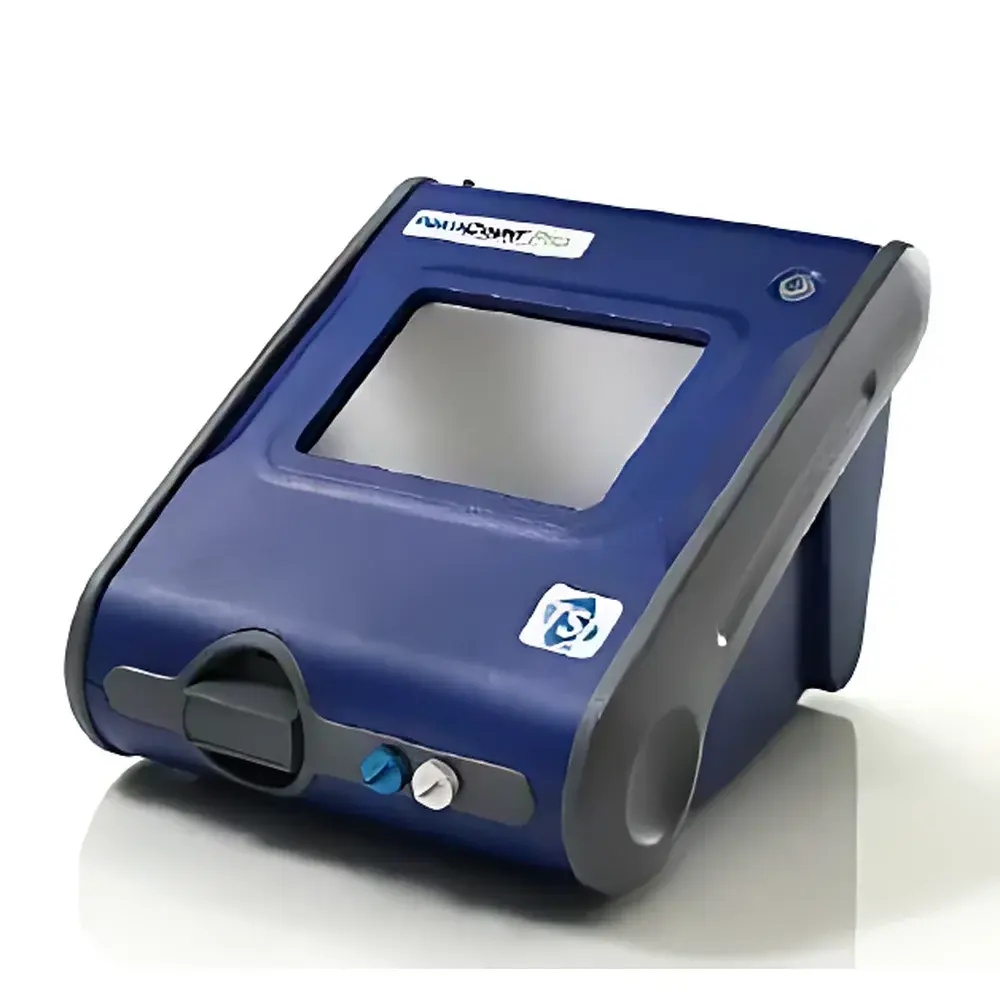
TSI PortaCount Pro+ Model 8030 Respirator Fit Tester
| Brand | TSI |
|---|---|
| Origin | USA |
| Model | 8030 |
| Fit Factor Range | 1 to >10,000 |
| Accuracy | ±10% of reading |
| Particle Sampling Flow Rate | 350 cm³/min |
| Total Flow Rate | 1000 cm³/min (nominal) |
| Operating Temperature | 0–38°C (32–100°F) |
| Storage Temperature | −40–70°C (−40–160°F) |
| Power Input | 100–250 VAC, 50–60 Hz |
| Dimensions (H×W×D) | 17 × 22 × 24 cm |
| Weight (main unit) | 2.7 kg (5.0 lb) |
| Weight (with case & accessories) | 7.3 kg (16 lb) |
| Alcohol Supply | ≥99.5% isopropyl alcohol (IPA), ~240 hours runtime at 21°C |
| Pass/Fail Threshold | User-selectable from 0 to 10,000 |
| Compliance | OSHA 29 CFR 1910.134, ISO 16900-1:2016, EN 13274-3:2008 |
| Software | FITPRO™ Fit Test Software (Windows XP/Vista compatible) |
| Optional Accessories | Model 8907 Thermal Printer, Model 8025 Test Kit, Mask Sampling Adapter Kit |
| Note | N95 respirator testing requires Model 8038 upgrade kit |
Overview
The TSI PortaCount Pro+ Model 8030 Respirator Fit Tester is a quantitative, real-time fit assessment instrument engineered for precision and regulatory compliance in occupational health and safety programs. It employs condensation particle counting (CPC) technology—based on the principle of controlled alcohol vapor nucleation—to detect and quantify ambient airborne particles both outside and inside a respirator facepiece during normal breathing and standardized test exercises. By calculating the ratio of external to internal particle concentrations (Cout/Cin), the device delivers an objective, numerical fit factor (FF) that directly reflects leakage magnitude. Unlike qualitative methods relying on subjective sensory responses (e.g., saccharin or irritant smoke tests), the Model 8030 eliminates operator bias and inter-test variability. Its design adheres to the foundational measurement science defined in ISO 16900-1:2016 and supports full alignment with OSHA 29 CFR 1910.134 Appendix A requirements for quantitative fit testing (QNFT). The system operates autonomously without continuous PC connection, making it suitable for field deployment in industrial hygiene surveys, healthcare facility respirator certification programs, and emergency response readiness audits.
Key Features
- Real-time, quantitative fit factor calculation using certified condensation particle counter (CPC) architecture with isopropyl alcohol (≥99.5% purity) as the working fluid
- Integrated color touchscreen interface enabling standalone operation—no laptop required for basic fit test execution
- Pre-programmed OSHA and EU-compliant test protocols, including seven standardized exercise sequences (e.g., normal breathing, deep breathing, head side-to-side, head up-and-down, talking, grimace, bending over)
- Fit factor range spanning 1 to >10,000, supporting evaluation of all NIOSH-certified elastomeric half-face and full-face respirators, filtering facepieces (N95, N99, N100, R95, P95), and SCBA facepieces
- On-device pass/fail decision logic with user-configurable threshold (0–10,000), configurable per respirator model and workplace exposure scenario
- Ruggedized portable design: compact footprint (17 × 22 × 24 cm), lightweight main unit (2.7 kg), and integrated carrying case (23 × 36 × 53 cm; total system weight 7.3 kg)
- Robust environmental tolerance: operational range 0–38°C, storage range −40–70°C, and stable performance across 30–80% RH
Sample Compatibility & Compliance
The Model 8030 is validated for use with all respirator types approved under U.S. NIOSH 42 CFR Part 84 and EU EN 149:2001+A1:2009 standards—including disposable N-series, R-series, and P-series filtering facepieces, reusable elastomeric half- and full-face respirators, and pressure-demand SCBA facepieces. It does not support qualitative testing of P1/P2 respirators per AS/NZS 1716:2012 due to fundamental differences in aerosol generation and detection methodology. For N95 respirator testing, the Model 8038 N95-Compliance Upgrade Kit is required to meet the enhanced sensitivity and calibration traceability stipulated in OSHA’s updated guidance documents. All measurements comply with ISO 16900-1:2016 (Respiratory protective devices — Methods of test — Part 1: Determination of inward leakage) and EN 13274-3:2008 (Respiratory protective devices — Methods of test — Part 3: Measurement of inward leakage). The instrument’s firmware and FITPRO™ software support audit-ready data logging compliant with GLP principles and FDA 21 CFR Part 11 when paired with appropriate IT infrastructure controls.
Software & Data Management
FITPRO™ Fit Test Software (included on CD, compatible with Windows XP and Vista) provides comprehensive test administration, reporting, and archival functionality. It enables automated test sequence control, customizable subject/respirator databases, electronic signature capture, and export of CSV/Excel-compatible reports containing fit factor time-series data, exercise-by-exercise leakage profiles, and pass/fail determinations. Each test record includes timestamp, operator ID, subject ID, respirator model/size, ambient conditions (temperature/humidity), and instrument calibration status. When deployed in regulated environments, the software supports role-based access control, electronic audit trails, and secure data encryption—facilitating compliance with internal quality management systems and external accreditation bodies (e.g., CAP, COLA, Joint Commission). Optional Model 8907 thermal printer generates tamper-evident hardcopy certificates for immediate worker documentation and HR records retention.
Applications
The Model 8030 serves critical functions across multiple sectors requiring documented respiratory protection efficacy. In healthcare settings, it validates surgical N95 respirators for tuberculosis and pandemic preparedness programs. Industrial hygienists deploy it for routine respirator certification in chemical manufacturing, pharmaceutical production, and metalworking facilities where exposure to crystalline silica, beryllium, or organic vapors mandates quantitative verification. Emergency response teams utilize its portability and battery-free AC operation for rapid pre-deployment fit verification in hazmat scenarios. Universities and government laboratories employ it for respirator development validation, comparative leakage studies, and training curriculum delivery. Its ability to operate independently of ambient aerosol generators makes it uniquely suited for low-infrastructure environments—including mobile clinics, offshore platforms, and field-based construction sites—where traditional challenge aerosol systems are impractical.
FAQ
What particle size range does the Model 8030 measure?
The instrument detects ultrafine particles in the 0.02–1.0 µm diameter range, optimized for ambient background aerosols including combustion byproducts, sea salt nuclei, and indoor organic condensables.
Is calibration required before each test?
No daily calibration is needed; however, a functional check using the built-in zero-air and challenge-air verification routines must be performed prior to initiating any test session per ISO 16900-1 Section 7.2.
Can the Model 8030 be used for annual respirator requalification?
Yes—it meets OSHA’s requirement for quantitative fit testing at least annually, or whenever a different respirator model or size is issued, or if facial changes occur that may affect seal integrity.
Does the system require external aerosol generation?
No—the Model 8030 uses ambient air as the particle source, eliminating need for polydisperse challenge aerosols, sodium chloride generators, or upstream dilution systems.
How is data integrity ensured during multi-user deployments?
FITPRO™ enforces unique user login credentials, time-stamped test logs, and immutable digital signatures—supporting forensic-level traceability required under GxP and ISO 9001 quality management frameworks.







