Hprobe IBEX-300 Wafer-Level Ultra-Fast 3D Magnetic Field Probe Station
| Brand | Hprobe |
|---|---|
| Origin | France |
| Model | IBEX-300 |
| Wafer Compatibility | 100–300 mm |
| Magnetic Field Orientation | Full 3D vector control (in-plane & out-of-plane) |
| Field Scan Speed | Sub-second field reorientation |
| Integrated Calibration | On-board Hall sensors with traceable calibration |
| Software Suite | MRAM characterization, sensor parameter extraction, and automated test sequencing |
| Probe Interface | Compatible with standard RF/microwave and DC probe cards |
| Compliance | Designed for ISO/IEC 17025-aligned lab environments and GLP-compliant magnetic device qualification |
Overview
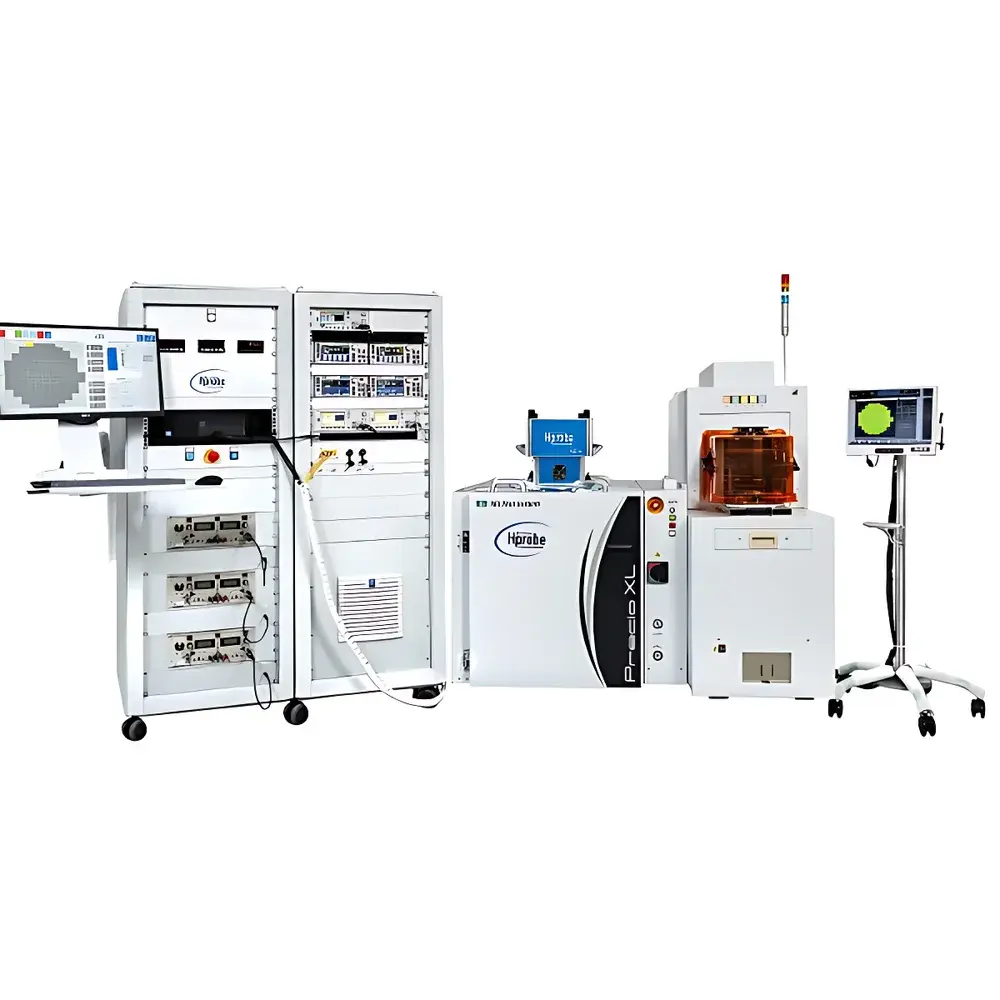
The Hprobe IBEX-300 is a wafer-level ultra-fast 3D magnetic field probe station engineered for high-throughput characterization of magnetoresistive devices directly on silicon wafers up to 300 mm in diameter. Unlike conventional electromagnet-based systems constrained by mechanical inertia and thermal drift, the IBEX-300 employs a proprietary array of independently controlled orthogonal electromagnetic coils—each optimized for rapid current modulation—to generate precisely defined magnetic field vectors in real time. This architecture enables sub-second reorientation of the applied field across all three spatial axes (Bx, By, Bz), supporting dynamic hysteresis loop acquisition, switching probability mapping, and angular-dependent anisotropy analysis without stage movement or coil repositioning. The system is purpose-built for process development and reliability validation of spintronic devices—including STT-MRAM, SOT-MRAM, GMR/TMR sensors, and magnetic logic elements—within semiconductor fabrication environments where spatial resolution, thermal stability, and integration with existing probe station workflows are critical.
Key Features
- Wafer-scale compatibility: Fully supports 100 mm, 150 mm, 200 mm, and 300 mm silicon wafers with vacuum chucking and Z-height auto-compensation.
- True 3D vector field generation: Independent control of in-plane (±200 mT typical) and out-of-plane (±150 mT typical) field components with <1° angular resolution and <0.5% field uniformity over 10 mm × 10 mm active area.
- Ultra-fast field scanning: Achieves full 3D field vector sweeps in under 500 ms using synchronized current drivers with 16-bit DAC resolution and <10 µs timing jitter.
- Embedded metrology-grade calibration: Integrated micro-Hall sensors co-located with the DUT plane provide real-time field feedback; factory-traceable to NIST-equivalent magnetic standards.
- Modular probe interface: Accepts industry-standard RF (e.g., Cascade Summit 12000 series), DC (e.g., FormFactor MPI), and microwave probe cards via kinematic mounting plates and calibrated signal routing.
- Thermally stabilized platform: Active temperature control (±0.1 °C) of the chuck and magnetic core assembly minimizes thermal drift during multi-hour parametric sweeps.
Sample Compatibility & Compliance
The IBEX-300 accommodates bare and packaged wafers, including those with backside metallization, oxide layers, or temporary bonding films. It supports both front-side probing and through-silicon-via (TSV) access configurations. All magnetic field delivery subsystems comply with IEC 61000-4-8 (power frequency magnetic field immunity) and meet CE/EMC Directive 2014/30/EU requirements. System firmware and data handling protocols support audit-ready operation under GLP and ISO/IEC 17025 frameworks. Optional configuration includes 21 CFR Part 11–compliant electronic signatures and audit trail logging for regulated MRAM qualification workflows.
Software & Data Management
The IBEX Control Suite is a Windows-based application built on a modular LabVIEW RT architecture, featuring deterministic real-time execution for synchronized field sweep and electrical measurement triggering. Core modules include: (1) Vector Field Composer for defining arbitrary 3D field trajectories (e.g., circular, elliptical, conical, or user-defined Lissajous paths); (2) MRAM Characterization Toolkit with built-in algorithms for R-H loop fitting, write error rate (WER) vs. pulse width/voltage, and thermal activation energy extraction; (3) Sensor Parameter Extractor for sensitivity, linearity, offset, and hysteresis quantification per IEEE Std 2020-2021. All raw and processed data are stored in HDF5 format with embedded metadata (field vector timestamps, probe position coordinates, environmental logs), enabling seamless import into Python (via h5py), MATLAB, or statistical analysis platforms.
Applications
- STT-MRAM bit cell reliability assessment: Write disturbance testing, retention time mapping, and endurance cycling under programmable field bias conditions.
- Angular magnetoresistance characterization of TMR stacks for compass sensor calibration and automotive ADAS applications.
- Spin-orbit torque (SOT) efficiency quantification via harmonic Hall measurements under rotating in-plane fields.
- Process window qualification for magnetic annealing steps using field-dependent resistance uniformity metrics across wafer maps.
- Co-design validation of magnetic shielding layouts by correlating local field distortion with layout geometry using on-wafer field mapping mode.
FAQ
What wafer sizes does the IBEX-300 support?
The system supports 100 mm, 150 mm, 200 mm, and 300 mm wafers with automatic chuck adaptation and optical centering.
Is the magnetic field calibrated in situ?
Yes—integrated micro-Hall sensors located within the probe zone enable real-time field monitoring and closed-loop correction; calibration certificates are provided with each system shipment.
Can the IBEX-300 be integrated into an automated test environment?
It features TCP/IP and IVI-COM interfaces for integration with SECS/GEM host systems and third-party ATE platforms such as Advantest T6391 or Teradyne UltraFLEX.
Does it support low-temperature operation?
The base configuration operates from 20 °C to 85 °C; cryogenic variants (down to 4 K) are available as custom-engineered options with superconducting coil integration.
How is probe alignment verified during magnetic field sweeps?
A motorized optical microscope with 5×–50× zoom and sub-micron XY stage positioning ensures precise DUT registration prior to field ramping; optional laser interferometric position feedback is available for sub-100 nm alignment repeatability.