
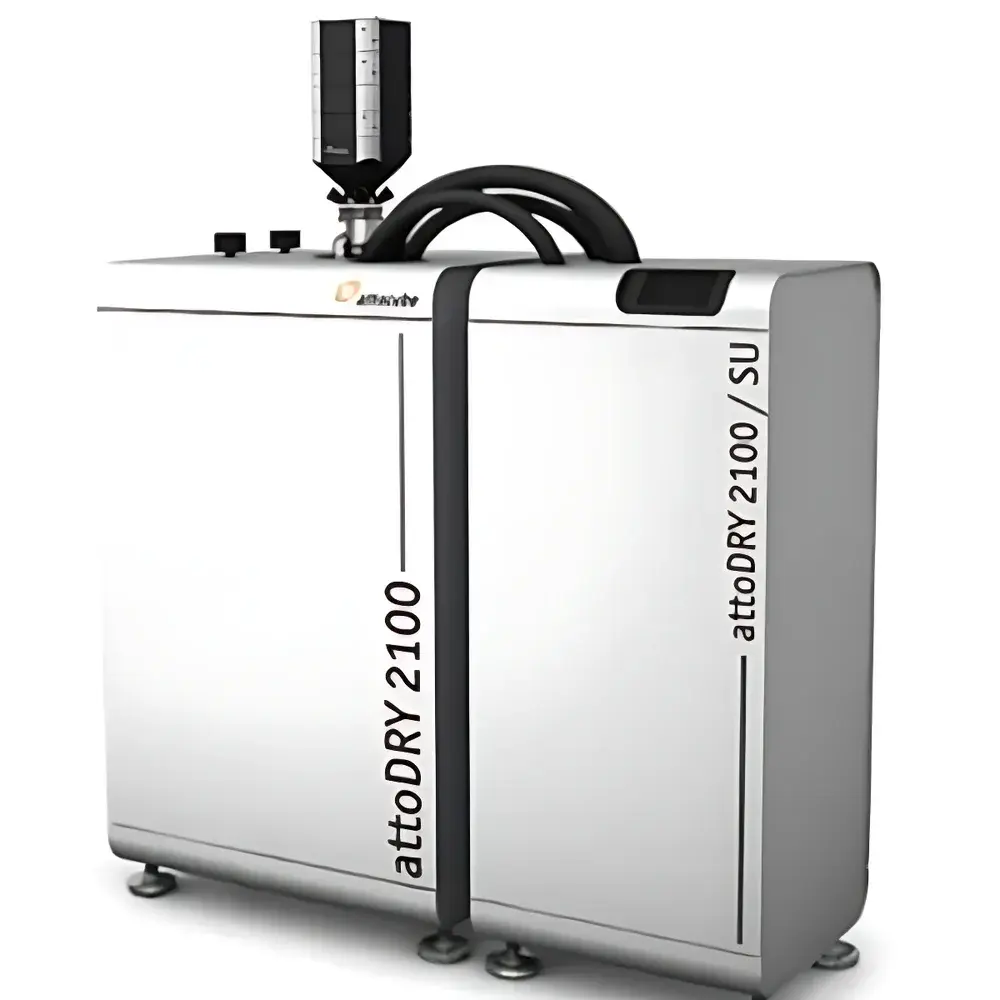
Attocube attoDRY Lab Helium-Free Low-Temperature High-Magnetic-Field Scanning Probe Microscope
| Brand | Attocube Systems AG |
|---|---|
| Origin | Germany |
| Model | attoDRY Lab |
| Instrument Type | Cryogenic Scanning Probe Microscope (SPM) |
| Magnetic Field Strength | Up to 15 T |
| Temperature Range | 1.5 K – 300 K (closed-cycle) |
| Positioning Noise | < 0.5 nm RMS |
| Sample Dimensions | Max 100 mm × 50 mm × 20 mm |
| XY Scanner Range | 10 µm × 10 µm |
| Vibration Level | 0.12 nm RMS (typ.) |
| Compliance | ASTM E2917, ISO/IEC 17025 compatible workflows, GLP/GMP-ready data logging |
Overview
The Attocube attoDRY Lab is a fully integrated helium-free cryogenic scanning probe microscope engineered for high-resolution surface characterization under extreme conditions—specifically, ultra-low temperatures (down to 1.5 K), high magnetic fields (up to 15 T), and sub-nanometer mechanical stability. Unlike conventional liquid-helium-dependent systems, the attoDRY Lab employs a closed-cycle pulse-tube cryocooler coupled with an actively shielded superconducting magnet, eliminating the operational complexity, cost volatility, and infrastructure dependency associated with liquid cryogens. Its core measurement architecture is based on piezo-driven, interferometrically calibrated scanning probe techniques—including atomic force microscopy (AFM), magnetic force microscopy (MFM), conductive AFM (c-AFM), and piezoresponse force microscopy (PRFM)—all operating in situ within the same cryogenic vacuum environment. This design enables direct correlation of electronic, magnetic, ferroelectric, and topographic properties at the nanoscale under precisely controlled thermodynamic and electromagnetic boundary conditions—critical for quantum materials research, 2D heterostructures, topological insulators, and correlated electron systems.
Key Features
- Helium-free operation: Fully closed-cycle cooling system ensures continuous, maintenance-light operation without liquid cryogen refills or dewar handling.
- Ultra-low vibration performance: Mechanical noise floor of 0.12 nm RMS (root-mean-square) achieved via optimized thermal anchoring, passive damping, and magnetically decoupled cryostat design—enabling true atomic-resolution imaging below 4 K.
- Wide temperature range: Continuous, programmable operation from 1.5 K to 300 K, with thermal stability better than ±10 mK over 1-hour intervals—essential for phase-transition studies and thermally activated transport measurements.
- High-field magnet integration: Persistent-mode superconducting magnet delivering up to 15 T with field homogeneity < 100 ppm over 5 mm DSV; field ramp rate programmable up to 1 T/min with active quench protection.
- Modular SPM head compatibility: Supports interchangeable probe modules—attoAFM, attoMFM, attoCFM (confocal), Raman/PL spectroscopy interfaces, and atto3DR dual-axis rotation stage—without breaking vacuum or warming the system.
- Integrated touchscreen control: Unified graphical user interface (GUI) for simultaneous real-time adjustment of temperature setpoint, magnetic field strength, scanner bias, feedback gains, and image acquisition parameters.
Sample Compatibility & Compliance
The attoDRY Lab accommodates standard and custom substrates up to 100 mm × 50 mm × 20 mm in dimension, including insulating (e.g., sapphire, h-BN), semiconducting (Si/SiO₂, GaAs), and metallic (Nb, YBCO) samples. Electrical contact is facilitated via spring-loaded low-noise wiring looms and gold-plated sample holders with 4-wire probing capability. All vacuum components conform to UHV standards (< 1×10⁻⁹ mbar base pressure), and the system is compatible with in-situ sample transfer via load-lock modules (optional). From a regulatory standpoint, the platform supports audit-ready data acquisition workflows compliant with ISO/IEC 17025 requirements for calibration traceability, and its software architecture permits configuration for FDA 21 CFR Part 11-compliant electronic records and signatures when deployed in regulated QC/QA environments (e.g., quantum device fabrication labs). Documentation packages include full CE marking, RoHS compliance, and IEC 61000-6-3/6-4 EMC certification.
Software & Data Management
Control and data acquisition are managed through the proprietary attoDRY Control Suite—a deterministic, real-time Linux-based platform supporting synchronized multi-channel input (topography, current, capacitance, photoluminescence intensity, Raman shift) at sampling rates up to 2 MHz. All raw sensor data are stored in HDF5 format with embedded metadata (timestamp, temperature, field, PID settings, scanner position), enabling reproducible post-processing and FAIR (Findable, Accessible, Interoperable, Reusable) data practices. The suite includes built-in FFT analysis, line-profile extraction, vector field reconstruction (for MFM), and automated drift correction algorithms. For laboratory information management, optional APIs allow integration with ELN (Electronic Lab Notebook) systems such as LabArchives or Benchling via RESTful endpoints. Audit trails—including user login history, parameter change logs, and acquisition start/stop events—are retained for ≥18 months and exportable as CSV or PDF for GLP/GMP inspections.
Applications
The attoDRY Lab serves as a foundational tool across multiple advanced research domains: (1) Nanoscale magnetic imaging of skyrmions, domain walls, and vortex lattices in type-II superconductors and van der Waals magnets using MFM and scanning Hall probe modes; (2) Correlated transport studies in moiré superlattices (e.g., twisted bilayer graphene, trilayer graphene), where c-AFM and Kelvin probe force microscopy (KPFM) quantify local band alignment and charge inhomogeneity under applied field; (3) Strain-engineered ferroelectric switching dynamics probed via PRFM at millikelvin temperatures; (4) In-situ optomechanical coupling experiments combining attoCFM confocal excitation with resonant AFM cantilever detection; (5) Quantum emitter localization and spin-state readout in hBN and TMD monolayers using combined PL-Raman-SPM modalities. Published work using this platform appears consistently in high-impact journals including Nature, Science, and Nature Physics, reflecting its role in frontier quantum material discovery.
FAQ
Does the attoDRY Lab require liquid helium or liquid nitrogen?
No. It operates exclusively on a closed-cycle pulse-tube refrigerator and does not consume any cryogenic liquids.
Can the system be upgraded to support additional SPM modalities after purchase?
Yes. The modular probe head architecture allows field-installation of attoCFM, Raman, or atto3DR rotation stages without system warm-up or vendor service dispatch.
What level of magnetic field homogeneity is guaranteed over the imaging area?
The 15 T magnet provides ≤100 ppm field variation over a 5 mm diameter spherical volume (DSV), sufficient for uniform vector field mapping across typical SPM scan ranges.
Is remote operation supported for collaborative or shared-facility use?
Yes. The control suite includes secure VNC and SSH access options with configurable user permissions and session logging.
How is thermal drift compensated during long-duration spectroscopic scans?
Active drift compensation is implemented via real-time interferometric position feedback (attoLFT laser interferometers) and adaptive Z-piezo correction algorithms running at 10 kHz update rate.





