
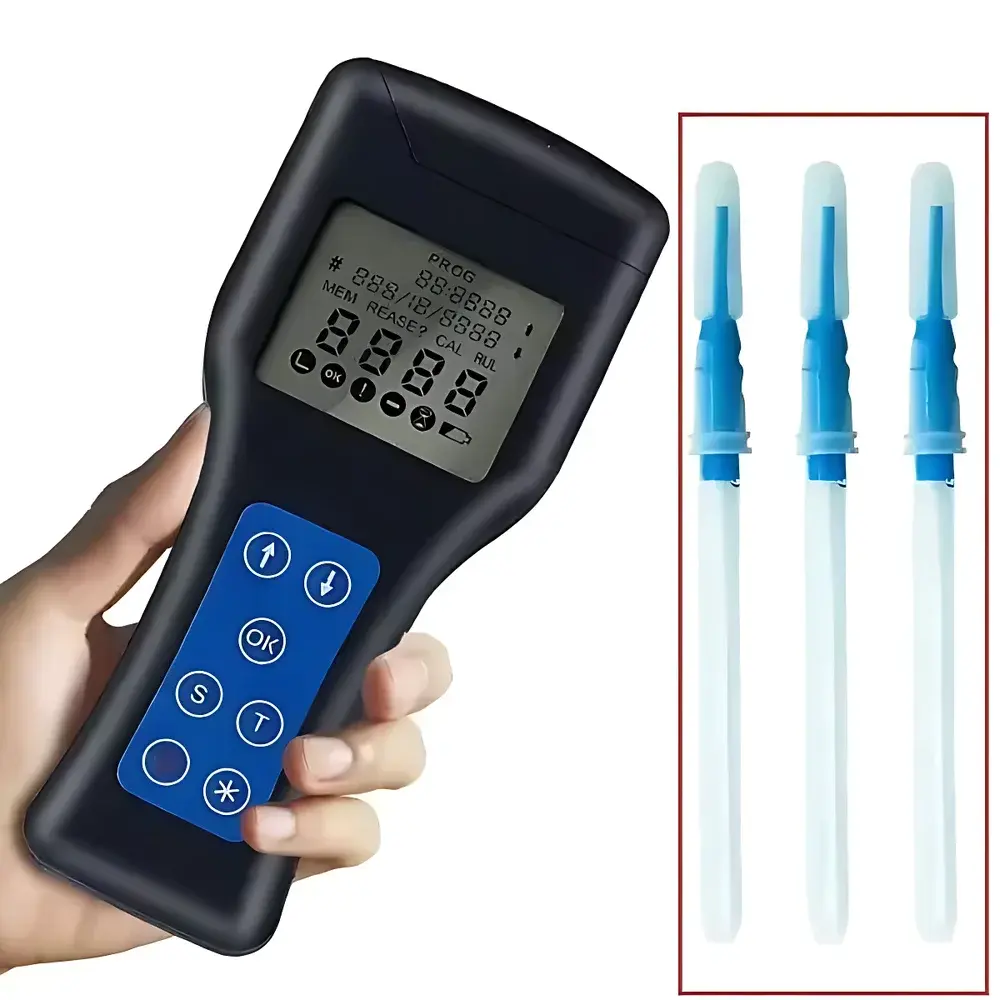
BJBY BY-2012 ATP Bioluminescence Detector
| Brand | BJBY |
|---|---|
| Origin | Beijing, China |
| Manufacturer Type | Authorized Distributor |
| Country of Origin | China |
| Model | BY-2012ATP |
| Detection Range | 0–9999 RLU |
| Detection Limit | 5×10⁻¹⁵ mol ATP |
| Detection Time | ≤15 s |
| Accuracy | ±5 RLU |
| Operating Temperature | 5–40 °C |
| Operating Humidity | 20–85 % RH |
| ATP Recovery Rate | 90–110 % |
| Display | Large Backlit LCD |
| User Accounts | 50 |
| Custom Limits | 250 |
| Data Storage Capacity | 2000 test records |
| Pass/Fail Auto-Judgment | Yes |
| Built-in Self-Calibration Light Source | Yes |
| Self-Test at Power-On | Yes (30 s) |
| Interface | RS232 + USB |
| Dimensions (W×H×D) | 192 × 87 × 34 mm |
Overview
The BJBY BY-2012 ATP Bioluminescence Detector is a portable, field-deployable luminometer engineered for rapid, quantitative assessment of adenosine triphosphate (ATP) in environmental and process hygiene monitoring applications. It operates on the principle of bioluminescent enzymatic reaction: ATP extracted from microbial cells or organic residues reacts with luciferase and luciferin under controlled buffer conditions, producing light proportional to ATP concentration. This emitted photon flux is measured in relative light units (RLU) by a high-sensitivity photomultiplier tube (PMT) or silicon photodiode detector. Unlike culture-based microbiological methods requiring 24–72 hours, the BY-2012 delivers objective, instrument-based hygiene verification within 15 seconds—making it suitable for real-time decision support in food safety validation, HACCP verification, and environmental monitoring programs compliant with ISO 22000, FDA Food Code, and EC No. 852/2004.
Key Features
- Quantitative ATP detection with a validated limit of detection of 5×10⁻¹⁵ mol ATP—enabling reliable detection of low-level microbial contamination and residual organic matter.
- Consistent measurement performance across ambient operating conditions (5–40 °C, 20–85 % RH), supporting use in cold storage facilities, production floors, and field inspection environments.
- Integrated self-calibration light source and automatic 30-second power-on diagnostic sequence ensure optical path stability and baseline integrity prior to each assay batch.
- On-device pass/fail logic with user-configurable RLU thresholds (up to 250 distinct limits) enables immediate compliance evaluation against internal SOPs or regulatory benchmarks (e.g., <10 RLU for food contact surfaces per NSF/ANSI Standard 154).
- Large backlit LCD display with intuitive icon-driven interface reduces operator training burden; no specialized microbiology or analytical chemistry background required.
- Dual communication interfaces (RS232 and USB) support direct data export to laboratory information management systems (LIMS), Excel, or custom QA databases—facilitating audit-ready recordkeeping aligned with FDA 21 CFR Part 11 requirements for electronic records and signatures.
Sample Compatibility & Compliance
The BY-2012 is validated for swab-based ATP sampling using standardized commercial ATP swabs (e.g., Copan, 3M Clean-Trace, Hygiena UltraSnap). It supports both liquid-phase (e.g., rinse water, potable water) and surface-extracted ATP samples. Instrument output (RLU) correlates linearly with ATP concentration across the full 0–9999 RLU dynamic range, with demonstrated recovery rates of 90–110 % across diverse matrix types—including stainless steel, plastic, ceramic, and glass surfaces. The device meets functional specifications referenced in ISO 22000:2018 Annex A.7.2 (verification of cleaning effectiveness), AOAC Official Method 2012.02 (ATP hygiene monitoring), and USP Water for Pharmaceutical Purposes (for rinse water screening). Its compact form factor (192 × 87 × 34 mm) and battery-compatible operation enable seamless integration into mobile hygiene auditing workflows.
Software & Data Management
While the BY-2012 operates autonomously without external software, its RS232/USB connectivity allows structured data transfer to PC-based analysis tools. Exported files include timestamp, operator ID (selected from 50 pre-assigned user accounts), sample ID, RLU result, pass/fail status, and configured limit identifier. Data logs retain full traceability—including date/time stamp, instrument serial number, and firmware version—to satisfy GLP and GMP documentation requirements. Optional companion software (available separately) provides trend analysis, statistical process control (SPC) charting, and automated report generation compliant with ISO/IEC 17025 clause 7.8.2 (reporting of results).
Applications
- Routine verification of cleaning-in-place (CIP) and sanitation-in-place (SIP) efficacy in dairy, meat, beverage, and ready-to-eat food processing lines.
- Pre-operational hygiene checks of food contact surfaces, conveyor belts, slicers, mixers, and packaging equipment prior to production startup.
- Environmental monitoring in healthcare settings—including operating rooms, endoscopy reprocessing areas, and patient care surfaces—to support CDC/HICPAC guidelines.
- Drinking water quality screening in distribution networks and point-of-use locations where microbial regrowth risk is elevated.
- Audit support for third-party certification bodies (e.g., BRCGS, SQF, FSSC 22000) conducting unannounced hygiene assessments.
FAQ
What does RLU stand for, and how is it related to microbial load?
RLU stands for Relative Light Unit—a dimensionless metric representing the intensity of bioluminescent signal generated per ATP molecule. While not directly equivalent to CFU/mL, RLU values correlate strongly with total viable microbial load when sampling methodology and surface type are standardized.
Can the BY-2012 quantify specific pathogens like E. coli or Salmonella?
No. The BY-2012 detects total ATP, which originates from all living cells (bacteria, yeasts, molds) and residual organic debris. It is a hygiene indicator—not a pathogen identification tool. Positive ATP results require follow-up with selective culture or molecular methods for pathogen confirmation.
Is calibration required before each use?
No routine calibration is needed. The built-in self-calibration light source and automatic power-on self-test eliminate daily calibration steps. However, periodic verification using certified ATP standards (e.g., 10⁻¹³ mol ATP control swabs) is recommended every 30 days or per internal QA protocol.
How many test records can be stored internally?
The device stores up to 2000 complete test records with full metadata—including timestamp, operator ID, result, and pass/fail status—without external memory cards or cloud dependency.
Does the instrument comply with FDA 21 CFR Part 11?
The BY-2012 itself does not enforce electronic signature or audit trail functions. However, when paired with validated PC software and secure network protocols, exported data meets Part 11 requirements for attributable, legible, contemporaneous, original, and accurate (ALCOA+) records.





