
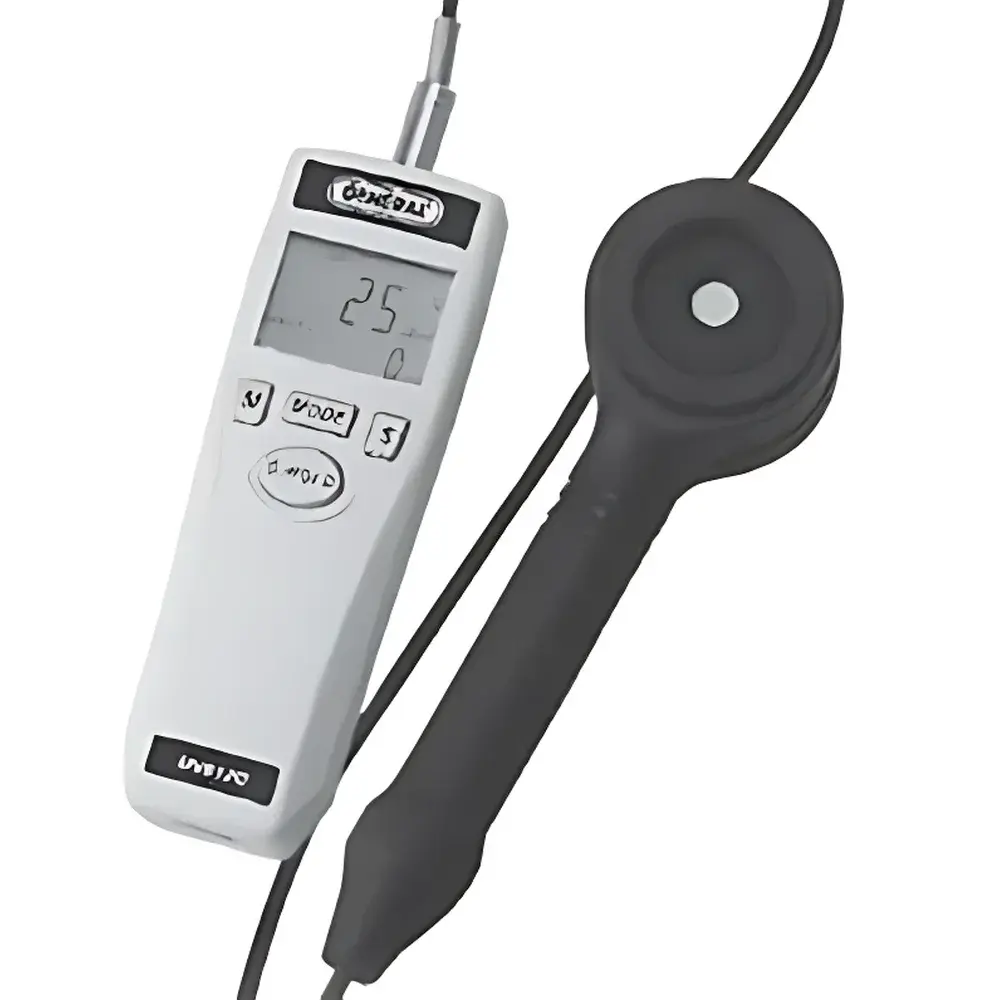
UV254M UV Radiometer (220–275 nm)
| Brand | BJBY |
|---|---|
| Model | UV254M |
| Spectral Range | 220–275 nm |
| Display | Dual 4-digit LCD with backlight |
| Measurement Ranges | High/Low auto-ranging |
| Mounting | Standard 1/4″-20 tripod socket |
| Calibration | NIST-traceable certificate included |
| Data Logging | Auto-record mode with 20-point memory |
| Zero Adjustment | Manual offset compensation |
| Power | Battery-operated with low-battery indicator |
| Compliance | Meets ISO/CIE spectral responsivity requirements for UVC radiometry |
Overview
The UV254M UV Radiometer is a precision optical measurement instrument engineered for quantitative radiometric assessment of ultraviolet radiation in the germicidal and photolytic UVC band (220–275 nm), with peak sensitivity centered at 254 nm. It operates on the principle of photoelectric detection using a filtered silicon photodiode calibrated to match the relative spectral responsivity curve defined by CIE S 019/E:2003 for UVC irradiance measurements. Unlike broadband UV-A or UV-B meters, the UV254M employs optical bandpass filtering and detector spectral correction to minimize out-of-band response—critical for applications where spectral selectivity directly impacts process validation, safety compliance, or dosimetric accuracy. Its design adheres to fundamental radiometric traceability frameworks, supporting laboratory-grade verification of UV source output in controlled environments where wavelength-specific irradiance quantification is mandated.
Key Features
- Precision-filtered photodiode sensor with spectral response optimized for 220–275 nm, validated against CIE-defined UVC weighting functions
- Dual-range auto-ranging circuitry enables seamless transition between low-intensity (e.g., ambient environmental monitoring) and high-intensity (e.g., UV lamp output validation) measurement regimes
- Backlit 4-digit LCD display with simultaneous dual-parameter readout—irradiance value and active range indicator—for unambiguous field interpretation under variable lighting conditions
- Integrated 1/4″-20 threaded tripod socket facilitates repeatable positioning during lamp characterization, conveyor-based process monitoring, or surface dose mapping
- Manual zero-offset adjustment compensates for thermal drift or background signal offset—essential for long-duration stability in temperature-variable settings
- Onboard data logging stores up to 20 sequential irradiance readings with timestamp-equivalent sequence indexing; exportable via manual recall for GLP-compliant recordkeeping
- Low-battery indicator and automatic power-down after 10 minutes of inactivity ensure operational continuity and battery longevity
Sample Compatibility & Compliance
The UV254M is compatible with continuous-wave (CW) and pulsed UVC sources emitting within its specified spectral window—including low-pressure mercury vapor lamps (253.7 nm), excimer lamps (222 nm), and UVC-LED arrays. It is not intended for use with broadband UV sources lacking spectral filtering or for measurements involving UV-C wavelengths below 220 nm (vacuum UV) or above 275 nm (UV-B). The instrument conforms to ISO/IEC 17025 calibration traceability requirements when used with its supplied NIST-traceable calibration certificate. Its spectral responsivity profile satisfies the minimum criteria outlined in ASTM E3086–22 for UVC radiometers employed in disinfection efficacy validation and industrial UV curing process control. Device housing meets IP54 ingress protection standards for resistance to dust and water splashing during routine lab or facility floor operation.
Software & Data Management
The UV254M operates as a standalone radiometric endpoint with no proprietary software dependency. All measurement data—including logged values and range status—are retained in non-volatile memory and accessible via front-panel recall. While it does not support USB or Bluetooth connectivity, the 20-point memory function supports audit-ready documentation in regulated environments operating under GLP or GMP frameworks. Users may manually transcribe logged entries into LIMS or Excel-based tracking systems compliant with FDA 21 CFR Part 11 requirements for electronic records, provided appropriate procedural controls (e.g., operator ID annotation, date/time stamping) are applied externally. Calibration certificates include uncertainty budgets per ISO/IEC 17025 Annex A.3, enabling full metrological traceability for internal quality audits.
Applications
- Validation and routine monitoring of UVC disinfection systems in healthcare facilities, HVAC ducts, and water treatment units
- Quantitative assessment of UV lamp aging and output degradation in semiconductor photolithography and UV-curable ink curing lines
- Environmental UV index estimation in occupational safety programs—particularly for personnel working near open UVC sources
- Verification of UV barrier efficacy in packaging materials and protective eyewear through transmission testing
- Supporting ISO 15858–2016-compliant validation of UV sterilization cycles in pharmaceutical cleanrooms
- Field measurement of solar UVC attenuation for atmospheric research and ozone layer monitoring proxies
FAQ
What is the spectral bandwidth (FWHM) of the UV254M sensor?
The effective full-width-at-half-maximum (FWHM) is ≤10 nm, centered at 254 nm, achieved through interference filter technology and detector spectral correction.
Can the UV254M measure pulsed UVC sources?
Yes—provided pulse repetition frequency exceeds 10 Hz and duty cycle remains ≥5%; for lower-frequency or single-pulse applications, use peak-hold mode if available or consult calibration report for temporal response limitations.
Is the calibration certificate valid for international regulatory submissions?
Yes—the included NIST-traceable certificate documents measurement uncertainty, reference standard IDs, and environmental conditions per ISO/IEC 17025, satisfying requirements for FDA, EMA, and PMDA submissions.
Does the device comply with IEC 62471 for photobiological safety assessment?
No—the UV254M is a radiometer, not a photobiological safety analyzer; it measures irradiance (W/m²), not effective radiant exposure (J/m²) weighted by the erythemal or actinic action spectrum.
How often should recalibration be performed?
Annual recalibration is recommended for routine QC use; biannual calibration is advised for high-use or mission-critical applications such as pharmaceutical UV sterilization validation.





