
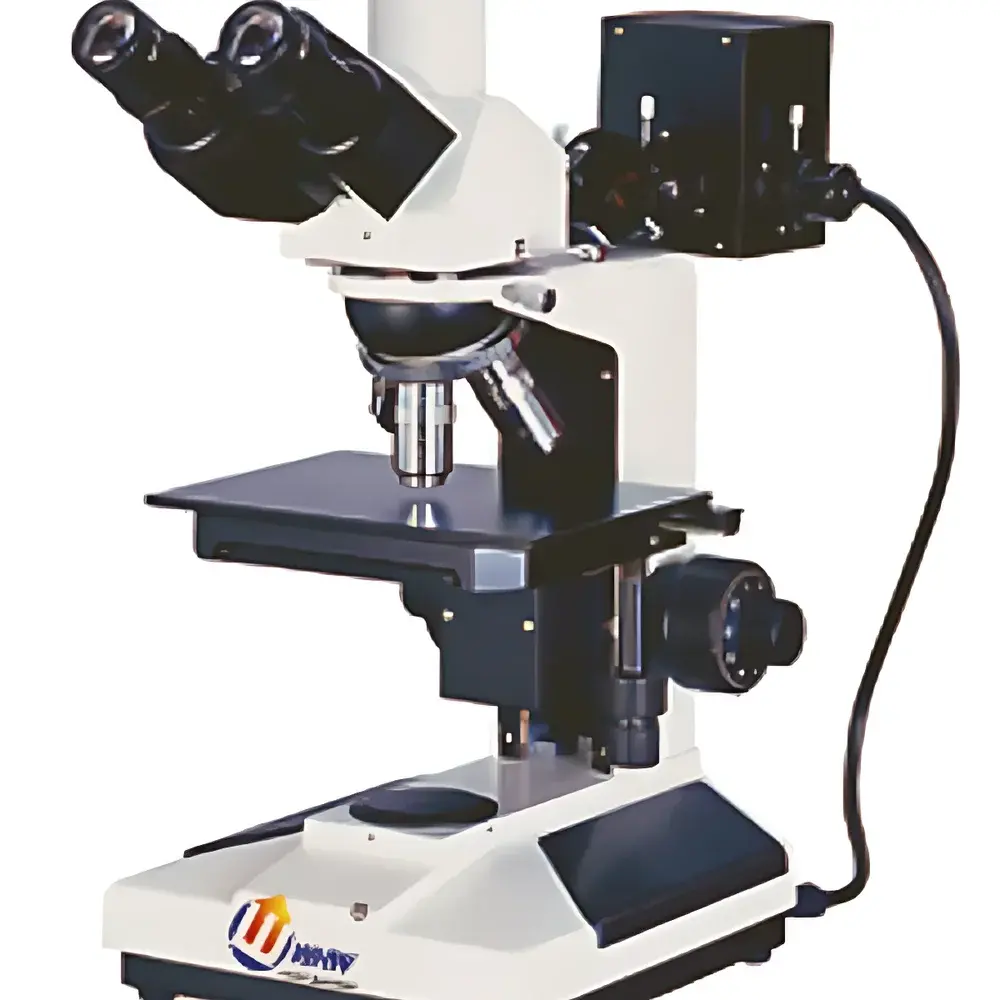
YANRUN 6XB Upright Metallurgical Microscope
| Brand | YANRUN |
|---|---|
| Origin | Shanghai, China |
| Manufacturer Type | Direct Manufacturer |
| Product Type | Upright Metallurgical Microscope |
| Model | 6XB |
| Eyepieces | WF10× (18 mm field of view) |
| Objectives | PL5× (NA 0.12, WD 18.3 mm), PL10× (NA 0.25, WD 8.9 mm), PL40× (NA 0.60, WD 3.7 mm), PL60× (NA 0.75, WD 0.96 mm) |
| Focusing Mechanism | Coaxial coarse/fine focus with 2 μm fine-focus graduation, adjustable coarse-focus tension, locking and travel-limiting mechanism |
| Stage | Dual-layer mechanical stage (186 × 142 mm, 75 × 50 mm travel range) |
| Illumination | 6 V / 20 W halogen transmitted & reflected Köhler illumination system with adjustable brightness, field diaphragm, aperture diaphragm, and built-in polarizer |
| Viewing Head | 30° inclined binocular tube with integrated rotatable analyzer for polarized light observation |
| Scale Resolution | Vernier scale with 0.1 mm reading accuracy |
| Standard Accessories | One unit main frame, one observation head, one pair WF10× eyepieces, four plan achromat objectives (5×, 10×, 40×, 60×), one 6 V / 20 W halogen lamp, certificate of conformity, warranty card, and user manual |
Overview
The YANRUN 6XB Upright Metallurgical Microscope is a precision-engineered optical instrument designed for high-fidelity microstructural analysis of opaque, polished metallic and alloy specimens. Unlike biological microscopes requiring transmitted light, the 6XB employs incident (epi-illumination) optics—optimized for reflective contrast techniques including brightfield, darkfield, and polarized light imaging. Its rigid mechanical architecture, coaxial focusing system, and calibrated mechanical stage support reproducible quantitative metallographic evaluation in quality control laboratories, foundry R&D departments, and academic metallurgy programs. The microscope conforms to fundamental ISO 10922:2018 (Metallographic specimen preparation) and ASTM E3-22 (Standard Guide for Preparation of Metallographic Specimens) workflows, enabling standardized grain size assessment, inclusion rating, phase identification, and coating thickness verification.
Key Features
- Rigid upright stand with reinforced base and thermal-stable aluminum alloy optical path for vibration-damped imaging stability
- 30° inclined binocular observation tube featuring an integrated rotatable analyzer—enabling rapid switching between unpolarized and cross-polarized observation modes without accessory reconfiguration
- Four-plan achromat long-working-distance objectives (PL5×, PL10×, PL40×, PL60×) optimized for use without cover slips; each objective features spring-loaded front lenses to prevent accidental contact damage during focusing
- Coaxial coarse/fine focusing mechanism with 2 µm fine-focus graduation, adjustable coarse-focus torque, and dual-position mechanical lock—ensuring precise Z-axis repeatability across serial sample inspections
- Dual-layer mechanical stage (186 × 142 mm footprint, 75 × 50 mm translation range) with engraved vernier scale (0.1 mm resolution) for coordinate-based feature localization and multi-field montage alignment
- Reflected-light Köhler illumination system powered by a regulated 6 V / 20 W halogen source, incorporating independently adjustable field and aperture diaphragms plus built-in polarizer for optimal contrast control and glare suppression
Sample Compatibility & Compliance
The 6XB accommodates standard metallographic specimens up to 30 mm in height and 50 mm in diameter, including mounted cross-sections, as-cast surfaces, heat-treated coupons, and coated or plated substrates. Its long working distance objectives permit safe imaging of rough, unpolished, or topographically complex samples—critical for failure analysis and corrosion morphology studies. All optical components meet ISO 8578:2017 (Microscopy — Nomenclature and specifications for objectives) dimensional tolerances. The instrument supports GLP-compliant documentation when paired with optional digital capture hardware, and its illumination uniformity and intensity stability align with ASTM E749-21 requirements for quantitative reflectance microscopy.
Software & Data Management
While the base 6XB configuration does not include integrated image analysis software, it features standardized C-mount threading (1″–32 UNF) compatible with third-party industrial cameras (e.g., Basler ace, FLIR Blackfly S) and metrology-grade digitization systems. When equipped with a compliant USB3 or GigE camera and validated software (e.g., Olympus Stream, Zeiss ZEN Core, or open-source Fiji/ImageJ with metallography plugins), the system supports automated grain size measurement per ASTM E112, inclusion counting per ASTM E45, and hardness impression analysis per ISO 6507. Audit trails, calibration logging, and user access controls can be implemented via external LIMS integration under FDA 21 CFR Part 11–compliant environments.
Applications
- Quantitative metallography: grain size distribution mapping, phase fraction analysis, and precipitate characterization in ferrous/non-ferrous alloys
- Heat treatment verification: martensite/austenite ratio estimation, decarburization depth measurement, and carburized case depth profiling
- Weld inspection: fusion zone morphology, HAZ microstructure, and porosity assessment in arc, laser, and friction stir welds
- Failure analysis: crack propagation path tracing, fatigue striation measurement, and intergranular vs. transgranular fracture mode differentiation
- Coating & surface engineering: thermal spray bond coat integrity, PVD/CVD layer adhesion evaluation, and wear track microtopography
- Quality assurance in automotive, aerospace, and power generation supply chains where ISO/TS 16949 or AS9100 traceability is mandated
FAQ
Is the 6XB compatible with digital imaging systems?
Yes—the microscope includes a standard C-mount port and supports industry-standard machine vision cameras. Adapter rings and relay lenses are available for optimal sensor coupling.
Can polarized light imaging be performed without additional accessories?
Yes—the inclined binocular head integrates a fixed polarizer in the illumination path and a rotatable analyzer in the observation path, enabling immediate polarized contrast without external components.
What is the maximum specimen height supported?
The vertical clearance from stage surface to objective nosepiece allows specimens up to 30 mm tall, accommodating most standard metallographic mounts and sectioned components.
Does the system comply with international metrology standards?
All mechanical graduations (stage vernier, fine-focus scale) adhere to ISO 8612:2015 (Metrological requirements for optical measuring instruments); optical performance is validated against ISO 10922 reference practices.
Are higher-magnification objectives available as options?
Yes—optional long-working-distance objectives (20×, 50×, 80×, 100×) and specialized contrast modules (DIC, differential interference contrast) are available through YANRUN’s OEM service channel.



