
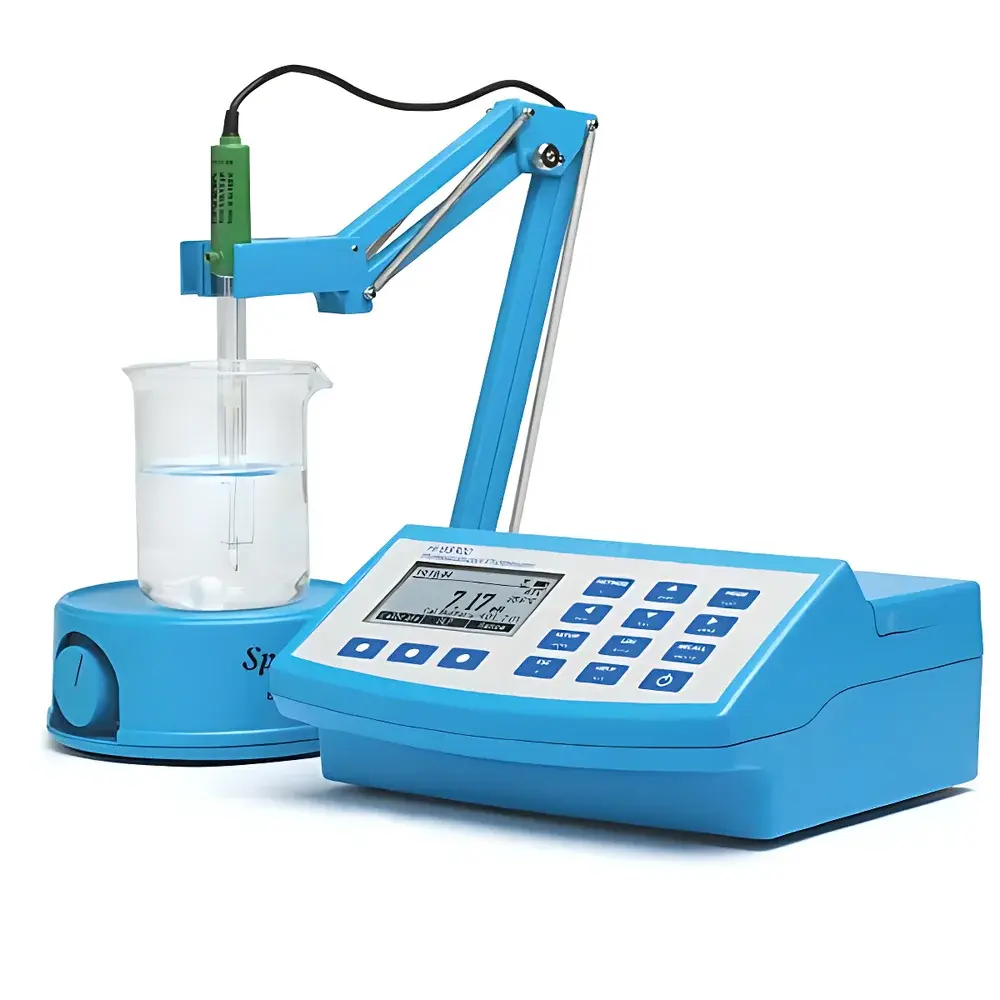
Hanna Instruments HI83300 Benchtop Multiparameter Photometer
| Brand | Hanna Instruments |
|---|---|
| Origin | Italy |
| Model | HI83300 |
| Measurement Principle | Dual-mode spectrophotometric and electrochemical detection |
| Total Parameters | >55 pre-programmed water quality methods |
| Wavelength Range | 380–760 nm (visible spectrum) |
| Optical System | Fixed-wavelength LED-based photometry with precision interference filters |
| Detector | Silicon photodiode |
| Resolution | Up to 0.001 mg/L (depending on parameter) |
| Accuracy | ±2–8% of reading + offset (method-specific, per ISO 8466-1 and ASTM D511/D129/D3370) |
| Operating Temperature | 10–40 °C |
| Power | Rechargeable Li-ion battery (up to 12 h continuous use) or AC adapter |
| Data Storage | 1000 measurement records with timestamp, sample ID, and operator ID |
| Connectivity | USB port for data export (CSV format), no Bluetooth/Wi-Fi |
| Compliance | CE, RoHS, ISO/IEC 17025 compatible operation |
Overview
The Hanna Instruments HI83300 Benchtop Multiparameter Photometer is a laboratory-grade, dual-detection platform engineered for precise, trace-level water quality analysis in environmental, municipal, industrial, and aquaculture laboratories. Unlike conventional single-mode photometers, the HI83300 integrates fixed-wavelength LED-based spectrophotometry with integrated electrochemical sensing capability—enabling simultaneous or sequential quantification of over 55 analytes across multiple concentration ranges without instrument reconfiguration. Its optical architecture employs narrow-band interference filters matched to standardized EPA, APHA, and ISO colorimetric methods (e.g., Standard Methods 4500-Cl G, 4500-P E, 4500-Cr VI B), ensuring method traceability and inter-laboratory comparability. The system operates within the visible spectrum (380–760 nm), eliminating UV-related maintenance while maintaining sensitivity for low-concentration targets such as sub-ppb hexavalent chromium (Cr⁶⁺) and microgram-per-liter hydrazine (N₂H₄). Designed for regulatory readiness, the HI83300 supports documented calibration verification, reagent lot tracking, and user-defined measurement protocols aligned with ISO/IEC 17025 clause 7.7 (measurement traceability) and US EPA Method 365.4 for phosphate.
Key Features
- Dual-detection architecture combining high-stability LED photometry and built-in electrochemical sensor interface for pH and redox potential (mV) measurements—eliminating need for separate meters in routine QA/QC workflows.
- Pre-programmed, method-locked assays for >55 parameters—including ammonia (NH₃-N), nitrate (NO₃⁻-N), orthophosphate (PO₄³⁻), total chlorine, dissolved oxygen (Winkler-modified), hardness (Ca²⁺/Mg²⁺), heavy metals (Cu, Fe, Zn, Cr⁶⁺, Ni), and specialty analytes like cyanuric acid and DEHA—each validated per APHA Standard Methods and ISO 8466-1 linearity criteria.
- Optical path integrity maintained via fixed 10 mm and 50 mm cuvette holders with automatic path-length compensation; includes dedicated seawater matrix correction algorithms for chloride, calcium, and alkalinity measurements per ASTM D511 and D129.
- Rechargeable lithium-ion power system rated for ≥12 hours of continuous operation at 25 °C—certified to IEC 62133 for safe field deployment without AC dependency.
- Onboard data management with 1000-entry non-volatile memory, including timestamp, operator ID, sample ID, calibration date, and reagent lot number—structured to support GLP-compliant record retention per 21 CFR Part 11 Annex 11 requirements when paired with Hanna’s HI92000 PC software.
- Self-diagnostic optical alignment check and zero-reference validation at startup; automatic blank recognition with dynamic dark-current compensation to minimize drift from ambient light or cuvette imperfections.
Sample Compatibility & Compliance
The HI83300 accommodates standard 10 mm square glass or plastic cuvettes (including HI731319 and HI731333) and 50 mm rectangular cells for low-transmittance samples (e.g., turbid wastewater or high-color effluents). It accepts both liquid reagents and powder pillows, with assay-specific vial geometry optimized for stoichiometric reaction completeness—critical for Cr⁶⁺ diphenylcarbazide and orthophosphate ascorbic acid/molybdate chemistries. All factory-loaded methods conform to international reference standards: chlorine assays align with ISO 7393-2; phosphate with ISO 6878; nitrate with ISO 10304-1; and hardness with ISO 6059. The instrument’s firmware implements matrix-specific corrections for seawater, brackish water, and high-TDS industrial process streams—validated against NIST-traceable reference materials (e.g., SRM 1643e, 1640a). CE marking confirms compliance with EU Directive 2014/30/EU (EMC) and 2011/65/EU (RoHS), and its mechanical design meets IP20 for indoor laboratory use per IEC 60529.
Software & Data Management
Data export is performed via USB 2.0 interface using Hanna’s HI92000 Windows-based software (v4.5+), which provides full audit-trail functionality: all calibrations, measurements, and configuration changes are logged with immutable timestamps, user credentials, and digital signatures. The software generates PDF reports compliant with ISO/IEC 17025 clause 7.8.2 (reporting results) and includes customizable templates for EPA Form 3330-2, ISO 17025 internal audits, and facility-specific SOP documentation. Raw CSV files contain column headers for analyte name, concentration, unit, method ID, uncertainty estimate (based on method-specific precision data), and QC flag status (e.g., “within control limits”, “recalibration required”). No cloud storage or remote access is implemented—ensuring full data sovereignty and alignment with GDPR Article 32 and HIPAA security rule requirements for sensitive environmental monitoring datasets.
Applications
The HI83300 serves as a primary analytical tool in drinking water treatment plants (DWTs) for daily compliance monitoring of residual disinfectants (free/total chlorine, chloramines), corrosion indicators (alkalinity, Langelier Saturation Index inputs), and emerging contaminants (cyanuric acid in recreational pools). In wastewater laboratories, it supports NPDES permit reporting for nutrients (N/P), heavy metals (Cr⁶⁺, Ni), and toxicity surrogates (COD via dichromate correlation). Aquaculture facilities rely on its rapid ammonia and nitrite profiling for biofilter health assessment, while pharmaceutical manufacturing sites deploy it for purified water (PW) and water-for-injection (WFI) conductivity-pH correlation checks per USP <1231>. Academic research labs utilize its programmable method editor for custom assay development—particularly in microplastic leachate studies requiring simultaneous trace metal and organic oxidant quantification.
FAQ
Does the HI83300 comply with EPA-approved methods for drinking water analysis?
Yes—its chlorine, nitrate, phosphate, and fluoride methods are aligned with EPA Methods 334.0, 300.0, 365.4, and 300.1 respectively, and include embedded matrix-specific corrections required for surface water and groundwater matrices.
Can the HI83300 be used for seawater analysis without modification?
Yes—preloaded seawater-specific methods (e.g., HI775-26 for alkalinity, HI758-26 for calcium) apply salinity-corrected calibration curves per ASTM D511 and include temperature-compensated molar absorptivity coefficients.
Is reagent lot traceability supported?
Yes—each assay requires manual entry of reagent lot number during calibration; this identifier is embedded in all associated measurement records and exported reports.
What is the maximum allowable turbidity for accurate photometric measurement?
For 10 mm pathlength, samples with turbidity ≤20 NTU yield reliable results; for higher turbidity, the 50 mm cell option reduces effective absorbance pathlength and enables valid readings up to 100 NTU when combined with method-specific scatter correction algorithms.
Does the instrument support multi-point calibration for nonlinear assays?
No—the HI83300 uses single-point calibration per method per ISO 8466-1 Annex B; however, all >55 pre-programmed methods were validated across ≥5 concentration levels during development to ensure linear response within stated ranges.
Related Products




