
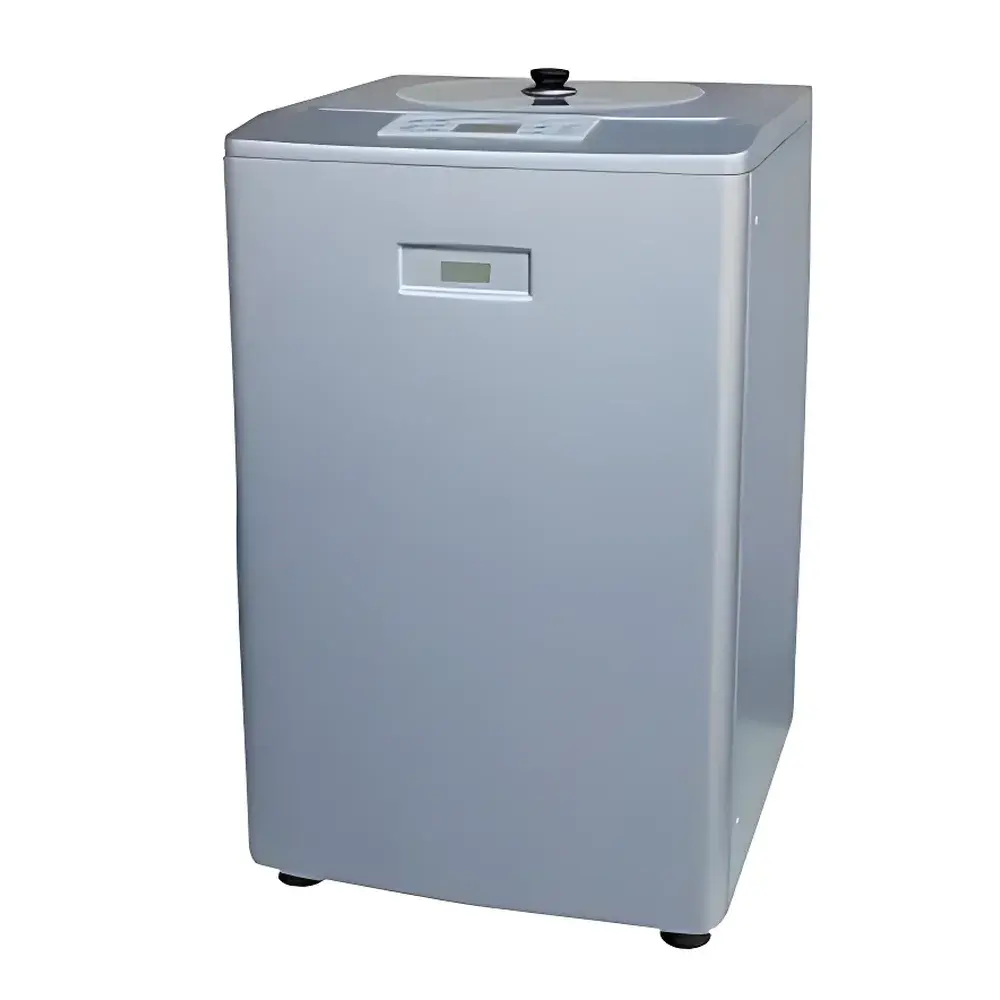
TTL TTL-100 Automated Vial Washer for Chromatography Sample Vials
| Brand | TTL |
|---|---|
| Origin | Beijing, China |
| Manufacturer Type | Direct Manufacturer |
| Region of Origin | Domestic (China) |
| Model | TTL-100 |
| Chamber Volume | 10 L |
| Heating Power | 120 W |
| Temperature Control | Thermostatically Maintained |
| Compatible Cleaning Solvents | Organic Solvents (e.g., Acetone, Methanol, Isopropanol) |
| External Dimensions (L×W×D) | 540 × 500 × 845 mm |
| Power Supply | AC 220 V, 50 Hz |
| Max. Batch Capacity | ≤97 × 2 mL Chromatography Vials (OD 11.05 ± 0.5 mm, Height 32 ± 1 mm) |
Overview
The TTL TTL-100 Automated Vial Washer is an engineered solution designed specifically for the high-reproducibility cleaning of 2 mL chromatographic sample vials used in HPLC, GC, and LC-MS workflows. It operates on a fully automated, microprocessor-controlled sequence comprising pre-rinse, soak, ultrasonic cleaning, and final rinse stages — all executed within a sealed 10 L stainless-steel chamber. Unlike general-purpose lab glassware washers, the TTL-100 integrates solvent-compatible thermal management and ultrasonic transducer arrays optimized for small-volume vial geometry, ensuring removal of trace organic residues, particulates, and adsorbed analytes without mechanical abrasion or thermal degradation. Its thermostatic temperature control maintains stable solvent conditions during prolonged soak cycles, critical for consistent recovery in trace-level quantitative analysis. The system is intended for integration into regulated laboratory environments where procedural repeatability, audit readiness, and compatibility with common analytical vial specifications (e.g., Agilent, Shimadzu, Waters) are mandatory.
Key Features
- Microprocessor-based control system with real-time process monitoring and stepwise operational feedback
- Three pre-programmed cleaning protocols (Standard, Heavy-Duty, and Low-Residue), plus user-definable parameter sets for method customization
- LCD interface with bilingual (English/Chinese) prompt support; displays water level, solvent status, cycle phase, and fault diagnostics
- Integrated low-water-level protection and automatic shutdown during ultrasonic activation to prevent transducer damage
- Intelligent solvent management: automatic detection of inlet water pressure, flow interruption, and dry-run prevention
- Stainless-steel chamber with corrosion-resistant internal coating compatible with common organic solvents (acetone, methanol, isopropanol, ethyl acetate)
- Acoustic coupling design optimized for uniform cavitation distribution across stacked 2 mL vial racks (max. 97 vials per cycle)
- Compliance-ready architecture supporting GLP documentation requirements through timestamped cycle logs and error event recording
Sample Compatibility & Compliance
The TTL-100 accommodates standard 2 mL screw-thread or crimp-top chromatography vials with outer diameter 11.05 ± 0.5 mm and height 32 ± 1 mm — conforming to ASTM D4327 and ISO 17025-aligned handling specifications. It supports both borosilicate glass and polymer vials rated for organic solvent exposure. While not certified to IEC 61000-6-3 or UL 61010-1 out-of-the-box, its electrical design adheres to Class I safety principles and CE-equivalent grounding practices. For laboratories operating under FDA 21 CFR Part 11 or EU Annex 11 requirements, optional external data logging modules can be integrated to capture cycle parameters, operator ID, and timestamped execution records — enabling retrospective validation of cleaning efficacy per USP Analytical Instrument Qualification guidelines.
Software & Data Management
The embedded firmware provides non-volatile storage of up to 500 completed cycle logs, each including start/stop timestamps, selected program ID, actual chamber temperature, solvent volume consumed (estimated), and any triggered alarms. Cycle data can be exported via USB port in CSV format for import into LIMS or electronic lab notebook (ELN) systems. No cloud connectivity or remote access is implemented — aligning with air-gapped laboratory security policies. Audit trail functionality includes immutable event tagging for critical actions (e.g., program modification, manual override, emergency stop), satisfying basic ALCOA+ data integrity expectations for routine QC/QA operations.
Applications
- Routine preparation of HPLC/GC autosampler vials in pharmaceutical QC labs performing assay, dissolution, or stability testing
- Removal of carryover contaminants between high-sensitivity LC-MS injections in metabolomics or proteomics core facilities
- Validation of cleaning effectiveness for residual solvent studies per ICH Q5C and Q7 guidelines
- Pre-analytical processing in environmental testing labs handling PAHs, PCBs, or pesticide residues in soil/water extracts
- Supporting ISO/IEC 17025 accredited methods requiring documented vial cleanliness verification prior to calibration standard preparation
FAQ
Is the TTL-100 compatible with aggressive solvents such as chloroform or DMSO?
Yes — the chamber gasketing and internal wetted surfaces are constructed from fluoropolymer-coated stainless steel and EPDM-free elastomers rated for intermittent exposure to halogenated and polar aprotic solvents.
Can the unit be validated for GMP use?
The TTL-100 supports IQ/OQ protocols through configurable cycle parameters and built-in logging; however, formal PQ must be conducted by the end user using residue detection methods (e.g., TOC, GC-FID, or swab testing) per your SOP.
Does it require connection to a dedicated water purification system?
No — it accepts standard laboratory tap water, though resistivity ≥1 MΩ·cm is recommended for final rinse stages to minimize ionic residue. Integration with TTL-100F deionized water generator is optional.
What maintenance intervals are recommended?
Ultrasonic transducers should be inspected quarterly; chamber seals and drain filters require cleaning after every 200 cycles or when visible residue accumulates.
Is remote monitoring or Ethernet connectivity available?
Not natively — the system operates as a standalone appliance. Third-party serial-to-Ethernet adapters may be used for basic status polling, but no native API or SCADA integration is provided.



