
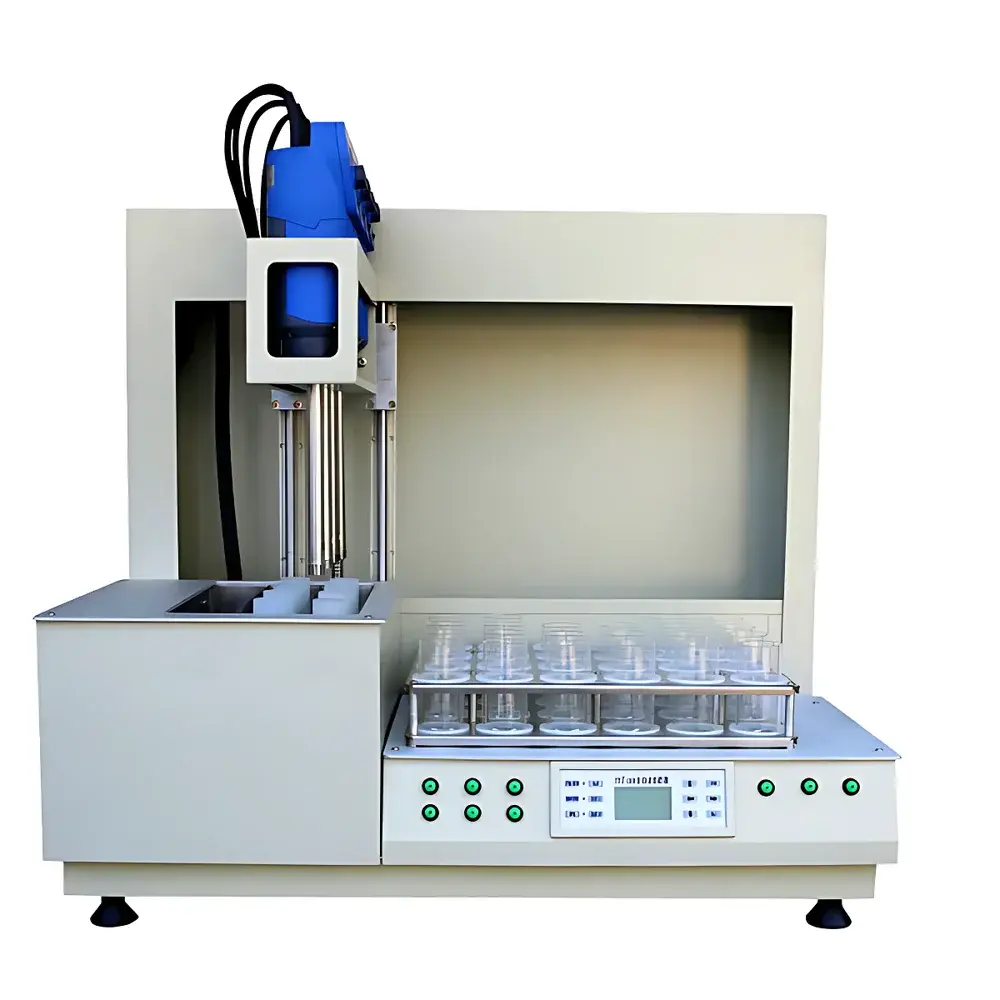
TTL TTL-200 Fully Automatic Multi-Channel Homogenizer
| Brand | TTL |
|---|---|
| Origin | Beijing, China |
| Manufacturer Type | Direct Manufacturer |
| Instrument Type | Probe-Rotor Homogenizer |
| Dimensions (W×D×H) | 860 × 500 × 770 mm |
| Sample Throughput | 24 samples/batch (165 mL beakers, standard) |
| Optional Throughput | 32 (100 mL screw-cap tubes), 40 (50 mL screw-cap tubes), 60 (10/15 mL screw-cap tubes) |
| Control Interface | LCD with Chinese-language UI |
| Cleaning System | Three-stage automated cleaning (running tap water → organic solvent → ultrasonic bath) |
| Channel Configuration | 4 independent homogenization channels with synchronized or asynchronous operation |
| Blade Motion | Vertical reciprocating motion during homogenization |
| Safety Features | Dry-run protection for ultrasonic cleaning stage |
| Compliance | Designed for GLP-compliant laboratory environments |
Overview
The TTL TTL-200 Fully Automatic Multi-Channel Homogenizer is an engineered solution for high-throughput, reproducible sample disruption in analytical, microbiological, and food safety laboratories. Based on probe-rotor (rotor-stator) homogenization principles, the system applies controlled mechanical shear forces to lyse cells, emulsify suspensions, and homogenize heterogeneous biological or environmental matrices. Its core architecture integrates four parallel, independently actuated homogenization stations—each equipped with a precision-engineered stainless-steel probe—enabling simultaneous processing of up to 24 samples per batch using standard 165 mL beakers. This design significantly reduces inter-batch variability and operator-induced inconsistency common in manual or single-channel systems. The instrument operates under programmable torque and speed profiles, ensuring consistent energy input across all channels, critical for applications requiring statistical comparability across replicates.
Key Features
- Four fully independent homogenization channels with synchronized or user-defined staggered start timing
- Vertical reciprocating probe motion (up/down oscillation during rotation) enhances fluid turbulence and particle disintegration efficiency
- Three-stage automated blade cleaning sequence: (1) running tap water rinse, (2) organic solvent immersion (e.g., ethanol, acetone), and (3) ultrasonic cavitation in dedicated cleaning baths—each stage housed in isolated, sealed reservoirs to prevent cross-contamination
- Dry-run protection logic for ultrasonic cleaning modules, with real-time sensor feedback and audible/visual alerts
- Intuitive LCD interface with native Chinese language support and step-by-step progress visualization including estimated time remaining
- Preloaded standard protocols for common matrices (e.g., tissue homogenization, bacterial lysis, soil slurry preparation) plus full user-programmable workflow editor for custom cycle definition (speed, duration, pause intervals, number of cycles)
- One-touch configuration for channel activation count (1–4), batch size selection, cleaning mode initiation, and tube-pathway flush function
- Robust aluminum-alloy chassis and corrosion-resistant internal components ensure long-term stability in routine QC/QA environments
Sample Compatibility & Compliance
The TTL-200 accommodates a broad range of container formats without hardware modification: standard 165 mL glass beakers (included), as well as optional 100 mL, 50 mL, and 10/15 mL screw-cap polypropylene tubes—enabling seamless transition between bulk tissue homogenization and low-volume clinical or environmental sample prep. All contact surfaces comply with ISO 8573-1 (compressed air purity) and USP guidelines for equipment qualification in regulated labs. While the base unit does not include 21 CFR Part 11-compliant software, its embedded controller logs timestamped operational events (start/stop times, selected program ID, error codes) to non-volatile memory—providing foundational traceability required for GLP audits. Optional firmware upgrades support CSV export of run logs for integration into LIMS or ELN platforms.
Software & Data Management
The TTL-200 operates via an embedded microcontroller with local storage of up to 200 protocol configurations and 500 recent run records. Each record includes date/time stamp, active channel map, selected program name, total runtime, and any triggered fault codes. Data export is supported via USB 2.0 port (FAT32-formatted drive), generating human-readable .txt files compatible with spreadsheet analysis tools. No cloud connectivity or remote access capabilities are implemented—ensuring data sovereignty and alignment with institutional IT security policies. For laboratories requiring electronic signature and audit trail functionality, TTL offers a validated PC-based companion application (sold separately) that meets FDA 21 CFR Part 11 requirements for electronic records and signatures when deployed on locked-down Windows workstations.
Applications
This homogenizer serves as a primary sample preparation tool in food testing laboratories performing pathogen enrichment (e.g., *Salmonella*, *Listeria*), environmental monitoring (water/sediment microbial load assessment), pharmaceutical raw material homogeneity testing, and academic research involving plant/animal tissue lysis for DNA/RNA extraction. Its multi-channel architecture is especially suited for method validation studies where parallel processing of reference standards, blanks, and spiked samples is mandatory. In veterinary diagnostics, it enables rapid homogenization of swab eluates or organ homogenates prior to PCR or immunoassay analysis. The three-stage cleaning system ensures compliance with AOAC 990.11 and ISO 16140-2 requirements for carryover prevention between analyte-sensitive assays.
FAQ
What container types are supported out-of-the-box?
Standard configuration includes fixtures for 165 mL beakers. Optional tube holders accommodate 100 mL, 50 mL, and 10/15 mL screw-cap tubes—each sold separately.
Can the homogenization speed and time be adjusted per channel?
No—speed and duration parameters are applied uniformly across all active channels within a given run. Independent channel control is limited to activation/deactivation and cleaning sequence initiation.
Is the ultrasonic cleaning stage adjustable in frequency or power?
The ultrasonic module operates at a fixed 40 kHz resonance frequency with preset power output optimized for stainless-steel probe decontamination; no user-adjustable settings are provided.
Does the system meet IP rating requirements for wet-lab environments?
The housing carries an IP42 rating—protected against solid objects >1 mm and vertically falling drops of water—suitable for standard laboratory benchtop use but not for direct washdown or splash-prone areas.
What maintenance intervals are recommended for the motor and probe assemblies?
TTL recommends biannual inspection of probe shaft bearings and O-ring integrity, with full lubrication and torque verification performed annually by certified service personnel.



