
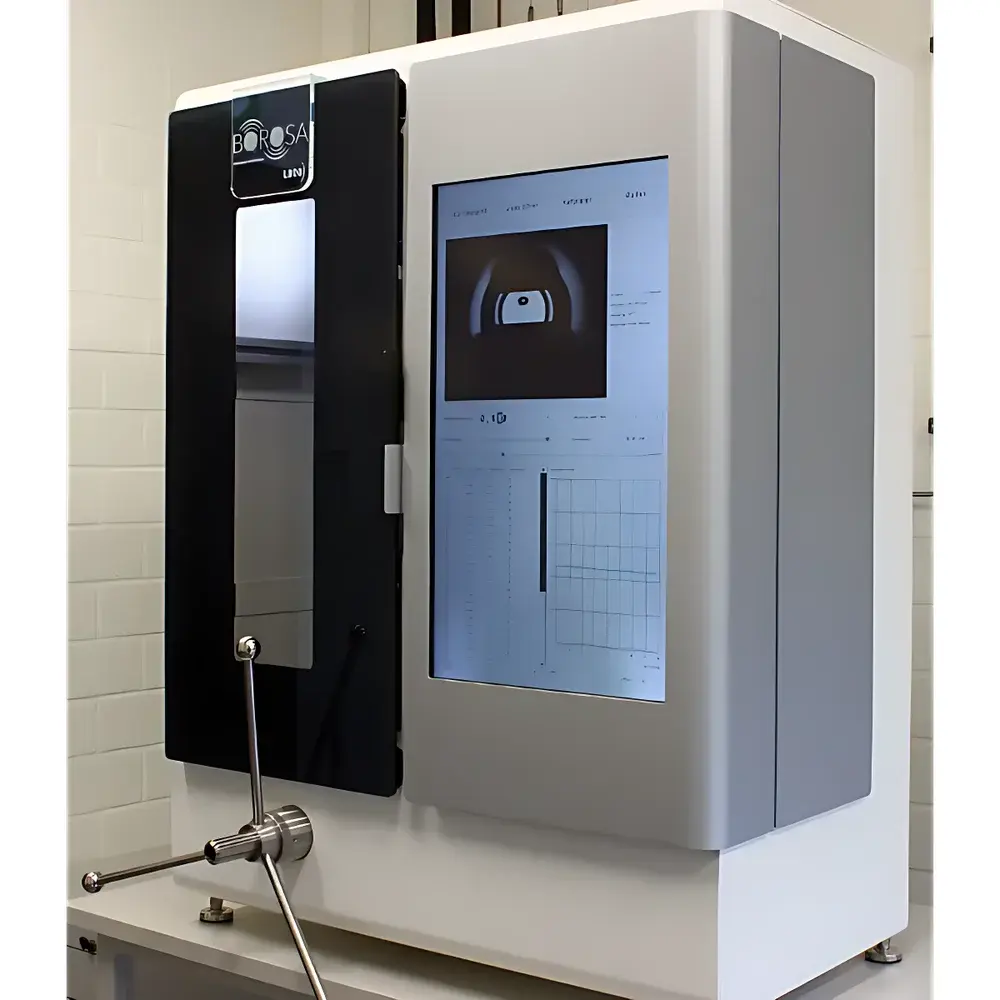
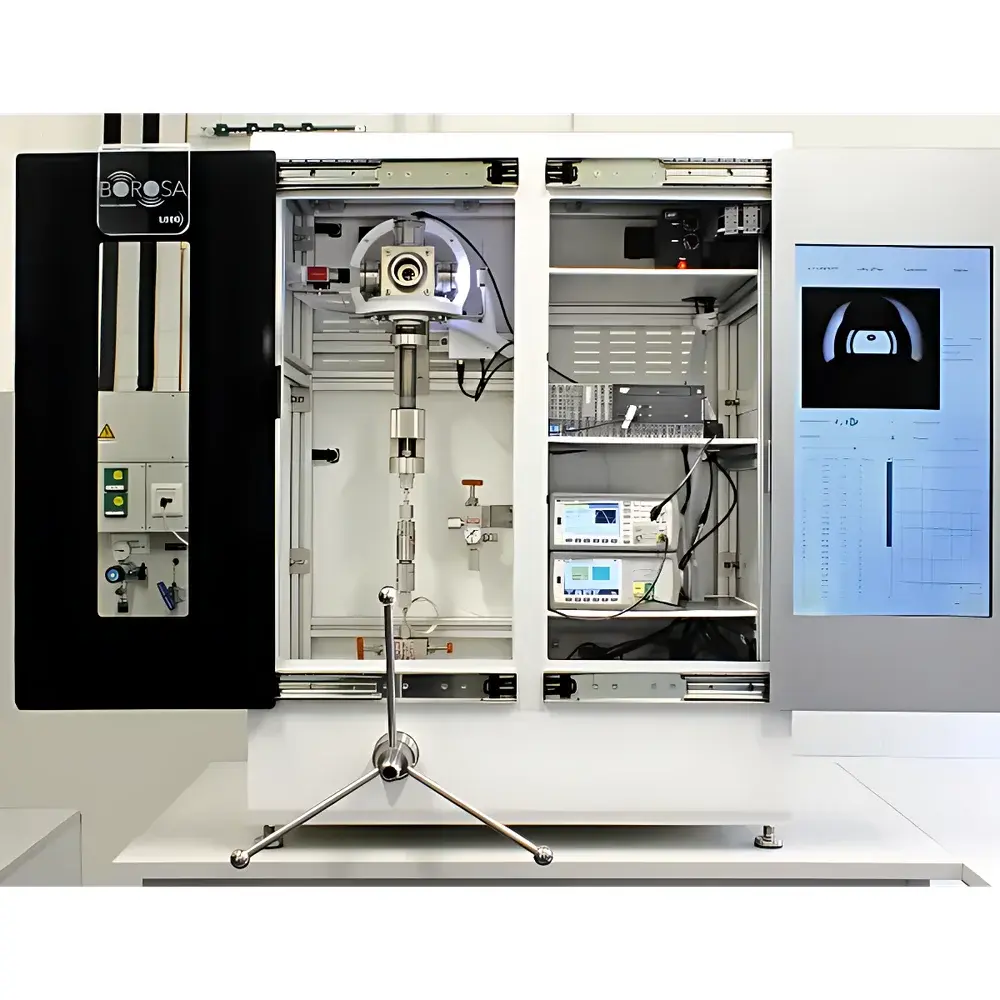
BOROSA L 800 High-Temperature High-Pressure Pendant Drop Tensiometer
| Brand | BOROSA |
|---|---|
| Origin | Germany |
| Model | L 800 |
| Operating Temperature Range | −20 °C to 200 °C |
| Maximum Pressure | 75 MPa (optional) |
| Compliance | DIN 55660-3 |
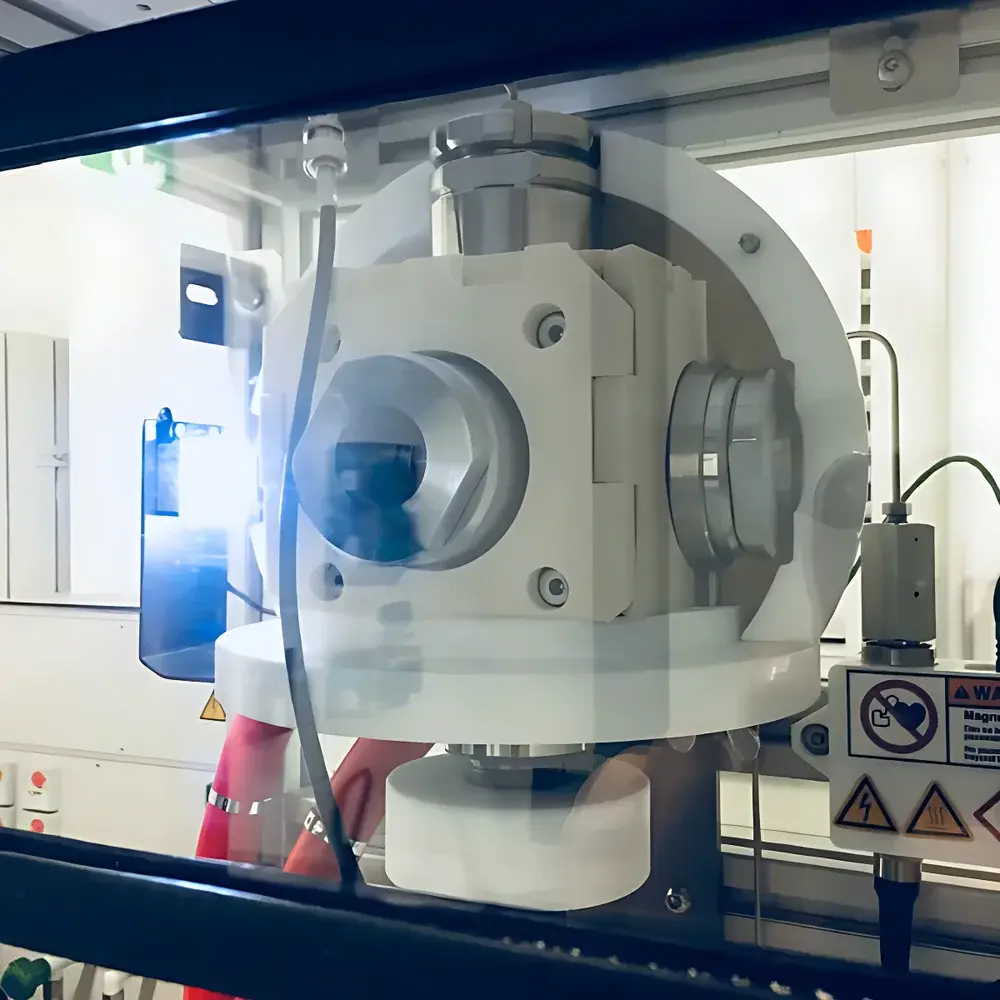
| Chamber Material | Titanium Alloy |
| Window Material | Sapphire |
| Measurement Principle | Pendant Drop Method |
| Pressure Range (Standard) | 0.1–20 MPa |
Overview
The BOROSA L 800 High-Temperature High-Pressure Pendant Drop Tensiometer is an engineered solution for precise interfacial and surface tension measurement under extreme thermodynamic conditions. It operates on the pendant drop method—a well-established optical technique grounded in Young–Laplace equation analysis—where a suspended liquid droplet is imaged under controlled pressure and temperature, and its contour is fitted to extract interfacial curvature and thus surface or interfacial tension. Unlike ambient-pressure systems, the L 800 integrates a robust titanium-alloy high-pressure chamber and sapphire optical windows rated for sustained operation up to 75 MPa (optional configuration) and temperatures from −20 °C to 200 °C. This enables direct quantification of tension behavior across phase boundaries in hydrocarbon systems, supercritical fluids, polymer melts, and electrolyte solutions—conditions highly relevant to reservoir engineering, enhanced oil recovery (EOR), CO₂ sequestration, and advanced material synthesis.
Key Features
- Titanium-alloy pressure vessel with full ASME BPVC Section VIII Div. 1 design validation and traceable material certification
- Optically transparent sapphire viewport (≥25 mm diameter, AR-coated) ensuring minimal chromatic aberration and high transmission from UV to NIR (200–2500 nm)
- Integrated PID-controlled heating/cooling system with dual-zone thermal management for uniform chamber temperature distribution (±0.3 °C stability over 24 h)
- High-resolution digital camera (≥5 MP, global shutter) coupled with telecentric illumination and motorized focus for automated droplet contour acquisition
- Modular pressure control architecture: dual-stage precision regulators with redundant pressure transducers (0.05% FS accuracy) and real-time leak monitoring
- Compliance with DIN 55660-3 for pendant drop methodology, including calibration traceability to NIST-traceable reference liquids (e.g., water, diiodomethane, ethylene glycol)
Sample Compatibility & Compliance
The L 800 accommodates a broad range of sample chemistries—including corrosive brines, H₂S-containing hydrocarbons, molten salts, and reactive organometallics—thanks to its inert titanium chamber and sapphire optics. All wetted surfaces are electropolished to Ra < 0.4 µm, minimizing nucleation artifacts and enabling repeatable droplet formation. The system meets essential regulatory requirements for laboratory instrumentation used in quality-critical workflows: it supports audit-ready electronic records per FDA 21 CFR Part 11 (when paired with validated software), conforms to ISO/IEC 17025 documentation standards for calibration traceability, and facilitates GLP-compliant data handling through configurable user roles and immutable metadata tagging. Pressure and temperature protocols can be pre-programmed and executed autonomously to ensure reproducibility across multi-day experiments.
Software & Data Management
Acquisition and analysis are performed using BOROSA’s proprietary TensiSoft v4.x platform, a Windows-based application developed in accordance with IEC 62304 Class B software safety requirements. The software provides real-time contour fitting using iterative Levenberg–Marquardt optimization, automatic baseline correction, and dynamic interfacial age tracking. Raw image sequences, pressure/temperature logs, and fitted parameters are stored in HDF5 format with embedded metadata (timestamp, operator ID, calibration status, environmental conditions). Export options include CSV, XML, and PDF reports compliant with ASTM D971 and ISO 1409. Version-controlled software updates are delivered via secure HTTPS with SHA-256 integrity verification; all changes are documented in release notes aligned with ISO 13485 change control procedures.
Applications
- Reservoir fluid characterization: interfacial tension (IFT) between crude oil/brine and CO₂ or CH₄ at reservoir-relevant P/T conditions
- Surfactant screening for EOR formulations under high-salinity, high-temperature environments
- Thermodynamic modeling validation: EOS parameterization using experimental IFT data at pressures >50 MPa
- Surface activity of ionic liquids and deep eutectic solvents in confined geometries
- Interfacial rheology precursor studies—droplet deformation analysis under oscillatory pressure modulation
- Material compatibility testing: wettability assessment of novel coatings or rock analogues under simulated downhole conditions
FAQ
What pressure and temperature ranges are standard versus optional?
The base configuration supports 0.1–20 MPa and −20 °C to 200 °C. Extended pressure capability up to 75 MPa is available as a factory-configured option with reinforced sealing and recalibrated transducers.
Is the system compatible with corrosive or H₂S-containing samples?
Yes—the titanium alloy (Grade 5, Ti-6Al-4V) chamber and sapphire windows provide excellent resistance to chloride-induced stress corrosion cracking and sulfide attack, validated per NACE MR0175/ISO 15156.
How is calibration verified under high-pressure conditions?
Calibration employs certified reference liquids measured at multiple P/T points; results are cross-validated against literature values from peer-reviewed datasets (e.g., J. Chem. Eng. Data) and archived with uncertainty budgets per GUM (JCGM 100:2018).
Can the system be integrated into automated lab infrastructure?
Yes—it features Ethernet/IP and Modbus TCP interfaces for integration with LIMS, SCADA, or PLC-based process control systems; API documentation is provided under NDA.
What maintenance intervals are recommended for long-term operational reliability?
Preventive maintenance is scheduled every 12 months or 2000 operating hours, whichever occurs first; includes O-ring replacement, transducer recalibration, optical alignment verification, and vacuum integrity testing per DIN EN ISO 2859-1 AQL 1.0.



