
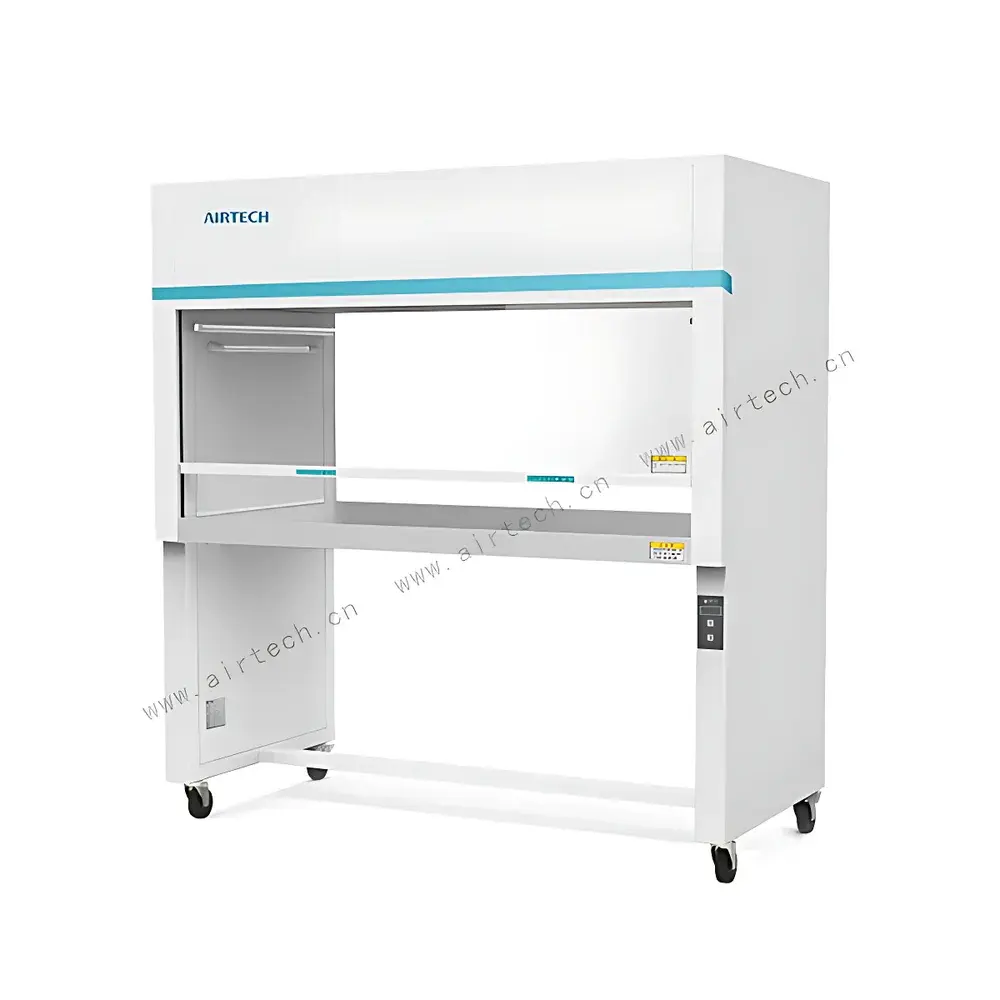
AIRTECH SW-CJ-II Series Vertical Laminar Flow Clean Bench
| Brand | AIRTECH |
|---|---|
| Origin | Jiangsu, China |
| Model Variants | SW-CJ-1F, SW-CJ-1FD, SW-CJ-2F, SW-CJ-2FD-II |
| Airflow Type | Vertical Downflow |
| Cleanliness Class | ISO Class 5 (100 @ ≥0.5 µm, per US Federal Standard 209E) |
| Noise Level | ≤62 dBA |
| Operator Configurations | Single-Person/Single-Side, Single-Person/Double-Side, Double-Person/Single-Side, Double-Person/Double-Side |
| Construction | Stainless Steel Work Surface, Powder-Coated Cold-Rolled Steel Enclosure |
| Pre-Filter | Quick-Release Design for Easy Cleaning and Replacement |
| UV Lamp Control | Programmable On/Off Scheduling with Runtime Monitoring |
| Fan Speed | Three-Step Adjustable |
| Safety Interlock | Lighting and UV Sterilization Systems Are Electrically Interlocked |
| Power Protection | Built-in Uninterruptible Power Backup Function |
| Mobility | Locking Swivel Casters with Brake Mechanism |
| Compliance | Factory-Tested per GB/T 25223–2010 (Chinese National Standard for Clean Benches), Meets General Requirements of YY 0569–2011 (Medical Device Safety for Biological Safety Cabinets) |
Overview
The AIRTECH SW-CJ-II Series Vertical Laminar Flow Clean Bench is an ISO Class 5-certified laboratory containment system engineered for non-hazardous applications requiring particulate-free environments. Operating on the principle of vertical unidirectional airflow—generated by a high-efficiency centrifugal blower and conditioned through a pre-filter and a final HEPA filter (≥99.99% @ 0.3 µm)—this clean bench delivers consistent laminar flow across the work surface at velocities optimized for both operator safety and sample integrity. Unlike biological safety cabinets, the SW-CJ-II does not recirculate air nor provide personnel or environmental protection against biohazards; instead, it is purpose-built for sterile material handling in pharmaceutical QC labs, cell culture preparation, microbiological assay setup, and precision electronics assembly where contamination control is critical but chemical or biological risk is low. All units undergo full factory performance validation—including airflow uniformity mapping, filter integrity testing, and noise emission verification—ensuring conformance to GB/T 25223–2010 and alignment with baseline expectations of ISO 14644-1 for cleanroom equipment.
Key Features
- Three-step electronically controlled fan speed adjustment enables precise optimization of airflow velocity for varying procedural demands—from delicate tissue manipulation to rapid reagent dispensing.
- Digital LED interface with membrane touch keys provides intuitive operation, real-time status feedback, and cumulative runtime tracking for UV lamps, blower motors, and HEPA filters—supporting predictive maintenance scheduling.
- UV lamp system features programmable start/stop timing with automatic shutdown after user-defined intervals, minimizing ozone generation and extending lamp service life.
- Work surface constructed from seamless, electropolished 304 stainless steel resists corrosion, inhibits microbial adhesion, and facilitates rapid decontamination between uses.
- Vertically sliding sash with frictionless, infinitely adjustable positioning allows ergonomic access while maintaining stable laminar flow integrity during operation.
- Enclosure fabricated from cold-rolled steel with electrostatically applied ivory-white epoxy-polyester powder coating offers superior resistance to abrasion, chemical splashes, and microbial colonization on external surfaces.
- Integrated interlock circuitry ensures UV irradiation is disabled whenever lighting is active—and vice versa—preventing accidental exposure and supporting compliance with IEC 61000-4 electromagnetic compatibility requirements.
- Locking dual-swivel casters with precision ball-bearing mechanisms permit smooth relocation and rigid stabilization on uneven laboratory flooring.
Sample Compatibility & Compliance
The SW-CJ-II accommodates standard Petri dishes, multi-well plates, glassware, pipette racks, and small-scale bioreactors without compromising airflow uniformity. Its open-front design supports manual or semi-automated workflows involving aseptic transfer, weighing, dilution, and plating. Units are certified to GB/T 25223–2010 (General Technical Conditions for Clean Benches) and satisfy functional safety benchmarks outlined in YY 0569–2011 (Class II Biological Safety Cabinet standards), though they are not classified as BSCs due to absence of inward inflow and exhaust filtration. While not FDA 21 CFR Part 11-compliant out-of-the-box, audit-ready documentation—including calibration records, filter test reports, and airflow certification sheets—is supplied with each shipment to support GLP/GMP-aligned lab quality systems.
Software & Data Management
The embedded microcontroller logs operational parameters—including total fan runtime, UV exposure duration, and filter usage hours—in non-volatile memory. Data export is not supported via USB or network interface; however, time-stamped runtime summaries can be manually recorded for inclusion in laboratory logbooks or electronic quality management systems (eQMS). Optional integration with facility-wide building management systems (BMS) is available through dry-contact relay outputs for remote status monitoring (e.g., fan fault, UV timeout, door position).
Applications
- Aseptic preparation of media, reagents, and cell culture components in academic and industrial life science laboratories.
- QC/QA testing of sterile pharmaceutical products—including vial filling line support and container-closure integrity verification setups.
- Microbiological analysis workflows such as colony isolation, streaking, and antibiotic susceptibility testing under particle-controlled conditions.
- Calibration and handling of reference standards in metrology labs where ambient particulate load must remain below 100 particles/ft³ @ ≥0.5 µm.
- Assembly and inspection of high-reliability microelectronic components sensitive to airborne metallic or organic contaminants.
FAQ
Is the SW-CJ-II suitable for handling pathogenic organisms?
No. This unit provides product protection only—not personnel or environmental protection. It must not be used for work involving Risk Group 2 or higher biological agents.
What filter replacement interval is recommended?
Pre-filters should be cleaned weekly and replaced every 3–6 months depending on ambient dust loading; HEPA filters require replacement every 18–24 months or following integrity test failure.
Does the unit comply with ISO 14644-1 Class 5 requirements?
Yes—validated airflow velocity, uniformity, and particle count data confirm compliance with ISO 14644-1:2015 for Class 5 (formerly Fed Std 209E Class 100) when operated under specified conditions.
Can the UV lamp be operated simultaneously with the main lighting?
No. The electrical interlock prevents concurrent activation to ensure operator safety and lamp longevity.
Is third-party certification (e.g., NSF, CE) available?
CE marking is not applicable as this device falls outside EU Directive scope for medical or EMC-regulated equipment; NSF certification is not pursued since the unit is not a biological safety cabinet.



