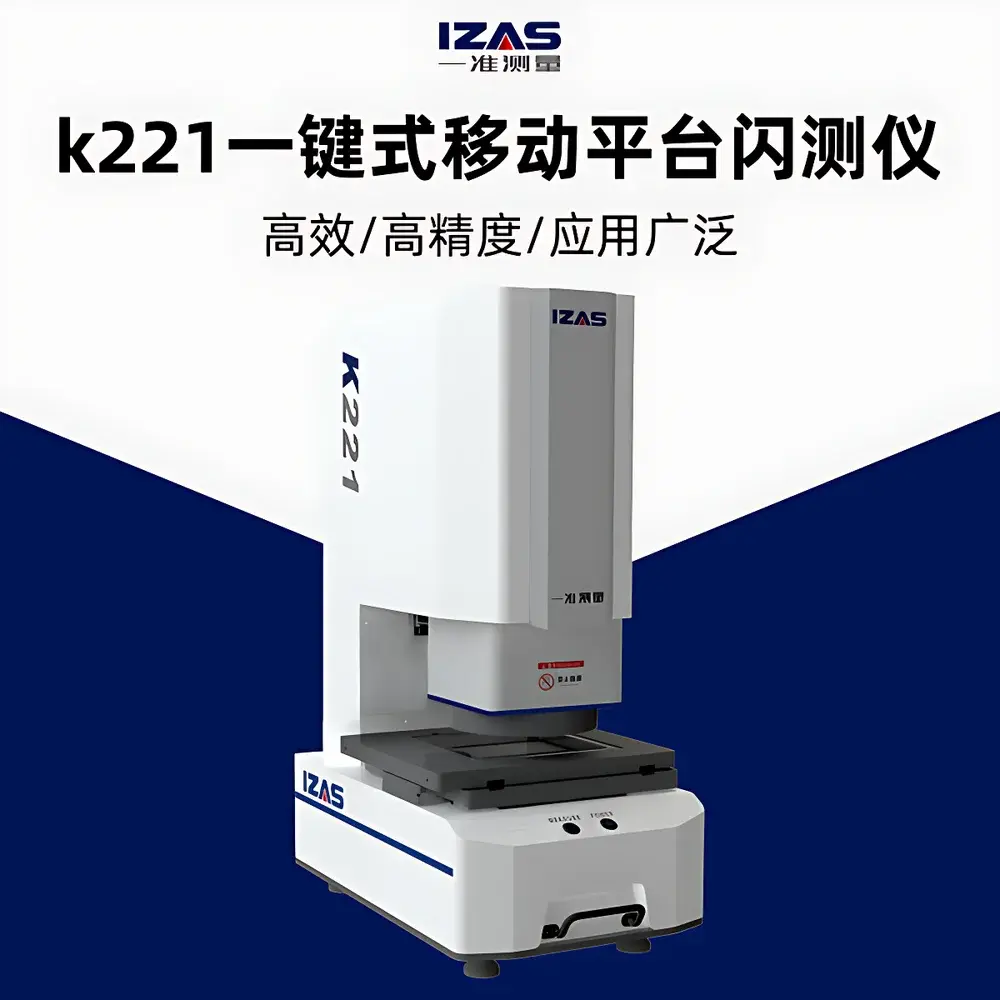
IZAS K221 One-Touch Mobile Platform Flash Metrology System
| Brand | IZAS |
|---|---|
| Origin | Hubei, China |
| Manufacturer Type | OEM Manufacturer |
| Product Category | Domestic |
| Model | K221 One-Touch Mobile Platform Flash Metrology System |
| Measurement Range | 200 × 200 × 75 mm |
| Maximum Load Capacity | 5 kg |
Overview
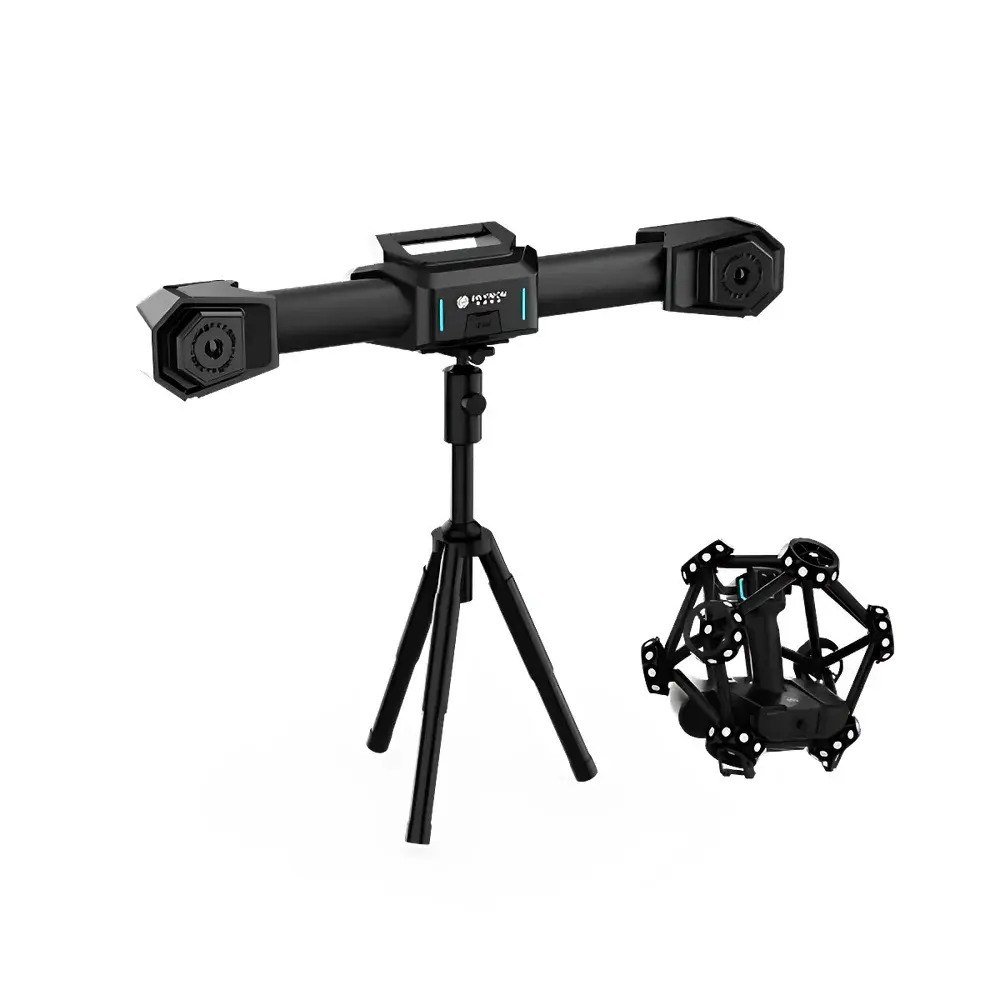
The IZAS K221 One-Touch Mobile Platform Flash Metrology System is a high-throughput, non-contact optical metrology instrument engineered for rapid, automated 2D and 3D geometric dimensioning and tolerancing (GD&T) of small-to-medium mechanical components. It operates on the principle of high-resolution digital image acquisition combined with real-time sub-pixel edge detection, stitching-based multi-field-of-view (MFOV) synthesis, and calibrated coordinate transformation across a precision motorized XY stage. Unlike traditional coordinate measuring machines (CMMs) or manual vision systems, the K221 eliminates dependency on fixture-based part alignment—enabling true “place-and-measure” operation through intelligent pattern-matching algorithms and auto-registration of part geometry within the field of view. Designed for production-floor integration, it delivers traceable dimensional data compliant with ISO 10360-7 (optical CMM verification) and supports routine calibration per ISO/IEC 17025 requirements when operated in accredited laboratories.
Key Features
- Integrated monolithic mechanical architecture with compact footprint (≤ 0.8 m²), optimized for cleanroom and shop-floor deployment.
- Motorized linear XY translation platform with bidirectional repeatability ≤ ±0.5 µm and maximum travel speed of 150 mm/s, ensuring stable, vibration-damped motion during high-speed scanning.
- Dual telecentric dual-magnification objective lens system with auto-switching between 0.5×, 1.0×, and optional 1.6× optical magnifications—maintaining < 0.05% geometric distortion across full FOV at all settings.
- Programmable multi-channel LED illumination suite including independently height-adjustable ring light, coaxial illuminator (optional), and directional oblique lighting—configurable per feature type (e.g., edge contrast enhancement for machined surfaces or shadow-free imaging for translucent polymers).
- Industrial-grade CMOS sensor (≥ 12 MP resolution, global shutter, ≥ 70 dB dynamic range) synchronized with stage motion to eliminate motion blur; pixel pitch calibrated to ≤ 0.8 µm at 1.0× magnification.
- Embedded real-time stitching engine enabling seamless mosaic construction from up to 64 individual image tiles without user intervention—critical for parts exceeding single-FOV limits while preserving micron-level spatial coherence.
Sample Compatibility & Compliance
The K221 accommodates a broad spectrum of rigid and semi-rigid components common in precision manufacturing: watch movement components (gears, bridges, balance wheels), stamped sheet metal parts, injection-molded plastic housings, rubber O-rings, and machined brass/steel fittings. Parts are placed freely on the stage without clamping—surface flatness tolerance ≤ 25 µm over 200 mm diagonal is recommended for optimal focus consistency. The system conforms to electromagnetic compatibility (EMC) standards EN 61326-1 and safety standard EN 61000-6-2. All measurement reports include timestamped audit trails, operator ID, environmental metadata (ambient temperature/humidity logs if external sensors are connected), and full traceability to NIST-traceable length standards via factory calibration certificates (ISO 17025-accredited calibration available upon request).
Software & Data Management
The proprietary IZAS VisionMetro v4.2 software provides intuitive workflow-driven measurement programming—supporting both teach-mode scripting and CAD-based feature recognition (import of STEP, IGES, or DXF files). All measurement routines generate XML-structured output compliant with ISO 10303-238 (AP238) for digital thread continuity. Native APIs (RESTful HTTP and OPC UA) enable direct integration with MES (e.g., Siemens Opcenter, Rockwell FactoryTalk) and ERP platforms (SAP S/4HANA, Oracle Cloud). Audit logging meets FDA 21 CFR Part 11 requirements—including electronic signatures, role-based access control, and immutable history of parameter changes and result edits. Raw image archives and stitched composites are stored in lossless TIFF format with embedded EXIF metadata for forensic re-analysis.
Applications
- High-volume inspection of gear tooth profile, pitch diameter, and runout in horology and automotive transmission suppliers.
- Dimensional validation of molded plastic connectors (e.g., USB-C housings, medical device enclosures) for flash, sink marks, and positional tolerance of mounting holes.
- Geometric verification of stamped spring contacts and MEMS packaging substrates requiring sub-10 µm form error assessment.
- In-process monitoring of rubber gasket compression set and cross-sectional uniformity in HVAC and appliance OEM lines.
- GD&T evaluation per ASME Y14.5–2018 and ISO 1101, including position, concentricity, parallelism, and profile of a surface on multi-feature parts.
FAQ
Does the K221 require periodic recalibration, and what documentation is provided?
Yes—annual recalibration is recommended per ISO/IEC 17025 guidelines. Each unit ships with a factory calibration certificate referencing NIST-traceable artifacts; accredited calibration services with uncertainty budgets are available as an option.
Can the system measure features with high aspect ratios, such as narrow slots or deep bores?
The K221 is optimized for surface-topography measurement within its Z-range (±37.5 mm). For features requiring depth profiling beyond shallow focus depth, complementary focus-stacking modules or tactile probe add-ons (via optional bridge interface) may be integrated.
Is GD&T reporting exportable in PDX or QIF format for downstream SPC analysis?
Native export to QIF (Quality Information Framework) per ASTM E3205–21 is supported; PDX requires middleware configuration via the open API toolkit.
What environmental conditions are required for optimal performance?
Operating temperature: 18–24 °C ± 1 °C; humidity: 40–60% RH non-condensing; vibration isolation table recommended if floor RMS acceleration exceeds 2 µm/s² above 10 Hz.