
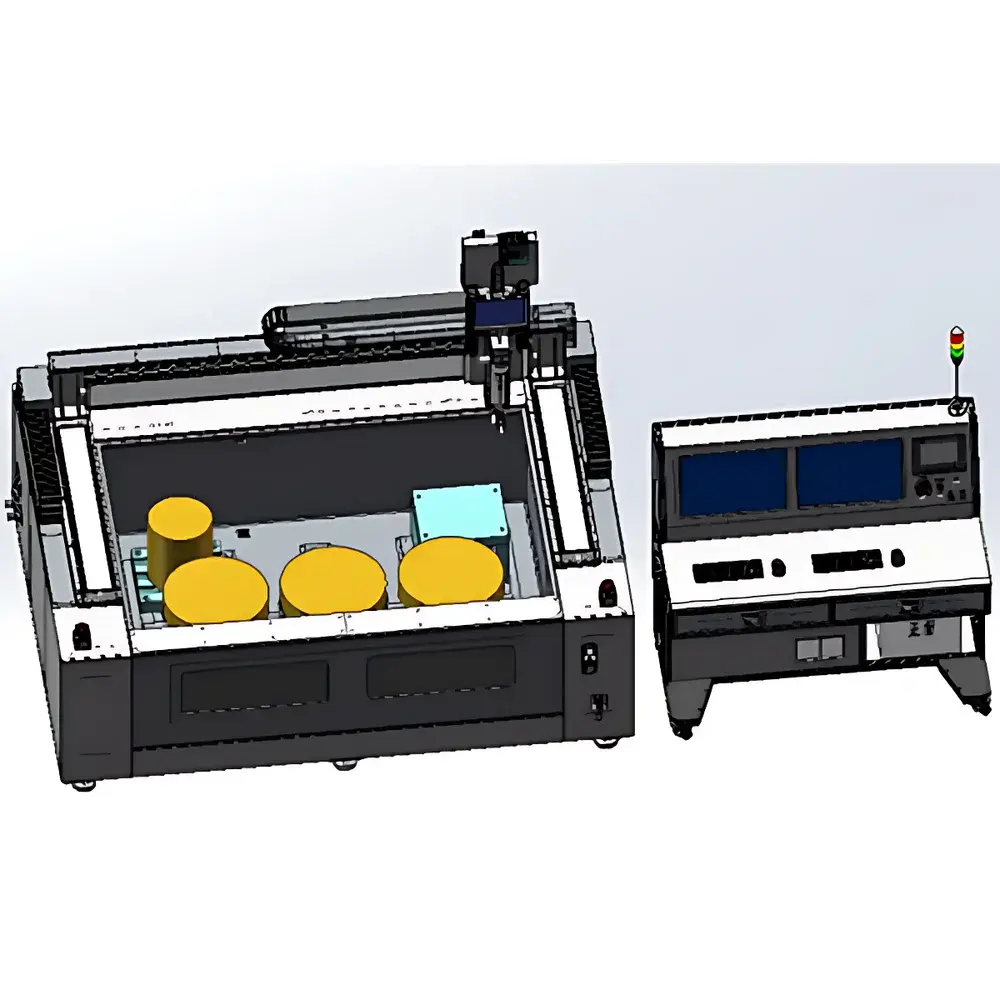
Doppler SAM-1 Automated Target Material Inspection System
| Brand | Doppler |
|---|---|
| Origin | Guangdong, China |
| Manufacturer Type | Authorized Distributor |
| Country of Origin | China |
| Model | SAM-1 |
| Price | USD 280,000 (FOB Guangdong) |
| Application Field | Aerospace & Semiconductor Sputtering Target Manufacturing |
| Scanning Mode | B-scan |
| Transducer Configuration | Single-element immersion transducer |
| Motion System | High-precision XYZ linear motor-driven scanning stage |
| Water Tank | Heavy-duty stainless steel immersion tank (modular sizing: Small / Medium / Large) |
| Imaging Modes | A-scan, B-scan, S-scan, C-scan, Top-C-scan, 3D volumetric reconstruction |
| Data Acquisition | Full RF waveform + positional metadata synchronized at sub-millisecond resolution |
| Compliance | Designed to support ISO 17025-compliant workflows |
Overview
The Doppler SAM-1 Automated Target Material Inspection System is a high-precision, water-coupled scanning acoustic microscope (SAM) engineered for non-destructive evaluation (NDE) of sputtering targets used in semiconductor thin-film deposition and advanced aerospace coating applications. It operates on the principle of pulse-echo ultrasonic microscopy, utilizing high-frequency broadband transducers (typically 10–100 MHz) to generate micron-resolution cross-sectional and volumetric images of internal microstructure. Unlike conventional industrial ultrasonic testing (UT), the SAM-1 integrates precise XYZ motion control with real-time RF data acquisition, enabling quantitative analysis of subsurface anomalies—including porosity, delamination, inclusion clusters, microcracks, and density gradients—within brittle ceramic, metal, or composite target materials up to 600 mm in thickness. Its immersion-based architecture ensures consistent acoustic coupling and eliminates air-gap artifacts, while the modular tank design accommodates target diameters from 100 mm to over 2,000 mm.
Key Features
- Linear motor-driven XYZ scanning stage with ≤0.05 mm repeatability across all three axes, eliminating mechanical backlash and wear-related drift.
- Real-time multi-mode imaging engine supporting simultaneous display and storage of A-scan (time-domain waveform), B-scan (cross-sectional slice), S-scan (sectorial scan), C-scan (planar projection), Top-C-scan (surface-normal projection), and 3D volumetric reconstruction.
- Synchronized acquisition of full RF echo data alongside positional metadata (encoder-resolved X/Y/Z coordinates), enabling post-acquisition reprocessing and parametric analysis.
- Automated defect recognition algorithm trained on reference target datasets, capable of region-of-interest (ROI)-based classification per ASTM E273 criteria, with configurable sensitivity thresholds and size-based filtering.
- Modular stainless steel water tank system available in Small (1350 × 950 × 400 mm), Medium (2150 × 1350 × 500 mm), and Large (4200 × 2200 × 600 mm) configurations—each structurally reinforced to maintain dimensional stability under long-term hydrostatic load.
- Industrial-grade motion control architecture using EtherCAT or SERCOS III bus protocols, paired with PLC or dedicated motion control cards for deterministic trajectory execution.
- Comprehensive hardware ecosystem: all power supplies, amplifiers, encoders, and I/O modules sourced from Tier-1 global suppliers (e.g., Beckhoff, Yaskawa, Keysight) to ensure >99.5% operational uptime over 10,000-hour service intervals.
Sample Compatibility & Compliance
The SAM-1 accommodates flat or slightly curved sputtering targets composed of metals (e.g., Cu, Al, Ti, Mo), ceramics (e.g., ITO, AZO, SiO₂, Al₂O₃), and bonded composites. Sample thickness ranges from 5 mm to 600 mm; maximum planar dimensions align with tank variants (up to 2,000 mm diameter). The system supports immersion testing per ASTM E114 (Standard Practice for Ultrasonic Testing of Materials) and E127 (Standard Specification for Ultrasonic Search Units). Data integrity meets GLP/GMP documentation requirements: audit trails record operator ID, timestamp, parameter settings, and raw RF file checksums. Optional FDA 21 CFR Part 11 compliance package includes electronic signature validation, role-based access control, and immutable data archiving.
Software & Data Management
The proprietary Doppler AcousticStudio v4.x software provides an integrated environment for setup, acquisition, analysis, and reporting. It features a dual-workspace interface: one pane for live scanning control and real-time imaging, the other for offline analysis—including gated amplitude mapping, time-of-flight tomography, and attenuation coefficient profiling. All acquired data is stored in HDF5 format with embedded metadata (transducer frequency, gain, PRF, water temperature, position calibration offsets). Report generation follows customizable templates compliant with ASNT SNT-TC-1A and ISO 9712 Level II/III reporting conventions. Export options include PDF, CSV, DICOM-SAM, and MATLAB-compatible .mat files. Remote diagnostics and firmware updates are supported via secure TLS-encrypted client-server architecture.
Applications
- Quality assurance of rotary and planar sputtering targets prior to vacuum chamber installation.
- Root cause analysis of arcing events during magnetron sputtering by correlating subsurface void networks with plasma instability patterns.
- Process validation for hot isostatic pressing (HIP) and spark plasma sintering (SPS) of ceramic targets.
- Life-cycle monitoring of recycled target remnants to assess residual crack propagation and grain boundary degradation.
- Material development support for next-generation high-entropy alloy (HEA) and multilayer nanocomposite targets.
FAQ
What ultrasonic frequencies does the SAM-1 support?
The system accepts immersion transducers from 5 MHz to 100 MHz; standard configuration ships with a 25 MHz focused transducer optimized for 10–100 mm thick metallic targets.
Can the system perform phased array ultrasonic testing (PAUT)?
Yes—optional PAUT upgrade replaces the single-element transducer with a 64-element linear or matrix array probe, enabling dynamic depth focusing and sectorial scanning without mechanical repositioning.
Is the water tank heated or temperature-controlled?
Standard tanks operate at ambient temperature; optional thermostatic circulation unit maintains ±0.5°C stability for high-precision velocity-based measurements.
How is positional calibration performed?
Calibration uses NIST-traceable step gauges and laser interferometer verification; automated routine executes daily to validate XYZ axis linearity and orthogonality.
Does the system support integration with factory MES or QMS platforms?
Yes—RESTful API and OPC UA server interfaces enable bidirectional communication with Siemens Opcenter, Rockwell FactoryTalk, or custom LIMS environments.



