
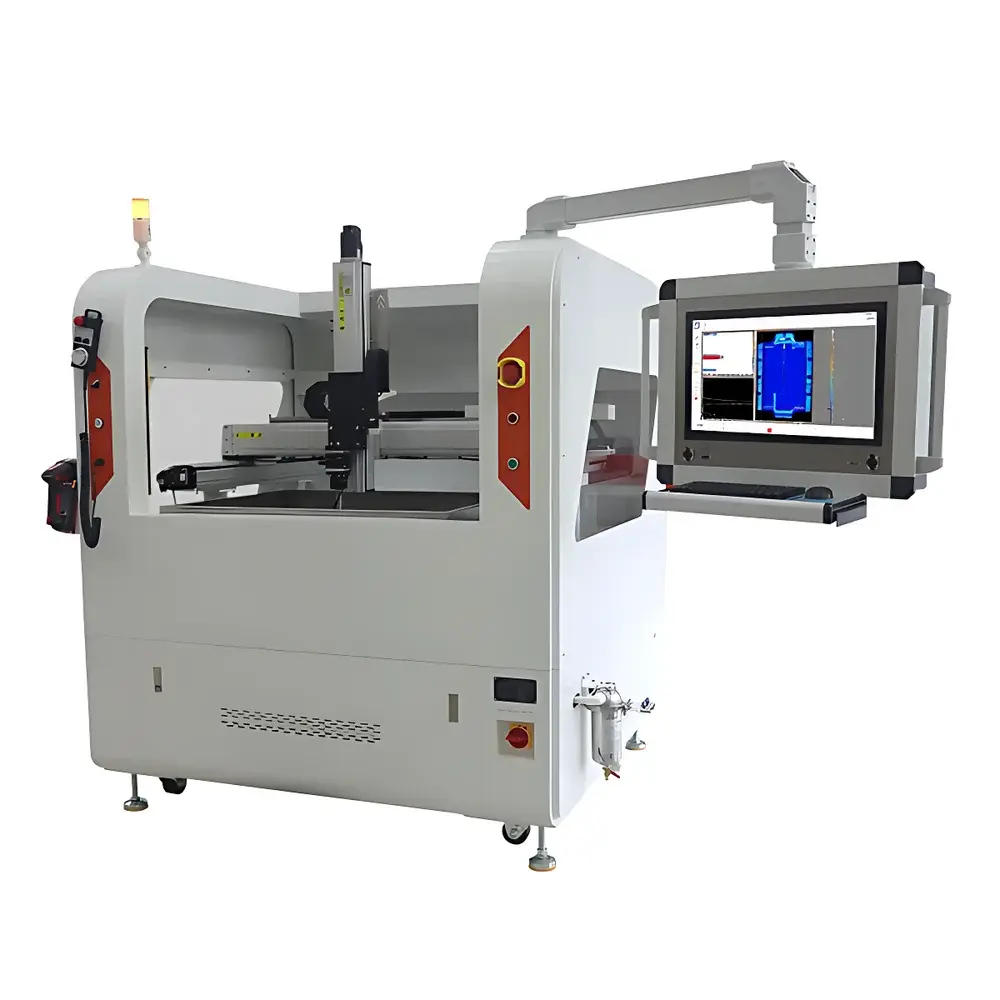
Doppler PAUT Water Immersion Automated Inspection System for Cold Plates
| Brand | Doppler |
|---|---|
| Model | Automated PAUT Water Immersion System |
| Origin | Guangdong, China |
| Motion Axes | X (800 mm), Y (600 mm), Z (400 mm) |
| Repeatability | < 0.05 mm/m (X/Y/Z) |
| Position Resolution | < 0.01 mm |
| Scan Speed | 1–500 mm/s |
| Operating Temperature | −10 °C to +40 °C |
| Software SDK Support | C++, C#, VB, VC, Delphi (source code provided) |
| System Components | PAUT instrument, industrial PC, multi-axis motion modules, immersion tank, custom probe fixtures, water circulation & filtration unit, control cabinet, mechanical frame |
| Compliance | Designed for ASTM E273, ISO 16810, and EN 13588-compliant ultrasonic inspection workflows |
| Application Focus | High-precision volumetric NDT of aluminum/copper cold plates in EV battery thermal management systems |
Overview
The Doppler PAUT Water Immersion Automated Inspection System for Cold Plates is an engineered solution for high-resolution, reproducible ultrasonic testing of thermally critical components used in electric vehicle (EV) battery packs and high-power electronics cooling systems. Built upon phased array ultrasonic testing (PAUT) principles and water-coupled immersion techniques, the system leverages controlled acoustic propagation through deionized water to eliminate air-gap interference and enable stable, quantitative echo amplitude and time-of-flight measurement. Its core architecture integrates precision motion control with real-time beam steering and dynamic depth focusing—allowing full volumetric interrogation of complex geometries such as micro-channel cold plates with wall thicknesses ranging from 1.5 mm to 12 mm. The system operates under fully programmable scan strategies—including raster, spiral, and contour-following trajectories—and supports both manual verification and production-grade automated pass/fail evaluation per predefined acceptance criteria.
Key Features
- Precision three-axis Cartesian motion platform (X: 800 mm, Y: 600 mm, Z: 400 mm) with sub-10 µm position resolution and repeatability better than 0.05 mm/m across all axes.
- Dual-angle adjustment capability via motorized A/B axes and manual A1/B1 fine-tuning stages, enabling precise probe skew and pitch alignment for optimal near-surface resolution and lateral wave suppression.
- Integrated water circulation and filtration subsystem maintaining turbidity < 1 NTU and temperature stability ±0.5 °C over extended operation—critical for consistent sound velocity calibration and signal-to-noise ratio.
- Open-architecture motion control software with documented API and source-level SDK support for C++, C#, VB.NET, Visual C++, and Embarcadero C++Builder—facilitating seamless integration into factory MES or custom QA dashboards.
- Real-time A-scan acquisition synchronized with encoder-triggered positional data, supporting post-processing reconstruction of B-, C-, and S-scans with depth-gated gating and synthetic aperture focusing technique (SAFT) options.
Sample Compatibility & Compliance
The system is validated for inspecting aluminum 3003/6061 and oxygen-free copper (OFC) cold plates with integrated micro-channels (channel width ≥ 0.3 mm), manifold headers, and brazed or welded interfaces. It meets the geometric and procedural requirements of ASTM E273 (Standard Practice for Ultrasonic Testing of the Welds of Aluminum Alloy Plate and Sheet), ISO 16810 (Non-destructive testing — Ultrasonic testing — General principles), and EN 13588 (Non-destructive testing of welds — Ultrasonic testing — Use of time-of-flight diffraction [TOFD] and/or phased array [PA] techniques). All motion logs, A-scan metadata, and pass/fail decisions are timestamped and stored with audit trail capability compliant with GLP/GMP documentation standards.
Software & Data Management
The embedded inspection software provides dual-mode operation: guided manual mode for setup and validation, and fully autonomous batch mode for serial part inspection. Raw RF data is archived in HDF5 format with embedded transducer ID, gain settings, focal law parameters, and coordinate mapping. Reporting modules generate PDF/CSV outputs containing defect location (mm), equivalent reflector size (ERL), depth, orientation angle, and classification against user-defined severity thresholds. Optional FDA 21 CFR Part 11 compliance package includes electronic signatures, role-based access control, and immutable audit logs for regulated manufacturing environments.
Applications
- Automated detection of micro-porosity, lack-of-bond, and interfacial delamination in vacuum-brazed cold plate assemblies.
- Quantitative assessment of channel blockage, erosion, or deformation in service-aged thermal plates prior to rework or retirement.
- Process validation support for new cold plate designs during APQP phase—enabling correlation between simulation (e.g., CFD + ultrasonic modeling) and empirical flaw response.
- In-line QA gate for Tier-1 EV battery suppliers performing 100% final inspection on coolant manifolds before module integration.
FAQ
What ultrasonic standards does this system support out-of-the-box?
The system is preconfigured for ASTM E273 Level 2 and ISO 16810 Annex B workflows, including reference block calibration using IIW Type 2 and DAC curve generation per ASME Section V Article 4.
Can the system perform TOFD alongside PAUT?
Yes—dual-probe mounting fixtures and synchronized multi-channel acquisition allow concurrent PAUT/TOFD data capture with shared positional referencing and fused reporting.
Is water chemistry monitoring included?
A conductivity sensor and automatic pH dosing interface are available as optional add-ons; base configuration includes flow rate and temperature monitoring only.
How is probe wear compensated during long-duration scans?
The system supports periodic auto-calibration routines using embedded reference reflectors, updating sensitivity correction factors in real time without interrupting production.
Does the motion controller support external PLC handshake signals?
Yes—standard digital I/O (24 VDC) and Modbus TCP interfaces are provided for synchronization with conveyor triggers, robotic part loading, and safety interlocks.



