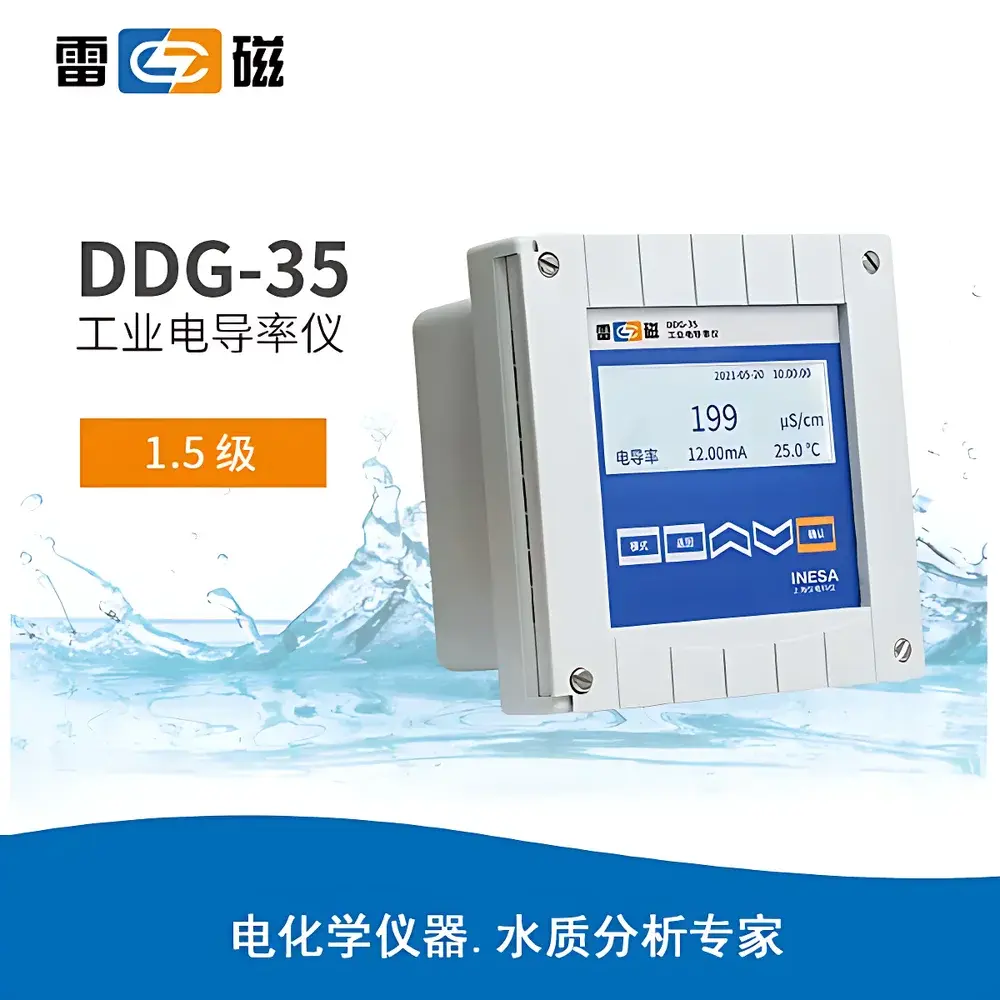
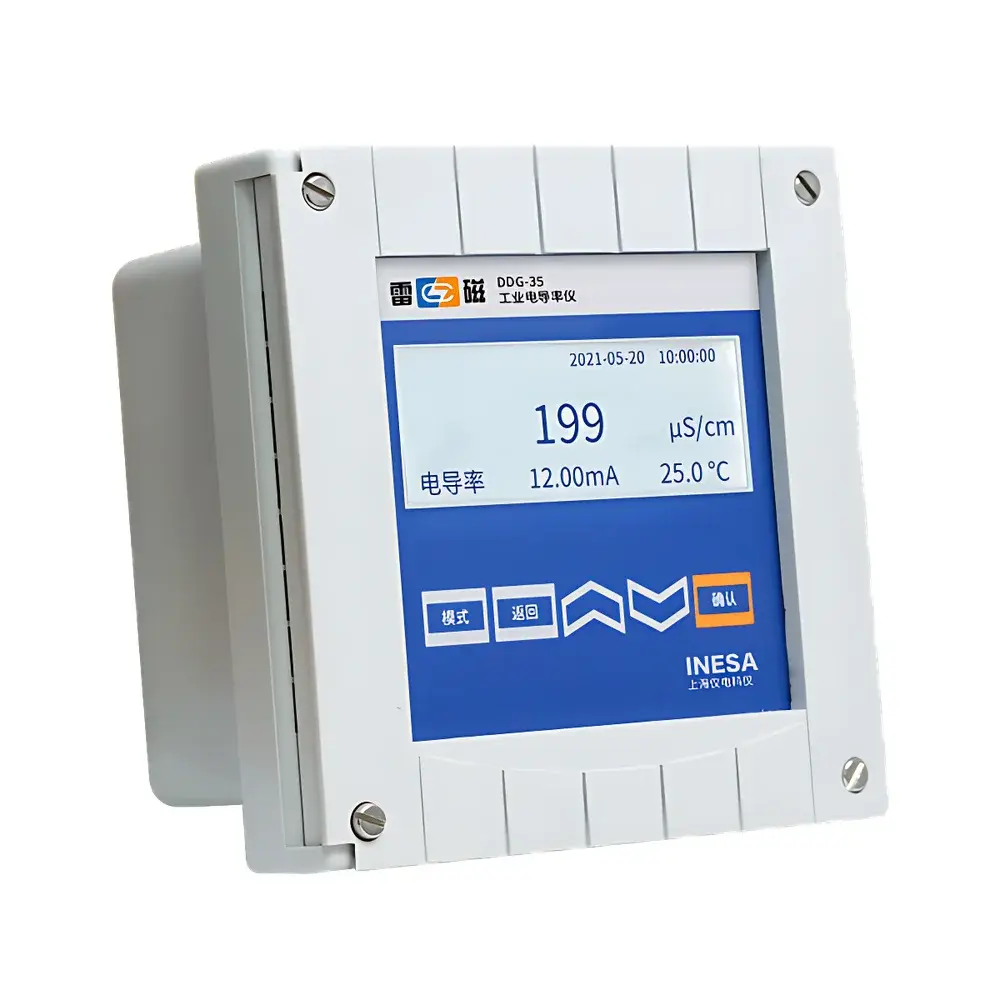
Leici DDG-35 Online Conductivity Analyzer
| Conductivity Range | 0.0 µS/cm to 200 mS/cm |
|---|---|
| Temperature Range | −10.0 to 120.0 °C |
| Accuracy | ±2.0% FS (instrument) |
| Resolution | 0.001 µS/cm (selectable: 0.001 / 0.01 / 0.1 / 1 µS/cm) |
| Dimensions | 166 × 166 × 110 mm |
| Weight | 2 kg |
| IP Rating | IP65 |
| Output | Isolated 4–20 mA DC & RS-485 |
| Sensor Cable Length | 10 m (standard) |
| Auto-Temperature Compensation | −10 to 120 °C |
| Electrode Compatibility | 2-electrode and 4-electrode conductivity cells |
| Data Storage Capacity | 2000 records |
Overview
The Leici DDG-35 Online Conductivity Analyzer is an industrial-grade, panel-mount conductivity measurement system engineered for continuous, high-stability monitoring of aqueous process streams in demanding environments. It operates on the principle of two- or four-electrode conductometric measurement—where electrical conductivity is determined by applying an alternating current across a known electrode geometry and measuring the resulting voltage drop—to deliver accurate, drift-resistant readings across a wide dynamic range (0.0 µS/cm to 200 mS/cm). Designed specifically for applications involving high-conductivity media—including wastewater effluent, seawater intake, brine solutions, cooling tower water, and industrial discharge streams—the DDG-35 integrates automatic temperature compensation (ATC), configurable TDS conversion algorithms, and robust electrode interface logic to minimize polarization error and fouling-induced signal degradation. Its microprocessor-based electronics ensure stable analog output and digital communication under fluctuating ambient conditions, making it suitable for integration into PLC-controlled SCADA systems and centralized process monitoring architectures.
Key Features
- True dual-mode electrode support: compatible with both standard two-electrode and fouling-resistant four-electrode conductivity sensors—enabling reliable operation in high-conductivity, high-solids, or viscous media where polarization effects would otherwise compromise accuracy.
- High-resolution display: large dot-matrix LCD simultaneously shows conductivity, resistivity, TDS, salinity, and temperature—with user-selectable resolution down to 0.001 µS/cm for low-conductivity calibration verification.
- Intelligent auto-ranging and auto-calibration: automatically selects optimal measurement range based on real-time signal level; supports one-point or two-point conductivity calibration with built-in reference validation logic.
- Configurable TDS conversion: adjustable TDS coefficient (0.4–1.0) allows precise correlation between conductivity and dissolved solids concentration per application-specific water chemistry profiles.
- Comprehensive alarm and control functions: programmable high/low limit alarms with relay outputs; power-fail data retention; optional automatic electrode cleaning trigger via external solenoid valve control signal.
- Ruggedized enclosure: front-panel IP65-rated housing ensures protection against dust ingress and water jet exposure—ideal for mounting in outdoor enclosures, pump stations, or humid industrial control rooms.
- Dual-output architecture: isolated 4–20 mA analog output (field-configurable span and zero) plus Modbus RTU over RS-485 for direct connection to DCS, PLCs, or cloud-based IIoT gateways.
Sample Compatibility & Compliance
The DDG-35 is validated for continuous monitoring of natural waters (surface water, groundwater), municipal and industrial wastewater, desalination plant feed/brine streams, and process cooling loops. Its four-electrode sensor interface eliminates electrode polarization artifacts common in high-conductivity samples (>10 mS/cm), ensuring long-term stability in saline or aggressive chemical environments. The analyzer complies with IEC 61000-6-2 (EMC immunity) and IEC 61000-6-4 (EMC emission) standards. While not certified for SIL or ATEX use, its design adheres to general-purpose industrial safety practices outlined in IEC 61010-1. Data integrity features—including timestamped storage of 2000 measurement records with configurable logging intervals—support basic GLP-aligned operational traceability. For regulated pharmaceutical or food-grade applications, users must validate sensor installation, calibration frequency, and output signal integrity per internal SOPs aligned with ISO/IEC 17025 or FDA 21 CFR Part 11 principles.
Software & Data Management
The DDG-35 operates autonomously without external software dependencies. All configuration—including TDS factor, temperature coefficient (0.0–10.0 %/°C), alarm thresholds, data logging interval (1 s to 24 h), and 4–20 mA output mapping—is performed locally via intuitive keypad navigation. Measurement records are stored in non-volatile memory with time/date stamps and retained during power interruption. While no proprietary PC software is supplied, the RS-485 interface enables integration with third-party SCADA platforms (e.g., Ignition, Siemens WinCC, or open-source Node-RED) using standard Modbus RTU function codes (0x03, 0x06, 0x10). Audit trail generation requires external historian integration; the unit itself does not implement electronic signature, role-based access control, or audit log encryption required for full 21 CFR Part 11 compliance.
Applications
- Municipal wastewater treatment: real-time monitoring of influent conductivity for load balancing and effluent compliance reporting.
- Seawater desalination plants: feedwater salinity tracking, RO membrane performance assessment, and concentrate stream management.
- Power plant cooling water systems: early detection of condenser tube leakage via sudden conductivity spikes.
- Chemical manufacturing: batch reaction endpoint detection, rinse water quality verification, and acid/base concentration control.
- Food & beverage processing: CIP (clean-in-place) cycle validation through conductivity-based detergent residue detection.
- Environmental monitoring stations: unattended long-term surface water quality profiling with solar-powered telemetry integration.
FAQ
What types of conductivity sensors are compatible with the DDG-35?
The analyzer supports both two-electrode (for low-to-moderate conductivity, <10 mS/cm) and four-electrode (for high-conductivity, fouling-prone, or high-accuracy applications) sensors with standard BNC or DIN connectors.
Does the DDG-35 support automatic temperature compensation?
Yes—it performs real-time ATC using either integrated Pt1000 RTD input or external sensor input, with compensation range from −10.0 to 120.0 °C and user-adjustable temperature coefficient (0.0–10.0 %/°C).
Can the 4–20 mA output be scaled to a custom measurement range?
Yes—both upper and lower output limits are fully configurable in engineering units (e.g., 0–100 mS/cm mapped to 4–20 mA) via the local menu.
Is the device suitable for outdoor installation?
With its IP65-rated front panel and wide operating temperature range (−10 to 60 °C ambient), it is appropriate for indoor control cabinets or NEMA 4X outdoor enclosures—but direct exposure to rain or sunlight requires additional weatherproof housing.
How is calibration performed?
Calibration is conducted using certified standard solutions (e.g., KCl 1413 µS/cm or 12.88 mS/cm); the unit guides users through single- or two-point procedures with pass/fail validation based on deviation from expected value.
Related Products