
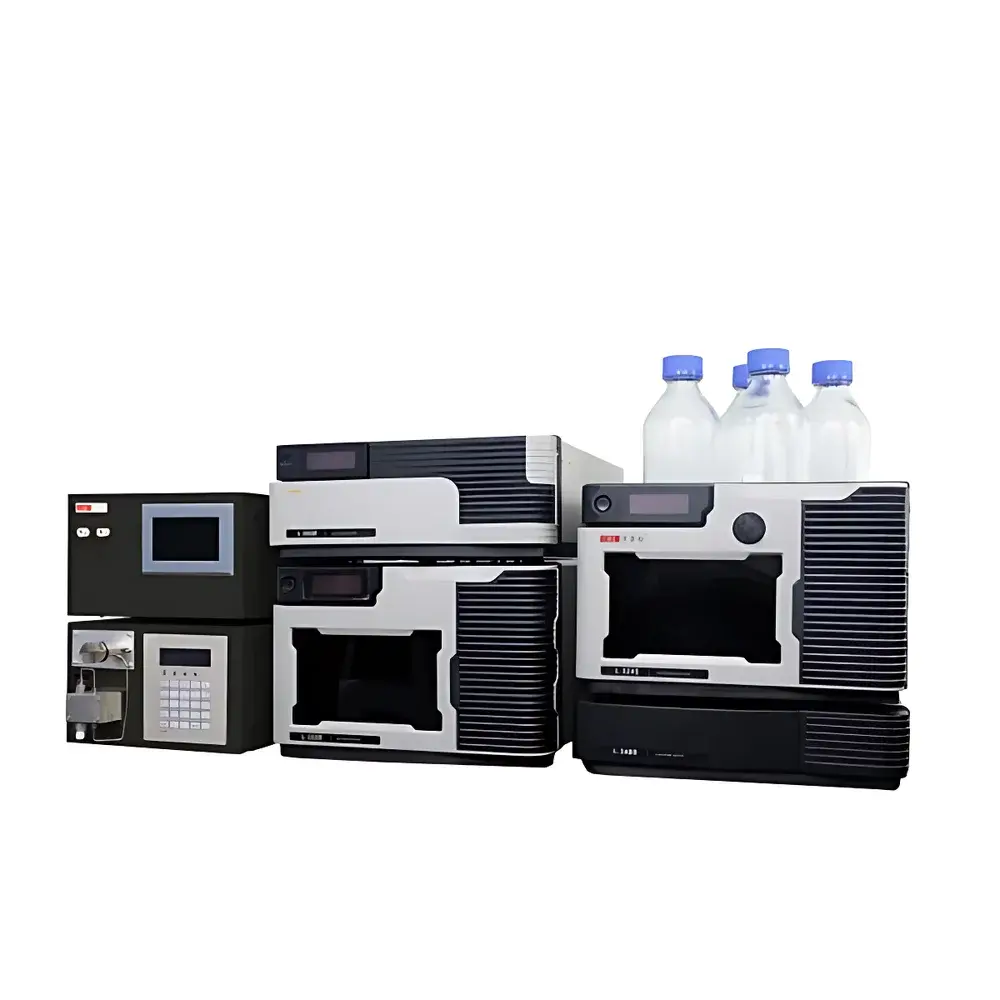
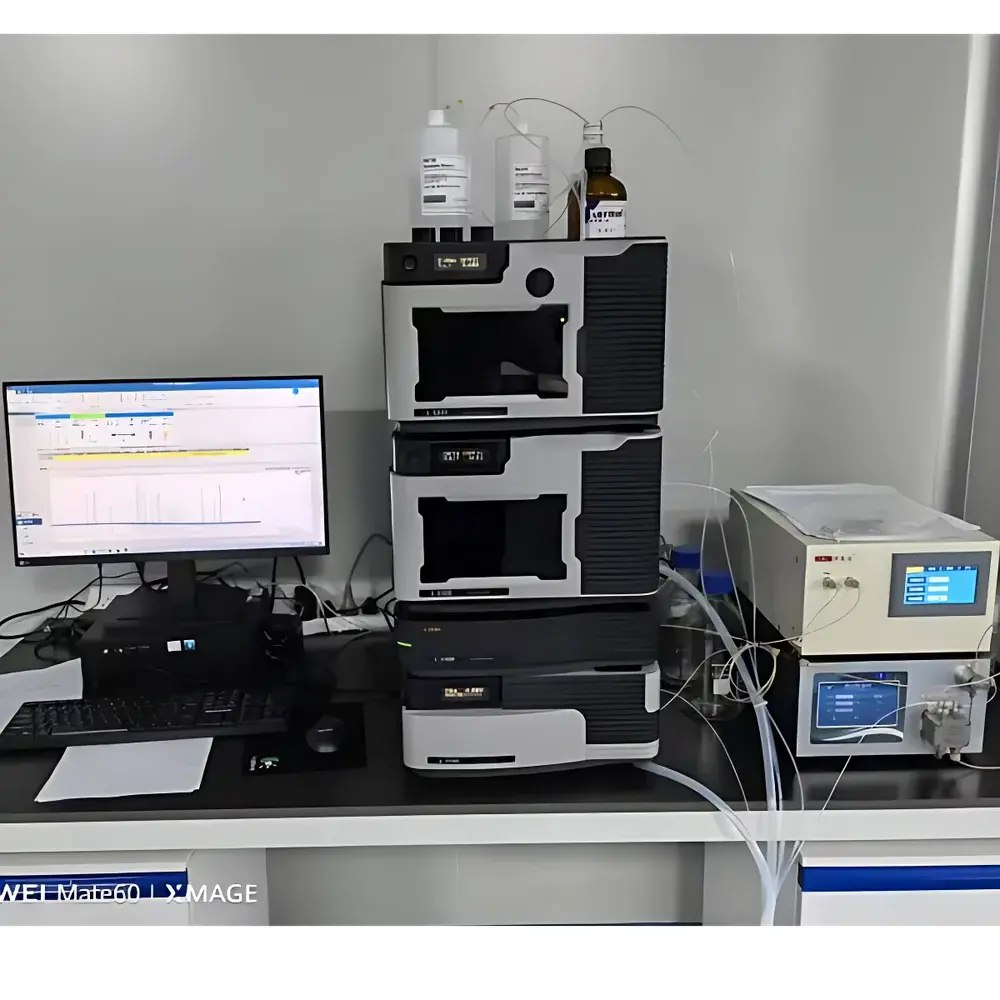
HMC L-3000pro Fully Automated Amino Acid Analyzer
| Brand | HMC |
|---|---|
| Origin | Jiangsu, China |
| Manufacturer Type | Authorized Distributor |
| Regional Classification | Domestic (PRC) |
| Model | L-3000pro |
| Instrument Type | Post-Column Derivatization System |
| Pump Flow Rate | 0.001–10.000 mL/min |
| Maximum Pump Pressure | 6000 psi |
| Autosampler Injection Volume | 1–500 µL |
| Post-Column Reactor Temperature Range | Ambient to 150 °C |
| Detection Wavelength Range | 190–800 nm |
| Flow Cell Volume | 4 µL |
Overview
The HMC L-3000pro Fully Automated Amino Acid Analyzer is a dedicated high-performance liquid chromatography (HPLC) system engineered for precise, reproducible quantification of free and hydrolyzed amino acids in complex matrices. It operates on the well-established post-column derivatization principle using ninhydrin chemistry—where amino acids elute from an ion-exchange column, undergo thermal reaction with ninhydrin reagent in a precisely controlled reactor, and are subsequently detected via dual-wavelength UV-Vis absorbance at 570 nm (primary α-amino detection) and 440 nm (secondary imino acid detection). The system integrates a robust four-solvent low-pressure gradient pump, a high-precision autosampler, a thermostatically regulated post-column reaction module, and a dual-beam UV-Vis detector with programmable wavelength scanning. Designed for compliance-driven laboratories, the L-3000pro meets the instrumental performance requirements specified in GB 5009.124–2016 (Food), GB/T 18246–2019 (Feed), NY/T 1975–2010 (Water-Soluble Fertilizers), and JJG 1064–2011 (Verification Regulation for Amino Acid Analyzers).
Key Features
- Four-solvent low-pressure gradient pumping system with pressure capability up to 6000 psi and flow accuracy ±0.1% RSD over 0.001–10.000 mL/min; incorporates dual-piston architecture with active pulse damping and real-time pressure feedback control.
- Autosampler with 2 × 60-position standard tray (expandable to 2 × 96 or 2 × 384), supporting full-loop, partial-loop, and micro-volume injection modes; features dual-stage needle wash (external surface + internal lumen) to minimize carryover below 0.01%.
- Post-column derivatization reactor with temperature control from ambient to 150 °C (±0.5 °C stability), packed with inert, uniformly sized silicon carbide particles to maximize surface area and ensure homogeneous heat transfer and reaction kinetics.
- UV-Vis detector with spectral range 190–800 nm, dual-wavelength simultaneous acquisition (570/440 nm), 4 µL flow cell volume, and data acquisition rate ≥20 Hz—enabling resolution of narrow peaks (<5 s width) typical in rapid amino acid separations.
- Ion-exchange separation column utilizing imported sulfonated cation-exchange resin with particle size <5 µm; compatible with both sodium-based (protein hydrolysate) and lithium-based (physiological fluid) elution systems.
Sample Compatibility & Compliance
The L-3000pro supports analysis of diverse sample types including hydrolyzed food proteins, serum/plasma, urine, feed extracts, and fertilizer solutions. Its method flexibility accommodates both standardized protocols (e.g., GB 5009.124–2016, AOAC 994.12) and laboratory-developed methods requiring method validation per ICH Q2(R2). All hardware modules—including pump, autosampler, reactor, and detector—are designed to operate within GLP/GMP environments. The system’s firmware and Ultrachrom software support full audit trail functionality, electronic signatures, and secure user access levels compliant with FDA 21 CFR Part 11 requirements. Calibration verification, system suitability testing (SST), and peak symmetry assessment are embedded in routine operation workflows.
Software & Data Management
Ultrachrom is a validated, instrument-integrated chromatography data system (CDS) developed exclusively for the L-3000 series. It provides end-to-end workflow management: method setup (gradient profiles, temperature ramps, wavelength programs), real-time instrument control, raw data acquisition, peak integration with customizable baseline algorithms, quantitative calibration (linear/non-linear), report generation (PDF/CSV), and electronic archiving. The software supports bilingual interface (English/Chinese), multi-user role-based permissions, and automated backup to network drives or NAS devices. All data files include embedded metadata (instrument ID, operator, timestamp, SST results), ensuring traceability and alignment with ISO/IEC 17025 documentation requirements.
Applications
- Quantitative profiling of 20+ proteinogenic amino acids in hydrolyzed dairy, meat, and plant-based foods for nutritional labeling and quality control.
- Monitoring essential amino acid ratios (e.g., leucine, lysine, tryptophan) in infant formula and clinical nutrition products per Codex Alimentarius standards.
- Clinical research applications: plasma amino acid screening for inborn errors of metabolism (e.g., phenylketonuria, maple syrup urine disease).
- Feed formulation analysis to verify lysine/methionine supplementation levels in poultry and swine rations.
- Quality assurance of water-soluble fertilizers under NY/T 1975–2010, including detection of glycine, glutamic acid, and other bioactive amino acids.
FAQ
Does the L-3000pro support method transfer from legacy Pickering or Biochrom systems?
Yes—the column dimensions, eluent compositions, and derivatization conditions are fully compatible with established Pickering PICO-TAG™ and Biochrom 30+ methodologies, enabling seamless migration without revalidation of core separation parameters.
Is the reactor temperature programmable during a single run?
Yes—Ultrachrom allows time-based temperature ramping in the post-column reactor, facilitating optimization of derivatization efficiency for early-eluting (e.g., aspartic acid) and late-eluting (e.g., tryptophan) analytes.
What maintenance intervals are recommended for the autosampler needle wash system?
Daily external needle rinse with water/methanol (1:1) is advised; internal needle flush should be performed every 100 injections or at the start of each batch to maintain carryover <0.01%.
Can the system be integrated into a LIMS environment?
Yes—Ultrachrom supports ASTM E1384-compliant data export via ODBC and HL7-compatible result transmission; custom API integration is available upon request.
Is column oven temperature control included as standard?
No—the L-3000pro does not include a built-in column oven; however, it is fully compatible with third-party column heaters (e.g., Supelco, Waters) mounted externally on the separation column.






