
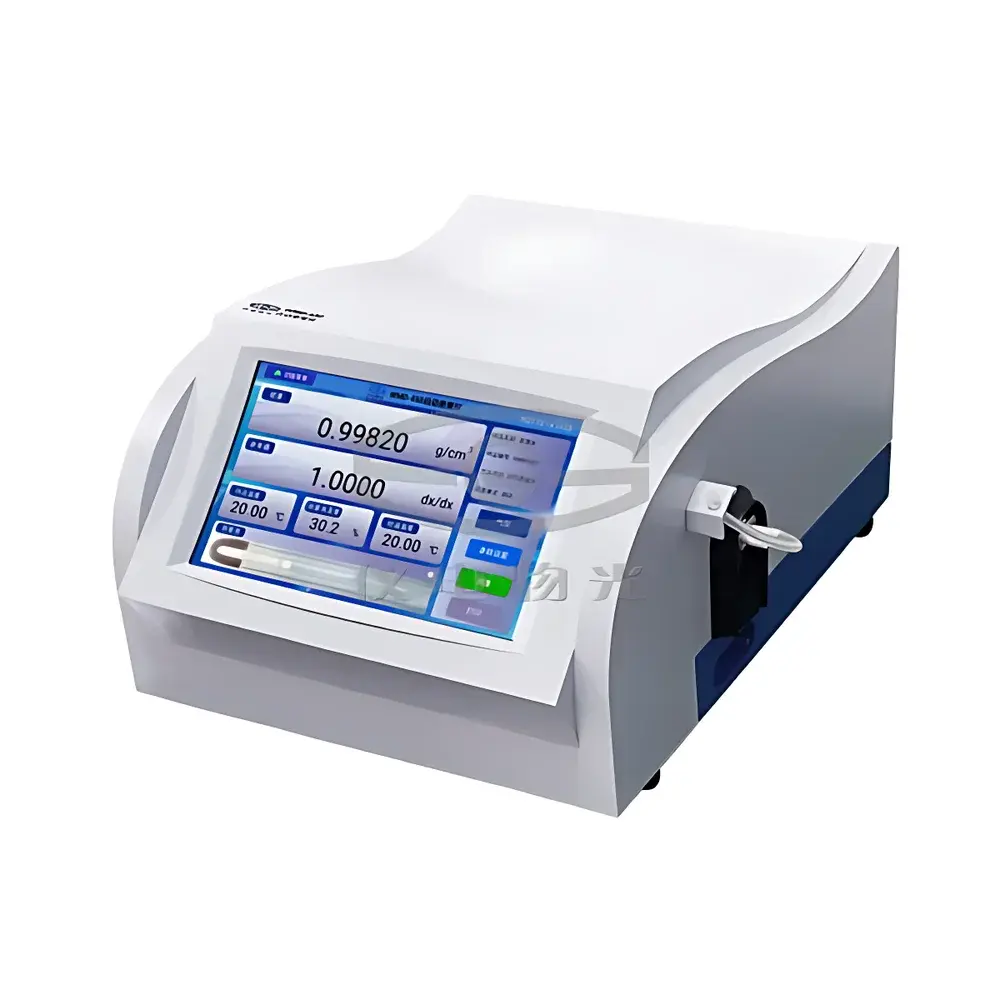
YDWG WMD-450 Video-Assisted Oscillating U-Tube Digital Density Meter
| Brand | YDWG |
|---|---|
| Origin | Shanghai, China |
| Model | WMD-450 |
| Instrument Type | Benchtop Laboratory Digital Densimeter |
| Measurement Principle | Oscillating U-tube (ASTM D4052, ISO 12185, GB/T 2013) |
| Density Range | 0.00000–3.00000 g/cm³ |
| Accuracy | ±0.0003 g/cm³ |
| Repeatability | ±0.00005 g/cm³ |
| Resolution | 0.00001 g/cm³ |
| Temperature Control Range | 5–70 °C |
| Temperature Accuracy | ±0.2 °C |
| Temperature Stability | ±0.05 °C |
| Sample Volume | 2–3 mL |
| Display | 10.1″ Android-based color touchscreen with integrated HD video camera for real-time sample injection monitoring |
| Data Storage | 64 GB internal |
| Connectivity | RS232 ×1, USB ×3, RJ-45 Ethernet |
| Compliance | ASTM D4052-11, ASTM D5002-13, ASTM D3505-12e1, ISO 12185:1996, GB/T 2013–2010, SH/T 0604–2000, GB/T 29617–2013 |
Overview
The YDWG WMD-450 Video-Assisted Oscillating U-Tube Digital Density Meter is a high-precision benchtop instrument engineered for accurate, traceable, and repeatable density determination of liquid samples in regulated laboratory environments. It operates on the fundamental physical principle of oscillating U-tube densimetry: a precisely manufactured borosilicate glass U-tube is electromagnetically excited to resonate at its natural frequency, which shifts inversely with the mass of the sample filling the tube. By correlating measured oscillation frequency with pre-established calibration curves (using dry air and certified water), the instrument computes density with metrological rigor. This method eliminates operator-dependent variables inherent in hydrostatic or pycnometric techniques, delivering intrinsic reproducibility and compliance with international standards including ASTM D4052, ISO 12185, and GB/T 2013. Designed for routine QC/QA, R&D, and regulatory testing, the WMD-450 integrates real-time video observation of sample introduction—enabling visual verification of bubble-free filling, meniscus positioning, and contamination detection—thereby reinforcing measurement integrity at the point of sample handling.
Key Features
- Real-time HD video monitoring via integrated 10.1″ Android touchscreen interface, allowing visual confirmation of sample injection quality and meniscus stability prior to measurement initiation
- Peltier-based active temperature control (5–70 °C) with ±0.05 °C stability and ±0.2 °C absolute accuracy, ensuring thermally stabilized measurements per ISO 12185 requirements
- Ultra-low sample consumption (2–3 mL per analysis), minimizing reagent cost and waste generation—critical for high-value or hazardous liquids
- Multi-mode measurement engine supporting density (g/cm³, kg/m³), relative density (vs. water at 4 °C/20 °C/25 °C), API gravity, and industry-specific protocols (pharmaceutical, petrochemical, food & beverage, chemical)
- Four-tier user permission architecture with electronic signature capability and optional FDA 21 CFR Part 11-compliant audit trail module for GLP/GMP-aligned workflows
- Comprehensive data management: internal 64 GB storage, export to PDF/Excel, direct printing (thermal or dot-matrix via USB/WiFi), and networked data transfer via Ethernet or RS232
Sample Compatibility & Compliance
The WMD-450 accommodates a broad spectrum of homogeneous liquids—including volatile solvents, viscous oils, aqueous solutions, alcohols, acids, bases, and pharmaceutical formulations—provided they do not corrode borosilicate glass or interfere with stable oscillation (e.g., highly viscous or particulate-laden samples require filtration or dilution). Its design conforms to the core technical requirements of ISO 12185:1996 and ASTM D4052-11 for oscillating U-tube densimeters, and supports full traceability under ISO/IEC 17025-accredited testing. Calibration is performed using two-point validation (dry air and double-distilled water), both traceable to NIST SRM standards. The instrument meets mandatory clauses for temperature uniformity, frequency resolution, and repeatability defined in GB/T 29617–2013 and SH/T 0604–2000, and is routinely deployed in laboratories subject to CNAS, FDA, and EMA inspections.
Software & Data Management
Running on a dedicated Android OS platform, the WMD-450’s firmware provides intuitive workflow navigation, customizable method templates, and context-sensitive guidance for calibration, measurement, and troubleshooting. All measurement events—including timestamp, operator ID, temperature setpoint, raw frequency data, density result, and video snapshot (optional)—are time-stamped and stored with immutable metadata. Exported reports include full audit-ready headers, digital signatures, and revision-controlled method parameters. When configured with the optional audit trail module, the system enforces 21 CFR Part 11 compliance through role-based access control, electronic signature authentication, and tamper-evident log files recording all user actions, parameter changes, and calibration events. Data synchronization over TCP/IP enables integration into LIMS or ELN platforms without proprietary middleware.
Applications
The WMD-450 serves as a primary density reference instrument across regulated industries. In pharmaceutical manufacturing, it verifies excipient density, monitors solvent composition in API synthesis, and validates density-based concentration assays per USP . In petroleum refining, it determines API gravity of crude fractions and blend ratios in additive dosing systems per ASTM D5002. Beverage producers use it for Brix-to-density conversion in juice standardization (GB/T 15038–2006), while food labs apply it to oil purity assessment (GB 5526–1985) and ethanol quantification in fermented products (GB/T 10345–2007). Chemical QA departments rely on its repeatability for batch release of ethylene glycol, ammonia solutions, and surfactant concentrates. Independent testing labs leverage its multi-standard support to deliver accredited density certifications compliant with SN/T 2383–2009 and DB/T 1231–2010.
FAQ
What standards does the WMD-450 comply with for regulatory submissions?
It fully implements ASTM D4052-11, ISO 12185:1996, and GB/T 2013–2010, and supports audit-ready reporting aligned with FDA 21 CFR Part 11 when the optional software module is activated.
Can the instrument measure samples above 3.0 g/cm³?
No—the validated operational range is strictly 0.00000–3.00000 g/cm³. Samples exceeding this limit (e.g., molten metals or concentrated brines) are outside design specifications and may damage the U-tube sensor.
Is automatic sample introduction available?
Manual injection is standard; an external autosampler can be integrated via RS232 or USB for unattended sequential analysis—contact technical support for compatibility documentation.
How often must calibration be performed?
Daily two-point calibration (air/water) is recommended for routine QC use; formal recalibration against certified reference materials is required every 6 months or after maintenance, per ISO/IEC 17025 clause 5.5.2.
Does the video function record or store footage?
The HD camera provides live feed only during manual injection; still-frame capture is supported for inclusion in PDF reports, but continuous video recording is not implemented to preserve storage integrity and data security.



