
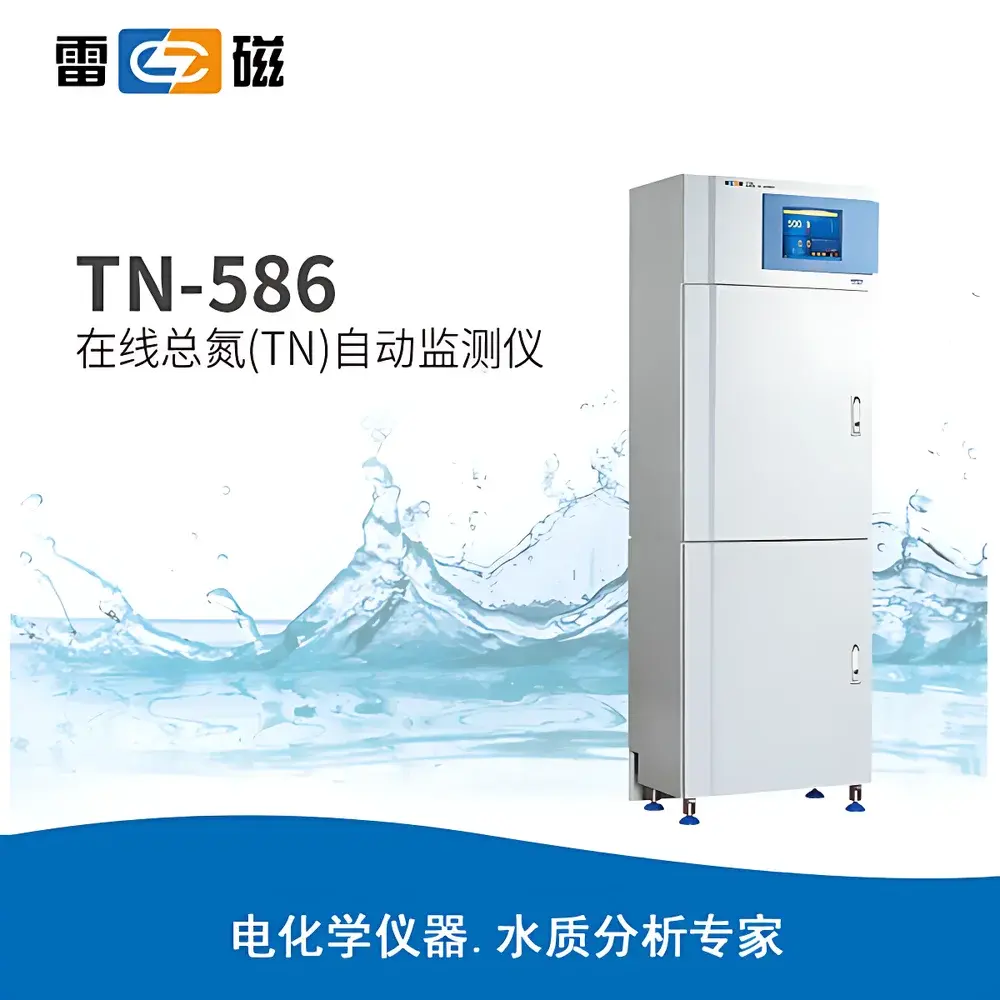
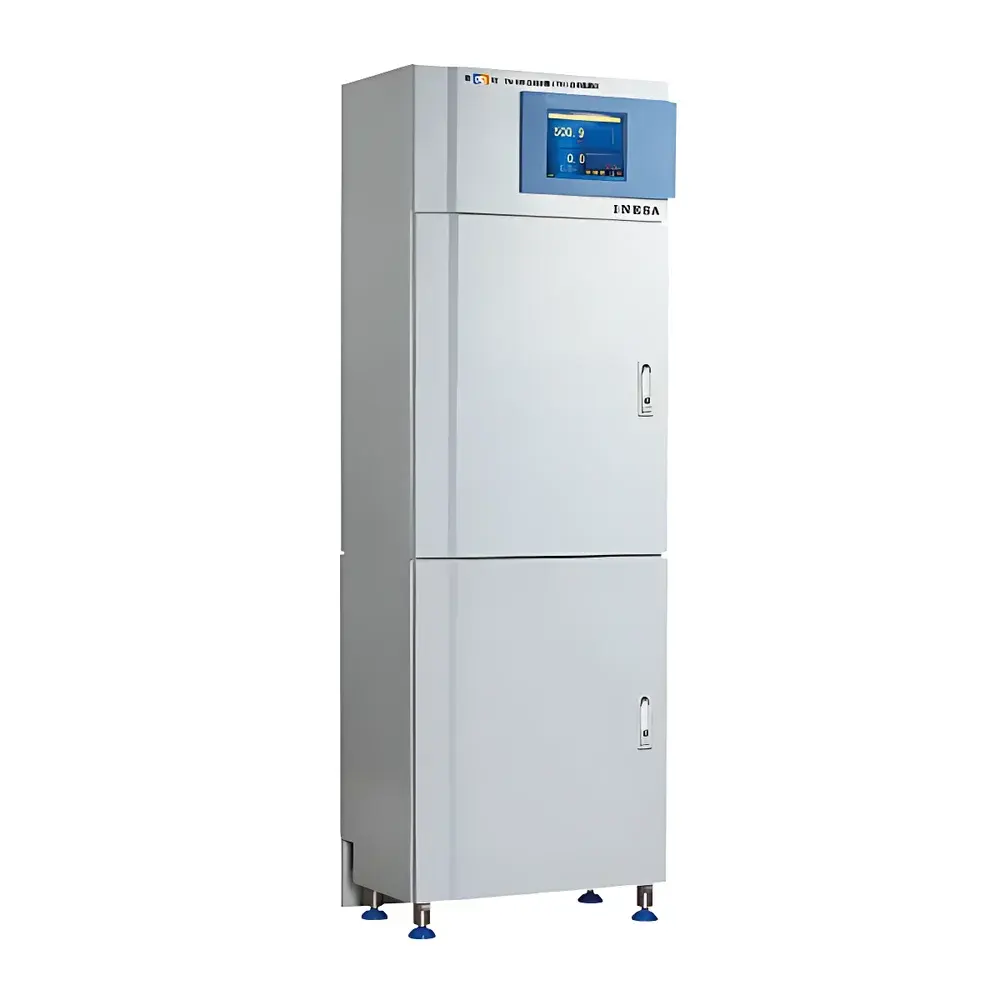
Leichi TN-586 Online Total Nitrogen (TN) Analyzer
| Brand | Leichi |
|---|---|
| Origin | Shanghai, China |
| Manufacturer Type | Authorized Distributor |
| Country of Origin | China |
| Model | TN-586 |
| Price | USD 12,300 (FOB Shanghai) |
| Measurement Method | Alkaline Potassium Persulfate Digestion with UV Spectrophotometry |
| Measurement Range | 0–150.0 mg/L (customizable extension available) |
| Accuracy | ±10% of reading |
| Detection Limit | 0.1 mg/L |
| Resolution | 0.1 mg/L |
| Compliance | GB 11894–1989 |
| Measurement Cycle | ≥40 min |
| Sampling Interval | 10–9999 min (programmable) or fixed-time mode |
| Calibration Modes | Manual and Automatic |
| Output Interfaces | RS-232, RS-485, 4–20 mA analog |
| Real-sample Comparison Error | ≤±10% |
| Dimensions | 1430 × 500 × 403 mm |
Overview
The Leichi TN-586 Online Total Nitrogen (TN) Analyzer is an industrial-grade, fully automated water quality monitoring system engineered for continuous, unattended quantification of total nitrogen in natural waters, wastewater effluents, and process streams. It operates on the standardized alkaline potassium persulfate digestion method (GB 11894–1989), followed by ultraviolet spectrophotometric detection at 220 nm and 275 nm to correct for nitrate interference. This dual-wavelength correction ensures robust performance in complex matrices—including turbid surface water, biologically active sewage influents, and chlorinated drinking water sources—where organic and inorganic nitrogen species coexist. Designed for deployment in fixed-site environmental monitoring networks, the TN-586 delivers trace-level sensitivity (LOD: 0.1 mg/L) and high measurement reproducibility (≤±10% RSD), meeting regulatory requirements for long-term trend analysis and compliance reporting under national water quality standards.
Key Features
- Sequential injection analysis (SIA) architecture minimizes reagent consumption and eliminates cross-contamination between samples;
- Corrosion-resistant multi-position selection valve with PTFE and ceramic components ensures >20,000 cycle durability in aggressive wastewater environments;
- Integrated power-loss recovery logic retains configuration settings and resumes measurement sequence upon re-powering without data loss;
- Onboard self-diagnostic routines continuously monitor digestion efficiency, photometric stability, fluidic pressure, and heater temperature—logging fault codes with timestamped event history;
- Modular optical path design features a fixed-pathlength quartz flow cell and stabilized deuterium-tungsten dual-lamp source for consistent UV absorbance measurement over extended operational periods;
- Configurable alarm thresholds trigger relay outputs and optional sample retention via external auto-samplers during exceedance events;
- IP54-rated enclosure with internal temperature regulation enables stable operation across ambient conditions from 5 °C to 40 °C.
Sample Compatibility & Compliance
The TN-586 accepts raw, unfiltered water samples with suspended solids up to 100 mg/L and chloride concentrations ≤2000 mg/L—within typical limits for municipal and industrial discharge monitoring. It complies with Chinese national standard GB 11894–1989 and aligns methodologically with ISO 11905-1 (Water quality — Determination of nitrogen — Part 1: Total nitrogen after acid digestion) and ASTM D5176 (Standard Test Method for Total Nitrogen in Organic Materials). All calibration, maintenance, and error logging activities are timestamped and stored locally for GLP-compliant audit trails. While not certified for FDA 21 CFR Part 11 out-of-the-box, the system supports secure user authentication and electronic signature integration when deployed with validated third-party SCADA platforms.
Software & Data Management
The embedded Linux-based controller runs Leichi’s TN-OS v3.2 firmware, supporting local HMI navigation via a 7-inch capacitive touchscreen. Data acquisition includes real-time absorbance spectra, digestion temperature profiles, and pump actuation logs. Communication protocols include Modbus RTU (RS-485), ASCII-over-RS-232, and isolated 4–20 mA analog output scaled to full-range TN concentration. Optional cloud connectivity via MQTT or OPC UA enables integration into centralized environmental data management systems (e.g., EPA’s STORET, EU’s WISE). All measurement records include metadata fields for sampling location ID, operator login, and QA/QC flagging (e.g., “calibration due”, “digestion timeout”). Internal storage retains ≥12 months of 15-minute interval data with automatic rollover.
Applications
- Real-time monitoring of TN at river intake points and reservoir outfalls to support eutrophication early-warning systems;
- Regulatory compliance tracking at municipal wastewater treatment plant (WWTP) influent, secondary effluent, and tertiary discharge points;
- Source water quality surveillance for drinking water utilities—particularly where agricultural runoff contributes seasonal nitrogen spikes;
- Continuous emission monitoring (CEMS) for industrial facilities subject to national pollutant discharge permits (e.g., chemical, food processing, pharmaceutical sectors);
- Process control feedback in denitrification basins and membrane bioreactors (MBRs), where rapid TN response informs carbon dosing and hydraulic retention time adjustments;
- Long-term trend analysis in ecological restoration projects targeting nutrient load reduction in sensitive aquatic ecosystems.
FAQ
What digestion temperature and duration does the TN-586 use?
The instrument maintains a precise 125 °C digestion temperature for 30 minutes under pressurized alkaline potassium persulfate conditions, per GB 11894–1989 specifications.
Can the TN-586 measure samples with high chloride content?
Yes—it tolerates chloride concentrations up to 2000 mg/L without significant interference; however, samples exceeding this threshold require dilution or pretreatment per method validation guidelines.
Is remote firmware update supported?
Firmware updates are performed via USB drive or secure FTP upload through the Ethernet interface, requiring administrator-level credentials and checksum verification.
Does the system support automatic blank correction?
Yes—daily automatic zero-point calibration using deionized water is configurable, and manual blanking can be initiated at any time via HMI or remote command.
How often does the system require preventive maintenance?
Recommended service intervals include quarterly replacement of digestion reactor seals, biannual photometer lamp inspection, and annual recalibration of analog outputs and flow sensors—documented in the onboard maintenance log.
Related Products







