
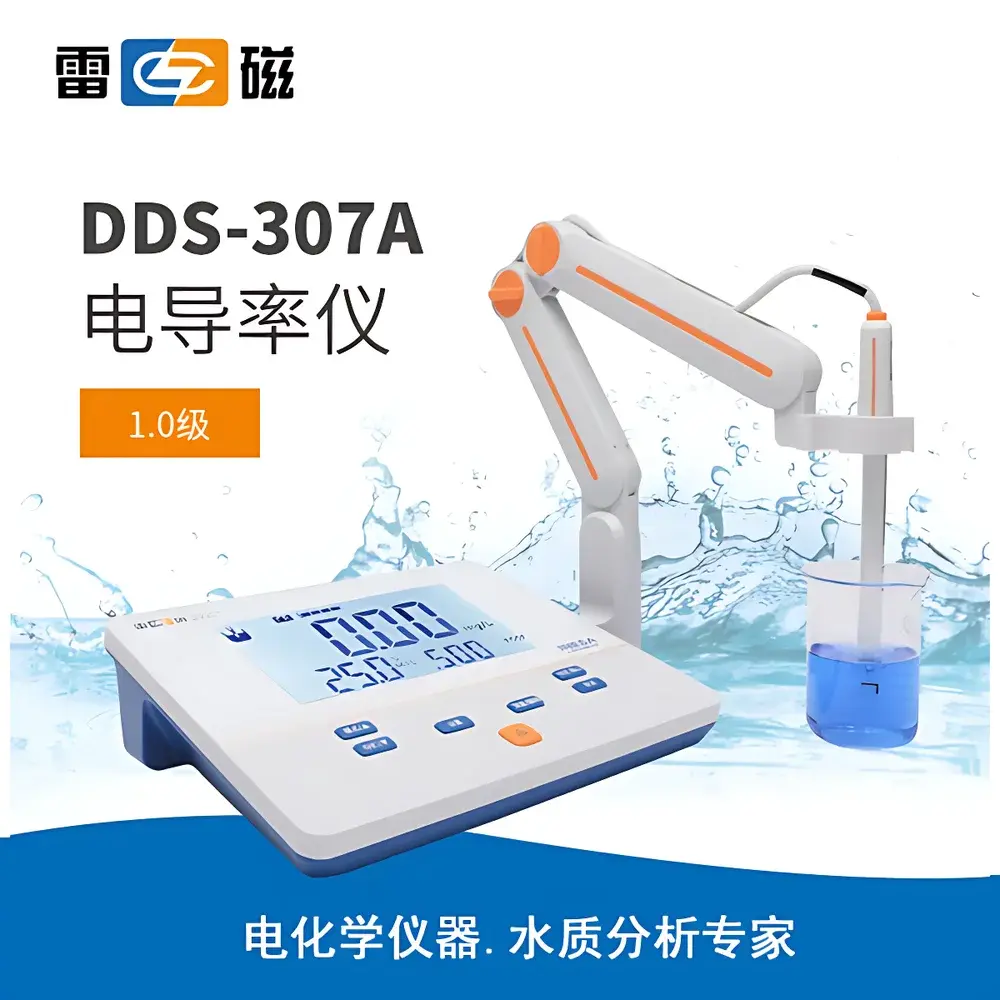
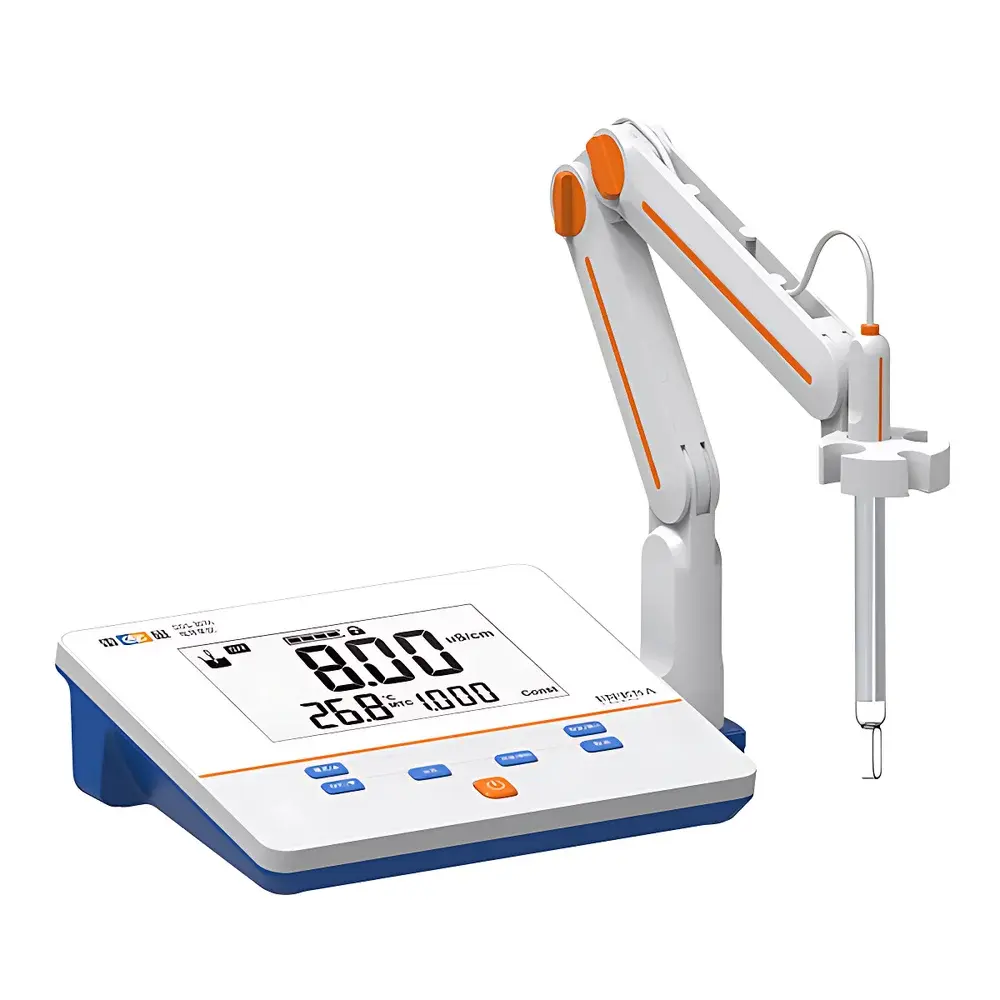
Leici DDS-307A Benchtop Conductivity Meter
| Brand | Leici |
|---|---|
| Origin | Shanghai, China |
| Model | DDS-307A |
| Form Factor | Benchtop |
| Application Environment | Laboratory |
| Conductivity Range | 0.00 µS/cm to 200 mS/cm |
| TDS Range | 0.00 mg/L to 100 g/L |
| Temperature Range | −5.0 °C to 110.0 °C |
| Accuracy | ±1.0% FS |
| Minimum Conductivity Resolution | 0.01 µS/cm (auto-ranging) |
| TDS Resolution | 0.01 mg/L (auto-ranging) |
| Temperature Resolution | 0.1 °C |
| Temperature Accuracy | ±0.2 °C |
| Conductivity Class | Class 1.0 per GB/T 11018 |
| IP Rating | IP54 |
| Data Storage | 50 measurement sets |
| Calibration | Single-point conductivity calibration with auto-recognition of 4 standard GB solutions |
| Temperature Compensation | Automatic and manual modes |
| Electrode Constant Support | Auto-frequency switching for K = 1.0 cell |
| Power Supply | AC/DC adapter (Input: 100–240 VAC, Output: 20 VDC / 1500 mA) |
| Dimensions (W×D×H) | 242 × 195 × 68 mm |
| Weight | 0.9 kg |
Overview
The Leici DDS-307A is a benchtop conductivity meter engineered for precision and reliability in routine laboratory electrochemical analysis. It operates on the principle of two-electrode AC conductometric measurement, applying a low-frequency alternating current across a conductive solution to determine its electrical conductivity—directly correlated to ionic concentration. Designed in compliance with Chinese national standards (GB/T 11018), the instrument meets Class 1.0 accuracy requirements for conductivity measurement, making it suitable for quality control, environmental monitoring, pharmaceutical water testing, and academic research where trace-level ionic quantification is required. Its robust architecture integrates temperature-compensated measurement algorithms, enabling accurate conversion of raw conductance readings into standardized conductivity values at 25 °C using either linear or non-linear (e.g., NaCl-based) compensation models.
Key Features
- High-contrast LCD display with intuitive button navigation and real-time parameter feedback
- Auto-ranging conductivity measurement with dynamic resolution switching—0.01 µS/cm at low ranges, up to 0.1 mS/cm at high ranges
- Integrated temperature sensor with ±0.2 °C accuracy over −5.0 °C to 110.0 °C, supporting both automatic and user-defined temperature compensation
- IP54-rated enclosure for protection against dust ingress and water splashes during routine lab handling
- Smart electrode detection and auto-recognition of four standard GB conductivity reference solutions (e.g., 1413 µS/cm, 12.88 mS/cm)
- Dual measurement modes: equilibrium mode (with intelligent endpoint detection) and continuous monitoring mode for kinetic studies
- Auto-frequency switching logic ensures optimal excitation frequency selection based on solution conductivity—critical for minimizing polarization error and electrode fouling
- Configurable auto-power-off and factory reset functions for operational consistency and data integrity management
Sample Compatibility & Compliance
The DDS-307A is optimized for aqueous samples ranging from ultrapure water (e.g., ASTM D1193 Type I, USP Purified Water) to concentrated brines and process streams. Its K = 1.0 cell compatibility supports measurements across the full specified range without manual cell replacement. The instrument conforms to GB/T 11018–2021 for conductivity meters and aligns with general metrological requirements outlined in ISO/IEC 17025 for laboratory equipment verification. While not inherently 21 CFR Part 11 compliant, audit-ready operation is supported via timestamped data logging, fixed storage capacity (50 entries), and non-volatile memory retention—even during power interruption. Routine calibration verification satisfies GLP documentation needs when paired with certified reference standards and controlled environmental conditions.
Software & Data Management
Data acquisition and review are handled locally via the built-in memory system. Each stored entry includes conductivity, TDS, temperature, date/time stamp, and calibration status flags. Users may browse, export (via optional RS232 or USB-to-serial interface—not included), or delete individual records directly from the front panel. No proprietary PC software is bundled; however, ASCII-formatted output is compatible with common spreadsheet and LIMS platforms. All calibrations are logged with solution ID, date, slope, and offset—enabling retrospective traceability for internal QA audits. Firmware does not support remote configuration or network connectivity, preserving data sovereignty in regulated environments.
Applications
- Monitoring conductivity of purified water systems in pharmaceutical manufacturing (e.g., WFI and PW loops per USP )
- Environmental testing of surface water, wastewater effluent, and soil leachates per EPA Method 120.1
- Quality assurance of electrolyte solutions in battery R&D and electroplating baths
- TDS estimation in food & beverage processing (e.g., brine concentration, syrup dilution control)
- Academic teaching labs for fundamental electrochemistry experiments including Kohlrausch’s law validation
- In-process verification of cleaning validation rinse water in medical device manufacturing
FAQ
Does the DDS-307A support multi-point conductivity calibration?
No—it supports single-point calibration only, with automatic recognition of four predefined GB standard solutions.
Can the instrument measure resistivity directly?
No—resistivity must be calculated manually as the reciprocal of conductivity (ρ = 1/σ), using recorded conductivity and cell constant.
Is the temperature probe integrated or external?
The temperature sensor is built into the supplied composite conductivity electrode, eliminating separate probe handling.
What is the maximum allowable sample temperature for continuous measurement?
The instrument supports stable operation up to 110.0 °C; however, prolonged exposure above 80 °C may affect electrode longevity and seal integrity.
Does the meter meet international conductivity standards such as ISO 7888 or ASTM D1125?
While designed to GB/T 11018, its measurement methodology and accuracy specification are functionally equivalent to ISO 7888:2019 and ASTM D1125–22 for routine applications—subject to proper calibration and traceable standards.
Related Products




