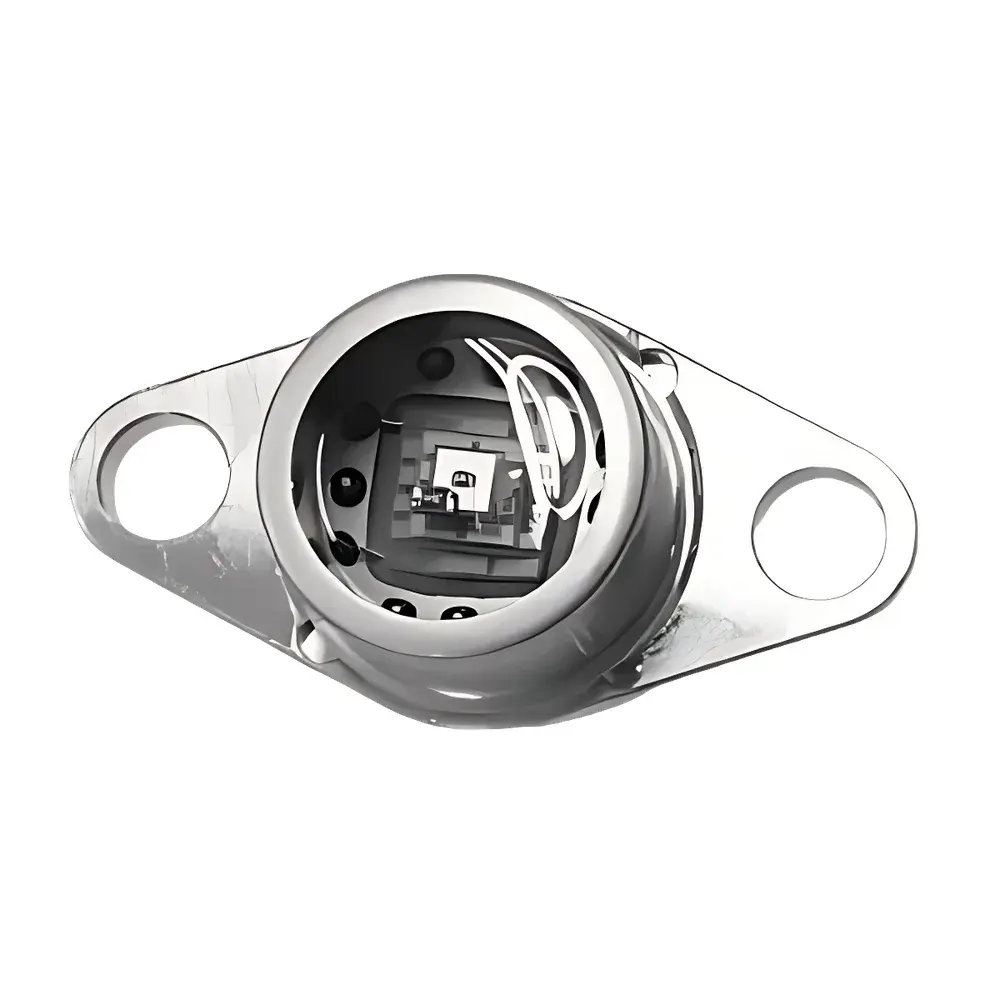
Wooriro NFAD Series Negative-Feedback Avalanche Photodiode
| Brand | Other brands |
|---|---|
| Origin | South Korea |
| Manufacturer Type | Authorized Distributor |
| Import Status | Imported |
| Model | NFAD Series |
| Pricing | Upon Request |
Overview
The Wooriro NFAD Series Negative-Feedback Avalanche Photodiode is a specialized single-photon-sensitive optoelectronic detector engineered for ultra-low-light, time-resolved photon counting applications. Unlike conventional avalanche photodiodes (APDs), the NFAD integrates an on-chip negative feedback mechanism—typically realized via integrated quenching resistors and optimized guard-ring structures—to stabilize gain, suppress afterpulsing, and enable linear operation at high count rates. Its core sensing element is fabricated using InGaAs/InP heterostructure technology, optimized for high quantum efficiency in the 900–1700 nm wavelength range—critical for telecom-band quantum communication and long-range LiDAR. The device operates in gated or free-running mode with active or passive quenching, supporting sub-nanosecond timing resolution and dark count rates below 100 Hz at cryogenic or thermoelectrically stabilized temperatures. It is not a standalone instrument but a precision component designed for integration into OEM quantum measurement systems, including QKD receivers, time-correlated single-photon counting (TCSPC) modules, and photon-starved ranging platforms.
Key Features
- InGaAs/InP-based planar structure with deep-trench isolation and multi-layer passivation for enhanced reliability and low surface leakage
- Integrated negative-feedback architecture enabling stable gain control without external active circuitry
- High photon detection probability (PDP) >25% at 1550 nm (typical, at −30 °C, 100 ns gate width)
- Low afterpulse probability (<5% after 100 ns hold-off) due to optimized carrier trapping mitigation
- Timing jitter <80 ps FWHM (full width at half maximum) under standard gating conditions
- Compatible with standard TO-46, TO-8, or ceramic LCC packages with hermetic sealing options
- Operable with thermoelectric cooling (−30 °C to +10 °C) or liquid nitrogen cooling for ultra-low dark count performance
Sample Compatibility & Compliance
The NFAD Series is designed for use with fiber-coupled or free-space optical inputs, supporting SMF-28, PM1550, or custom lensed configurations. It complies with JEDEC JESD22-A108 for temperature cycling and MIL-STD-883H for mechanical shock and vibration robustness. While not certified as a final product per ISO/IEC 17025, its fabrication process adheres to semiconductor cleanroom protocols aligned with IATF 16949 quality management standards. For quantum cryptography deployments, the device meets the photon-source and detector requirements specified in ETSI GS QKD 004 and supports protocol-level security assumptions under the decoy-state BB84 framework. It is suitable for environments requiring GLP-compliant traceability when integrated into validated test benches.
Software & Data Management
As a component-level detector, the NFAD does not include embedded firmware or native GUI software. However, it is fully compatible with industry-standard data acquisition and timing electronics—including ID Quantique ID120, PicoQuant HydraHarp 400, Becker & Hickl SPC-150NX, and Quantum Opus QO-DAQ platforms. These systems provide timestamp recording, histogramming, dead-time correction, and coincidence logic essential for QKD key sifting and LiDAR point-cloud generation. All supported DAQ interfaces comply with USB 3.0, PCIe Gen3, or LVDS protocols, and support NIST-traceable time-stamping with <10 ps RMS uncertainty. Audit trails, user access controls, and electronic signatures are implemented at the system level per FDA 21 CFR Part 11 when deployed in regulated R&D or metrology laboratories.
Applications
- Quantum Key Distribution (QKD) receivers in metropolitan and backbone fiber networks (e.g., CV-QKD and DV-QKD implementations)
- Single-photon time-of-flight (SP-TOF) LiDAR for atmospheric sensing, space debris tracking, and autonomous vehicle navigation
- Fundamental quantum optics experiments: Bell inequality tests, quantum eraser setups, and heralded entanglement generation
- Fluorescence lifetime imaging (FLIM) and time-resolved spectroscopy in near-infrared biological windows (NIR-II)
- Calibration references for national metrology institutes performing photon flux and timing standardization
FAQ
Is the NFAD suitable for continuous-wave (CW) single-photon detection?
Yes—when operated in free-running mode with active quenching, the NFAD supports CW photon counting with appropriate bias voltage and thermal stabilization.
What cooling method is recommended for optimal dark count rate performance?
Thermoelectric (Peltier) cooling to −30 °C is standard; for sub-10 Hz dark counts, liquid nitrogen immersion or closed-cycle cryocoolers are advised.
Does Wooriro provide SPICE models or TCAD simulation files for circuit integration?
Yes—upon NDA, Wooriro supplies compact behavioral models and layout-ready footprint libraries for Cadence Virtuoso and Synopsys Custom Compiler.
Can the NFAD be used in space-qualified payloads?
The base die is radiation-hardened to 100 krad(Si) total ionizing dose (TID); full module qualification requires customer-specific environmental testing per ECSS-Q-ST-60-13C.
Is there documentation available for compliance with export control regulations (e.g., EAR99 or Wassenaar Arrangement)?
Yes—Wooriro provides dual-use classification letters and ECCN screening reports upon request for export licensing support.