
ALPHALAS Dual-Wavelength Zero-Order Phase Retardation Plate
| Brand | ALPHALAS |
|---|---|
| Origin | Germany |
| Model | Dual-Wavelength Zero-Order Retardation Plate |
| Designation | Dual Wave® |
| Application | Femtosecond Tripling Polarization Matching |
| Compliance | ISO 10110 Optical Component Standards, RoHS 2015/863/EU |
| Coating | Broadband AR (350–2000 nm), R < 0.25% per surface |
| Substrate | Fused Silica (Suprasil® or equivalent) |
| Surface Quality | 10-5 scratch-dig |
| Wavefront Distortion | λ/10 @ 633 nm |
| Clear Aperture | ≥90% of diameter |
| Damage Threshold | >5 J/cm² (1064 nm, 10 ns, 10 Hz) |
Overview
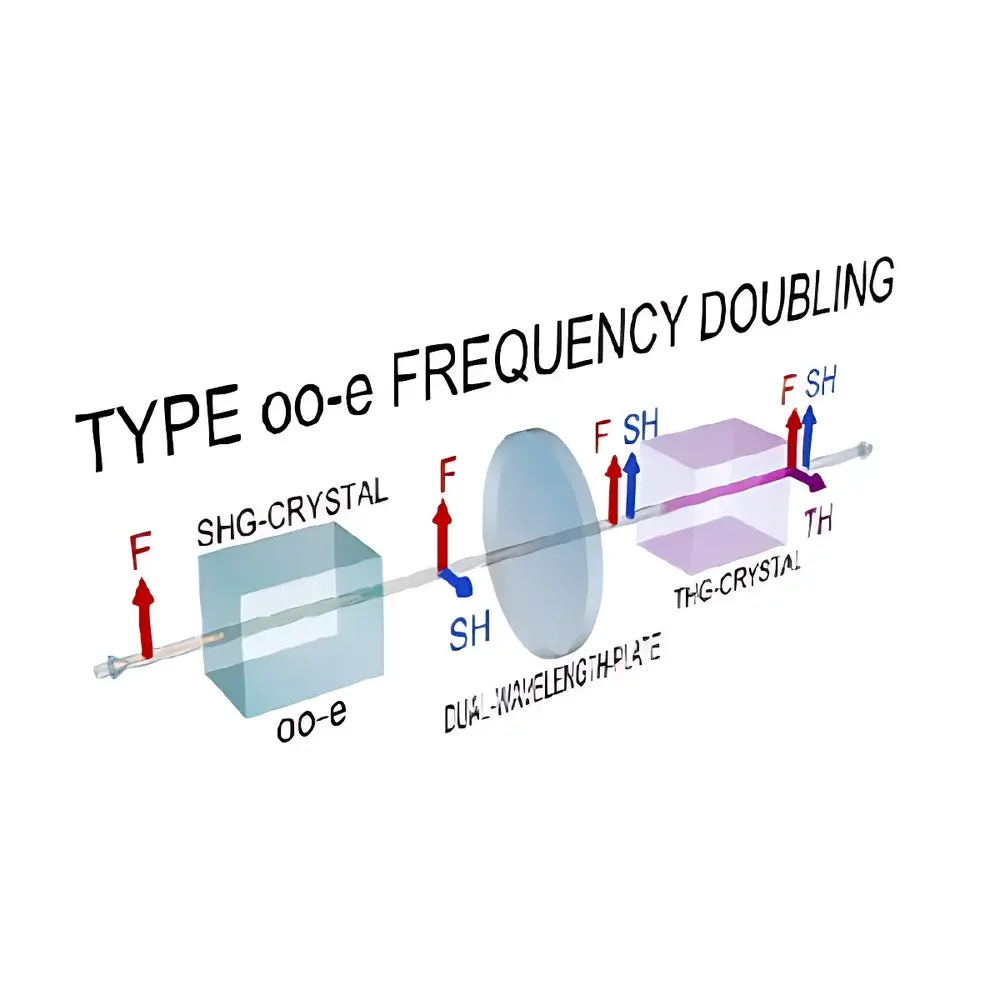
The ALPHALAS Dual-Wavelength Zero-Order Phase Retardation Plate (Dual Wave®) is an engineered optical component designed specifically for polarization state management in ultrafast nonlinear frequency conversion systems—particularly femtosecond third-harmonic generation (THG). Unlike conventional multi-order quartz waveplates, this plate operates on the principle of true zero-order retardation at two distinct wavelengths simultaneously: the fundamental (F) and its second harmonic (SH). This dual-wavelength zero-order behavior eliminates wavelength-dependent phase error accumulation across broad spectral bandwidths, making it essential for maintaining high-fidelity polarization alignment in broadband, chirped-pulse, or tunable femtosecond laser systems. The device functions by introducing precisely calibrated retardance—λ/2 at the fundamental wavelength and λ (full-wave) at the SH wavelength—enabling independent rotation of the fundamental’s polarization axis while leaving the SH polarization invariant. This differential control ensures optimal parallel alignment of F and SH electric field vectors prior to incidence on the THG crystal, thereby maximizing the effective nonlinear overlap integral and boosting THG conversion efficiency beyond conventional limits.
Key Features
- True zero-order retardation at two user-defined wavelengths (e.g., 800 nm F / 400 nm SH), eliminating temperature- and wavelength-induced walk-off common in multi-order designs
- Typical spectral bandwidth of ±50 nm around each design wavelength (i.e., ≥100 nm total usable bandwidth), supporting stable operation across tunable OPA outputs and amplified Ti:sapphire spectra
- Engineered fused silica substrate with ultra-low thermal expansion (α ≈ 0.5 × 10⁻⁶ K⁻¹) and high laser-induced damage threshold (LIDT), certified for use with high-repetition-rate femtosecond amplifiers
- Broadband anti-reflection coating optimized from 350 nm to 2000 nm, minimizing insertion loss and ghost reflections critical for low-noise THG diagnostics
- Surface figure accuracy better than λ/10 @ 633 nm and surface quality rated 10–5 scratch-dig per ISO 10110–7, ensuring diffraction-limited beam propagation
- Patented mechanical mounting interface compatible with standard kinematic rotation mounts (e.g., Thorlabs KM100, Newport URS series) for sub-arcminute angular repeatability
Sample Compatibility & Compliance
The Dual Wave® plate is compatible with all commercially available femtosecond laser platforms operating in the near-UV to NIR range—including Ti:sapphire (700–1000 nm), Yb-based (1030–1080 nm), and optical parametric amplifier (OPA) systems. It meets ISO 10110–5 (retardation uniformity), ISO 10110–8 (coating durability), and EU Directive 2015/863/EU (RoHS 3) for hazardous substances. Its fused silica substrate complies with ASTM F1713–22 for optical-grade synthetic silica. No calibration certificate is supplied as a standard item; however, NIST-traceable retardance verification reports are available upon request for GLP-compliant laboratories requiring audit-ready documentation.
Software & Data Management
While the Dual Wave® plate is a passive optical element and requires no firmware or driver software, ALPHALAS provides downloadable technical datasheets, spectral retardance maps (in CSV and MATLAB .mat formats), and mounting alignment guides via its secure customer portal. For integration into automated alignment routines, the plate’s angular sensitivity (dθ/dα ≈ 2.0 ± 0.05° per degree of physical rotation, verified at 800/400 nm) enables predictive modeling in LabVIEW, Python (using NumPy/SciPy), or MATLAB-based beamline control frameworks. Full traceability logs—including lot number, interferometric surface map ID, and coating deposition batch—are archived for 15 years in accordance with ISO 9001:2015 clause 8.5.2 (Identification and traceability).
Applications
- Femtosecond third-harmonic generation (THG) in high-resolution multiphoton microscopy, where polarization-matched F+SH input increases signal-to-background ratio and reduces photodamage
- Ultrafast pump-probe spectroscopy requiring precise, wavelength-resolved polarization gating between broadband excitation and narrowband probe beams
- Polarization-encoded quantum optics experiments involving entangled photon pairs generated via SPDC, where differential retardance enables deterministic Bell-state analysis
- Industrial laser processing systems utilizing THG UV pulses (e.g., 266 nm from 800 nm fundamental) for maskless lithography or cold ablation of transparent dielectrics
- Calibration reference for polarimetric metrology systems requiring known, stable, dual-wavelength retardance standards traceable to national labs
FAQ
Can this plate be used outside its specified F/SH wavelength pair?
Yes—within limits. While peak performance occurs at the design wavelengths, the zero-order architecture maintains usable retardance fidelity over ±30 nm deviation in either wavelength, provided the F/SH ratio remains close to 2:1.
Is custom wavelength pairing available?
Yes. ALPHALAS offers bespoke design and fabrication for non-standard F/SH combinations (e.g., 1030/515 nm, 1550/775 nm) with lead times of 8–12 weeks and full interferometric characterization report.
How does temperature affect retardance stability?
The fused silica substrate exhibits negligible thermal drift: retardance shift is <0.005°/°C over 15–35°C ambient range, verified per ISO 10110–14 thermal testing protocol.
What mounting options are recommended for ultrafast applications?
We recommend kinematic mounts with vacuum-compatible stainless steel construction and ≤0.5 arcmin angular resolution. Avoid epoxy bonding; use only certified low-outgassing clamping mechanisms compliant with UHV environments (≤1×10⁻⁹ mbar).
Does the plate support polarization-resolved THz generation?
No—it is not optimized for THz spectral regions. Its AR coating and substrate dispersion are tailored for visible–NIR operation (350–2000 nm); THz applications require specialized polyethylene or silicon-based retarders.




