
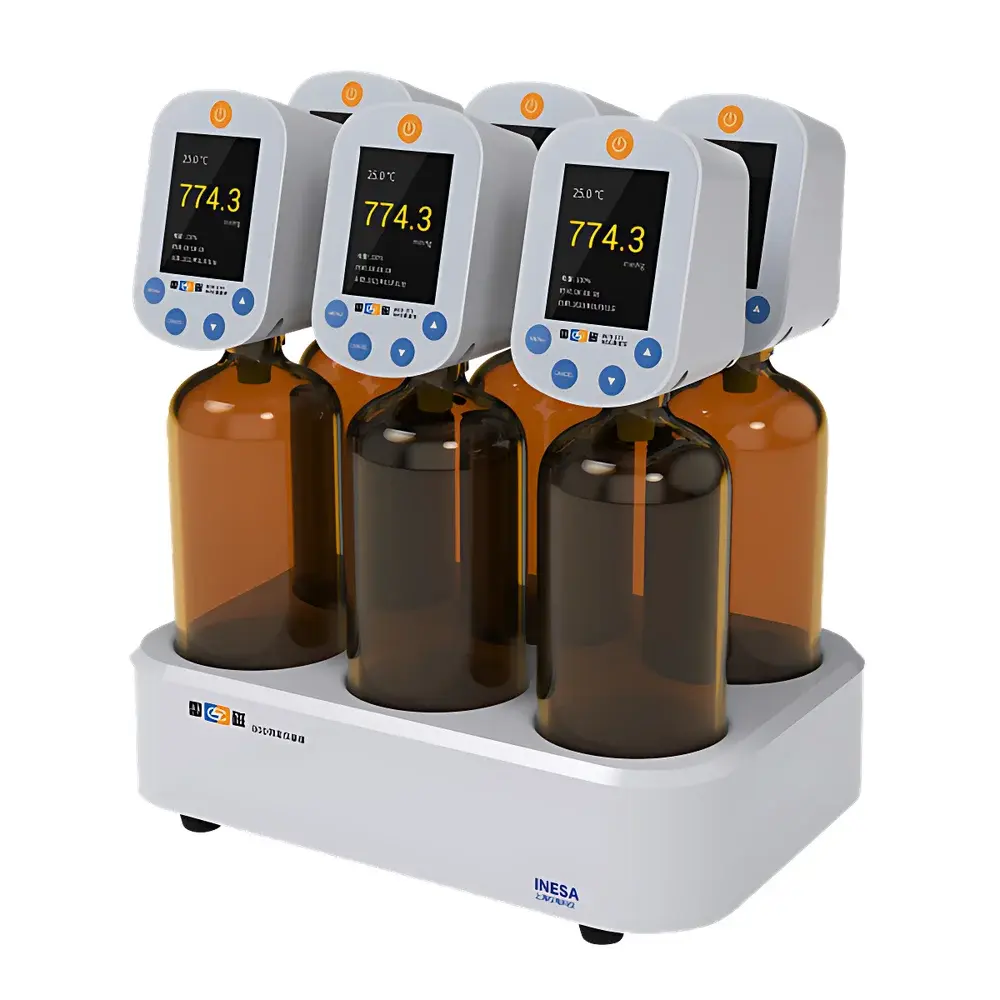
Leici BOD-573 Laboratory BOD Analyzer
| Brand | Leici |
|---|---|
| Origin | Shanghai, China |
| Manufacturer Type | Authorized Distributor |
| Country of Origin | China |
| Model | BOD-573 |
| Instrument Type | Laboratory BOD Analyzer |
| Measurement Principle | Pressure Differential Method |
| Measurement Range | 0–4000 mg/L |
| Accuracy | Complies with HJ 505–2009 for BOD₅ precision validation (glucose–glutamic acid standard solution: BOD₅ = 180–230 mg/L) |
| Sample Capacity | ≤6 samples per run |
| Incubation Duration | 1–30 days programmable |
| Data Storage | 10 years of BOD₅ result records |
| Cultivation Vessel Volume | 580 mL |
| Temperature Control | 20 ±1 °C |
| Power Supply | AC 110–220 V, 50/60 Hz |
| Rated Power | 10 W |
| Dimensions | 272 × 185 × 75 mm |
| Net Weight | 2.4 kg |
Overview
The Leici BOD-573 Laboratory BOD Analyzer is a fully automated, pressure differential-based instrument engineered for precise and compliant biochemical oxygen demand (BOD) measurement in accordance with China’s national standard HJ 505–2009. It replicates the natural aerobic biodegradation process of organic matter under controlled laboratory conditions, quantifying the dissolved oxygen consumed by microorganisms during a defined incubation period—typically 5 days (BOD₅), though configurable from 1 to 30 days. Unlike mercury-manometer systems, the BOD-573 employs a solid-state, high-stability pressure transducer to detect minute pressure differentials caused by oxygen depletion within sealed, water-saturated headspace above the sample. This non-mercury methodology eliminates toxic handling risks while maintaining metrological traceability to standardized reference materials. The system operates at a tightly regulated 20 ±1 °C using integrated Peltier-assisted thermal stabilization, ensuring reproducible microbial activity across all samples. Designed for unattended operation, it autonomously initiates timing upon temperature equilibration, logs time-series pressure data, calculates BOD concentration directly in mg/L, and stores final results without manual unit conversion.
Key Features
- Mercury-free pressure differential sensing architecture compliant with global environmental safety directives and laboratory chemical hygiene standards.
- Integrated high-resolution pressure transducer with temperature compensation and drift correction algorithms for stable long-term measurements over multi-day incubations.
- Simultaneous analysis of up to six 580 mL BOD bottles—each independently monitored via dedicated pressure channels—enabling parallel batch testing with full data segregation.
- Programmable incubation duration (1–30 days), ideal for extended BOD monitoring (e.g., BOD₂₀), low-BOD wastewater characterization, or kinetic studies requiring variable time resolution.
- Auto-start function triggered only after sample temperature stabilizes at 20 °C, minimizing thermal lag artifacts and improving inter-laboratory reproducibility.
- Onboard non-volatile memory retaining ≥10 years of BOD₅ result records—including raw pressure curves, timestamped milestones, and calibration metadata—with no external storage dependency.
- Real-time data logging with local display of current pressure differential, elapsed time, calculated BOD value, and system status—accessible during active runs or post-analysis review.
Sample Compatibility & Compliance
The BOD-573 accommodates standard 580 mL glass BOD bottles conforming to ISO 5815-1:2019 and APHA Standard Methods 5210B. It supports undiluted and diluted samples—including municipal wastewater, industrial effluents, surface water, and treated discharge—provided appropriate seed acclimation and nitrification inhibition (e.g., allylthiourea) are applied per HJ 505–2009 protocol. All measurement outputs meet the statistical precision requirements specified in HJ 505–2009 for glucose–glutamic acid (GGA) control checks (target BOD₅: 180–230 mg/L). While not certified to ISO/IEC 17025 out-of-the-box, the instrument’s deterministic pressure-to-BOD algorithm, audit-ready data logs, and user-accessible calibration history support GLP-compliant documentation workflows and internal QA/QC verification.
Software & Data Management
Data acquisition and reporting are managed entirely through the embedded firmware interface—no PC software required. Each test generates a structured dataset including: start/end timestamps, temperature profile summary, pressure decay curve (sampled at 15-min intervals), interpolated BOD values at user-defined intervals (e.g., BOD₁, BOD₃, BOD₅), and final reported BOD₅. Historical records are browsable by date, sample ID, or incubation duration; export is supported via USB flash drive in CSV format for integration into LIMS or statistical analysis platforms. Audit trails include operator login (if enabled), parameter changes, calibration events, and system error logs—all time-stamped and immutable. The system satisfies foundational elements of FDA 21 CFR Part 11 for electronic records when deployed with institutional access controls and procedural SOPs.
Applications
- Regulatory compliance testing for wastewater discharge permits (e.g., GB 8978–1996, local environmental bureau mandates).
- Performance evaluation of biological treatment units (activated sludge, MBR, trickling filters) in municipal and industrial plants.
- Environmental impact assessment (EIA) studies requiring baseline and post-intervention BOD profiling of rivers, lakes, and groundwater.
- Quality assurance in food and beverage manufacturing where process water or effluent BOD must remain below operational thresholds.
- Academic research on biodegradability kinetics, microbial community response to contaminants, and method validation studies.
FAQ
Does the BOD-573 require daily manual intervention during incubation?
No—the system operates unattended from initiation to completion. Temperature stabilization, timing, pressure acquisition, calculation, and data storage occur autonomously.
Can the instrument validate its own accuracy between runs?
Yes—users may run GGA standard checks at any time; the system compares measured BOD₅ against the accepted 180–230 mg/L range and flags deviations in the log.
Is external temperature control (e.g., incubator) needed?
No—the BOD-573 includes an integrated thermostatic chamber maintaining 20 ±1 °C across all six sample positions without auxiliary equipment.
How is data integrity ensured over multi-year deployment?
All records are written to industrial-grade flash memory with wear leveling and power-fail protection; no volatile RAM is used for permanent storage.
What maintenance is required for long-term reliability?
Annual verification of pressure sensor zero-point stability and temperature uniformity across bottle positions is recommended; no consumables or routine recalibration are mandated.
Related Products







