
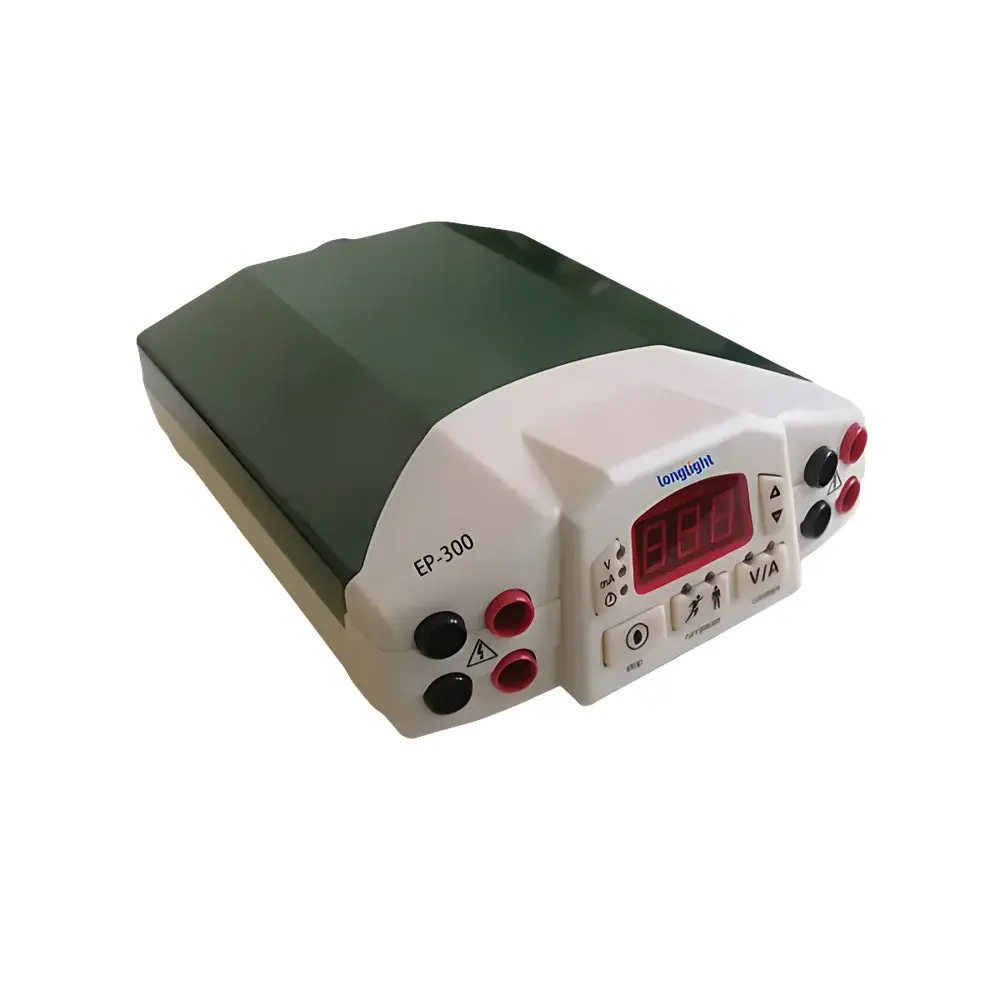
Longlight EP-300 Electrophoresis Power Supply
| Brand | Longlight |
|---|---|
| Model | EP-300 |
| Output Modes | Constant Voltage / Constant Current |
| Timer Range | 0–999 min |
| Max Output | 300 V / 400 mA / 120 W |
| Input Voltage | 100–240 V AC, 50/60 Hz |
| Safety Features | Overload, Overheat, and Short-Circuit Protection |
| Memory Function | Yes |
| Multi-Channel Capability | Supports up to four identical electrophoresis tanks simultaneously |
| Compliance | CE, RoHS, ISO 9001-certified manufacturing |
Overview
The Longlight EP-300 Electrophoresis Power Supply is a microprocessor-controlled, dual-mode DC power source engineered for precision and reliability in nucleic acid and protein separation workflows. Based on regulated switching power supply architecture, it delivers stable, low-ripple DC output essential for reproducible electrophoretic mobility across agarose, polyacrylamide, and SDS-PAGE gels. Its design adheres to fundamental electrophoresis principles—where migration velocity of charged biomolecules is directly proportional to applied electric field strength (V/cm) and inversely related to matrix resistance—ensuring consistent band resolution and transfer efficiency in both slab-gel and capillary formats. The EP-300 serves as a core component in molecular biology laboratories performing routine DNA fragment analysis, plasmid verification, PCR product validation, Western blotting, and Southern/Northern hybridization protocols.
Key Features
- Dual operating modes: User-selectable constant voltage (0–300 V) or constant current (0–400 mA), enabling optimal control for diverse gel matrices and buffer systems.
- Precision digital timer with 1-second resolution and programmable range from 1 second to 999 minutes, supporting overnight runs and multi-step protocols.
- Intelligent fault detection system: Real-time monitoring of open circuit, short circuit, overcurrent, and thermal overload conditions, with automatic shutdown and on-screen error codes (e.g., “E01”, “E03”).
- Non-volatile parameter memory: Automatically stores last-used settings—including mode, setpoint values, and timer—and restores them at power-on, minimizing setup time between experiments.
- Multi-tank capability: Simultaneous operation of up to four identical electrophoresis units under synchronized output parameters, improving throughput in high-volume teaching or QC labs.
- Universal AC input compatibility: Auto-ranging 100–240 V AC, 50/60 Hz input eliminates need for external transformers when deployed globally.
- Robust mechanical construction: High-impact ABS housing with UV-stabilized polymer formulation ensures resistance to common laboratory solvents (e.g., ethanol, acetic acid), mechanical shock, and long-term environmental aging.
Sample Compatibility & Compliance
The EP-300 is validated for use with standard horizontal (e.g., mini-submarine, large-format agarose) and vertical electrophoresis systems (e.g., Mini-PROTEAN, SE 250, Hoefer Mighty Small), as well as semi-dry and wet-tank blotting apparatuses. It supports common electrophoresis buffers including TAE, TBE, Tris-Glycine, and SDS-PAGE running buffers without output drift or waveform distortion. All electrical safety and electromagnetic compatibility (EMC) designs conform to IEC 61010-1:2010 (Safety Requirements for Electrical Equipment for Measurement, Control, and Laboratory Use) and EN 61326-1:2013 (EMC for Laboratory Equipment). Manufacturing follows ISO 9001:2015 quality management standards; CE marking and RoHS 2011/65/EU compliance are documented in the technical file.
Software & Data Management
While the EP-300 operates as a standalone instrument without proprietary software dependency, its parameter logging and error reporting support integration into GLP/GMP-compliant environments. All operational events—including mode selection, setpoint changes, timer activation, and fault triggers—are timestamped and retained in non-volatile memory for post-run review. When connected to lab information management systems (LIMS) via optional RS-232 or USB-to-serial interface (adapter sold separately), output logs can be exported in CSV format for audit trail generation. The device meets foundational requirements for FDA 21 CFR Part 11 compliance when used in conjunction with validated electronic record procedures—specifically regarding operator authentication, data integrity, and change control documentation.
Applications
- Routine agarose gel electrophoresis for DNA sizing (100 bp–20 kb), restriction digest analysis, and plasmid isolation QC.
- Polyacrylamide gel electrophoresis (PAGE) and SDS-PAGE for protein molecular weight determination, purity assessment, and sample normalization prior to mass spectrometry.
- Electroblotting (wet, semi-dry, and tank transfer) for immobilizing nucleic acids or proteins onto nitrocellulose or PVDF membranes.
- Two-dimensional electrophoresis (2D-PAGE) first-dimension IEF focusing when paired with compatible IPG strips and carrier ampholyte systems.
- Teaching laboratories requiring robust, intuitive instrumentation with fail-safe operation for undergraduate and graduate molecular biology courses.
FAQ
Does the EP-300 support constant power (W) mode?
No. The EP-300 operates exclusively in constant voltage and constant current modes, consistent with standard electrophoresis practice where field strength or current density—not total power—is the primary controlled variable.
Can I connect multiple different types of electrophoresis tanks simultaneously?
The EP-300 is designed to drive up to four *identical* tanks under matched electrical load conditions. Connecting dissimilar tanks (e.g., horizontal + vertical) may result in unequal current distribution and compromised run consistency.
Is remote control or computer interface included?
No built-in Ethernet or USB host interface is provided. Optional RS-232 connectivity is available via accessory cable; third-party LabVIEW or Python-based control scripts require external serial adapters and custom driver development.
What maintenance is required for long-term reliability?
No periodic calibration is needed. Routine cleaning of ventilation grilles and terminal posts with isopropyl alcohol is recommended. Internal capacitor aging is mitigated by derated thermal design; mean time between failures (MTBF) exceeds 50,000 hours under continuous operation at ≤80% rated load.
How does the EP-300 handle buffer conductivity changes during extended runs?
The microprocessor continuously monitors output impedance and adjusts pulse-width modulation (PWM) duty cycle to maintain setpoint accuracy within ±1.5% of full scale, even as electrolyte concentration shifts due to Joule heating or evaporation.






