
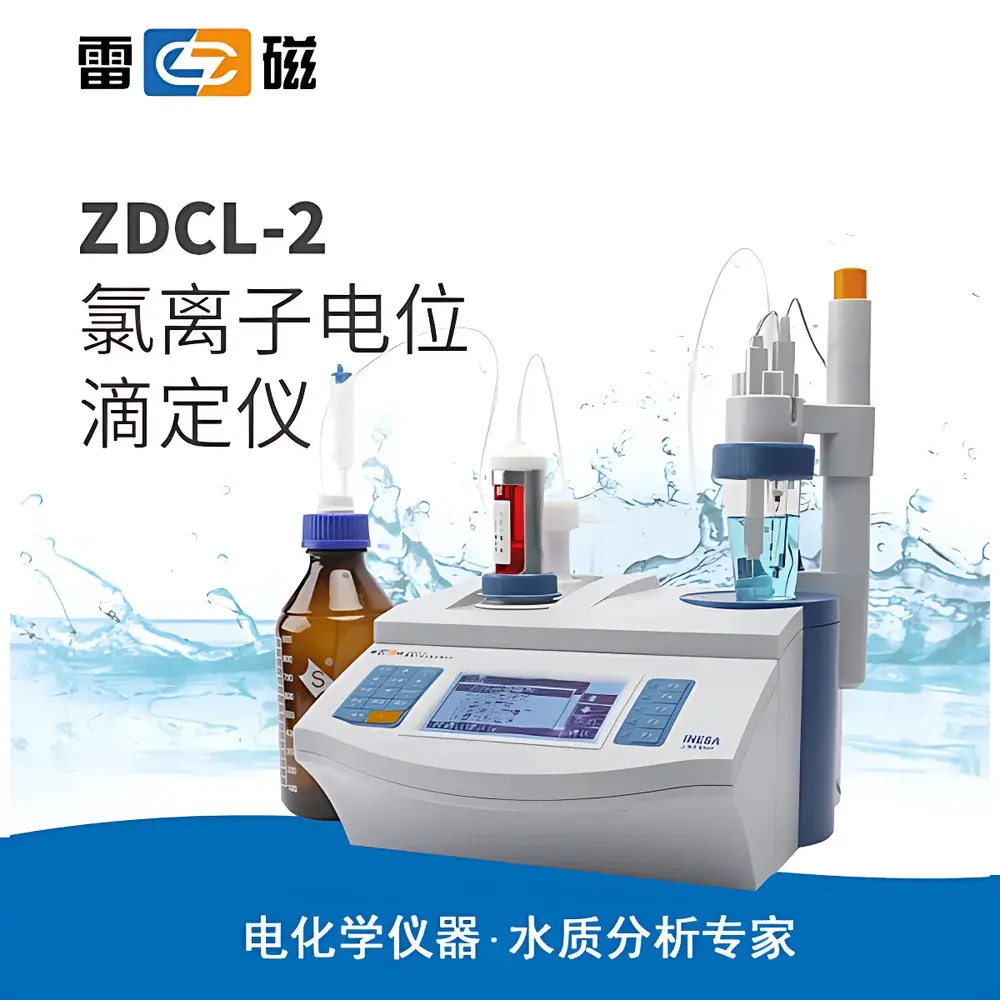
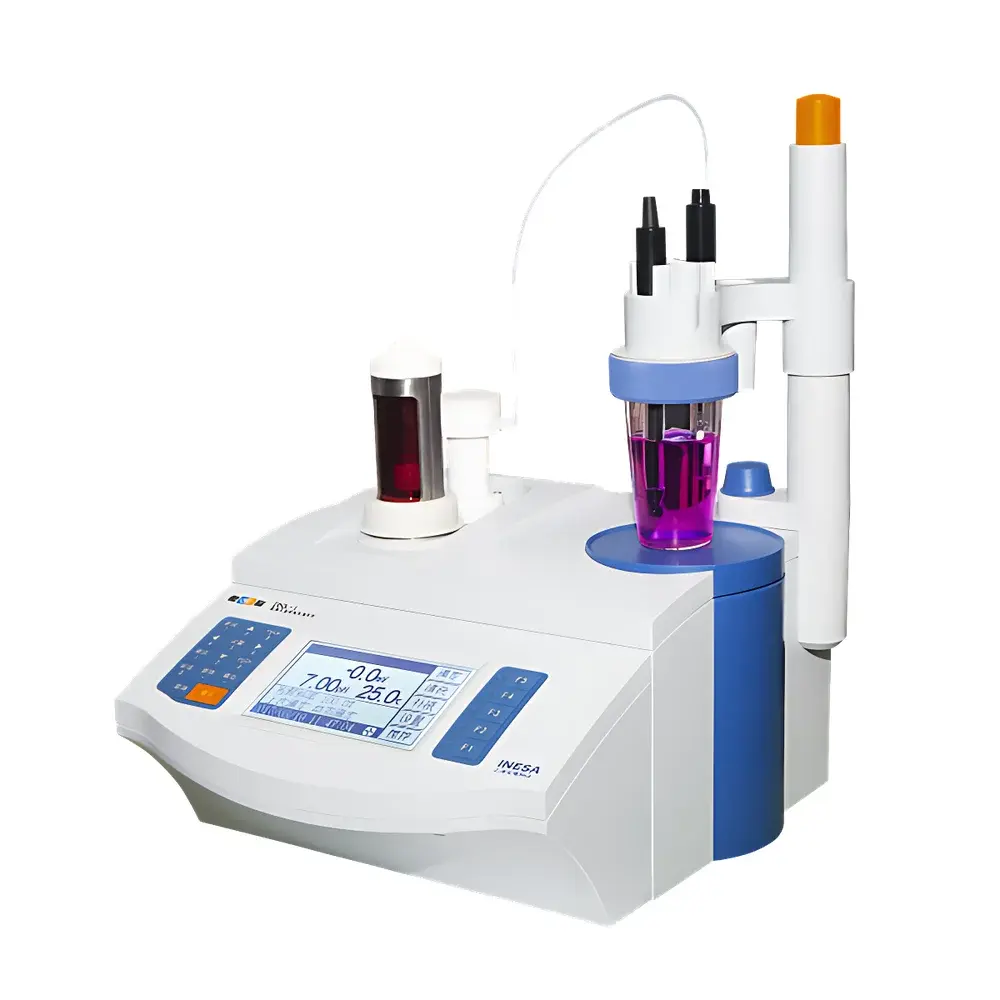
Leichi ZDCL-2 Chloride Ion Potentiometric Titrator
| Brand | Leichi |
|---|---|
| Origin | Shanghai, China |
| Model | ZDCL-2 |
| Measurement Range | (−1800.0 to +1800.0) mV |
| Potential Resolution | 0.1 mV |
| Potential Accuracy | ±0.2 mV |
| Stability | (±0.3 mV ±1 digit)/3 h |
| Titration Resolution | 1/10000 (for 10 mL burette) |
| Titration Precision | ≤0.20% RSD |
| Burette Error | ±0.025 mL (10 mL), ±0.035 mL (20 mL) |
| Temperature Compensation Range | (−5.0 to 105.0) °C, Resolution: 0.1 °C, Accuracy: ±0.3 °C |
| Interface | RS232 |
| Data Storage | 200 titration results + 1 full dataset |
| Compliance | GB/T 176–2017, GB/T 8077–2012, GB 50344–2004, JGJ/T 322–2013 |
Overview
The Leichi ZDCL-2 Chloride Ion Potentiometric Titrator is a dedicated electrochemical analyzer engineered for high-reproducibility potentiometric titration of chloride ions in construction materials and related aqueous matrices. It operates on the principle of silver nitrate (AgNO₃) titration with a silver/silver chloride (Ag/AgCl) reference electrode and a chloride-selective indicator electrode, detecting the endpoint via a sharp potential inflection in the titration curve (first derivative or Gran plot method). Designed specifically for compliance-driven environments in cement, concrete admixture, and structural material testing laboratories, the ZDCL-2 implements standardized potentiometric detection protocols without requiring user-defined calibration curves—ensuring traceable, method-locked measurements aligned with Chinese national standards. Its microprocessor-controlled architecture integrates real-time potential monitoring, dynamic curve visualization, and automated endpoint recognition, minimizing operator dependency while maintaining metrological integrity across routine batch analysis.
Key Features
- Dedicated chloride ion assay mode pre-configured to GB/T 176–2017 (cement), GB/T 8077–2012 (concrete admixtures), GB 50344–2004 (structural inspection), and JGJ/T 322–2013 (chloride quantification in hardened concrete)
- Integrated dual-mode operation: chloride content determination and AgNO₃ standard solution standardization—including automatic blank correction and reagent titer validation
- High-resolution potentiometric measurement system with ±0.2 mV absolute accuracy, 0.1 mV resolution, and long-term stability of (±0.3 mV ±1 digit)/3 h
- Ultra-precise burette drive mechanism offering 1/10000 resolution (10 mL burette) and volumetric accuracy per ISO 385:2005 (±0.025 mL at 10 mL full scale)
- Onboard temperature compensation (−5.0 to 105.0 °C; 0.1 °C resolution; ±0.3 °C accuracy) to correct for thermal drift in electrode potential and solution conductivity
- RS232 serial interface supporting direct connection to external printers for GLP-compliant hardcopy output of titration reports, including timestamp, sample ID, endpoint volume, mV curve, and calculated Cl⁻ concentration (mg/kg or %)
Sample Compatibility & Compliance
The ZDCL-2 is validated for use with solid and semi-solid construction samples requiring acid digestion or water extraction prior to titration—including Portland cement, blended cements, liquid and powdered concrete admixtures, fresh and hardened concrete cores, and mortar specimens. Sample preparation follows prescribed leaching procedures outlined in referenced GB standards to ensure representative chloride dissolution and minimize interference from sulfides, bromides, or iodides. The instrument’s fixed-method firmware enforces procedural adherence—preventing parameter override during analysis—and supports full audit trails required under GLP (Good Laboratory Practice) frameworks. While not certified to FDA 21 CFR Part 11, its data storage architecture (200 result sets + one complete raw dataset per session), time-stamped records, and immutable endpoint identification meet foundational requirements for regulated quality control labs operating under ISO/IEC 17025 or internal QA/QC protocols.
Software & Data Management
The ZDCL-2 operates via embedded firmware—not PC-dependent software—eliminating version control issues and ensuring deterministic behavior across deployments. All measurement metadata (date/time, operator ID, sample code, electrode type, burette volume, temperature, raw mV vs. volume points, first-derivative peak location, final Cl⁻ result) are stored internally in non-volatile memory. Users may review, export (via RS232), or print historical results; selective deletion is permitted but leaves no residual fragments. Data fields conform to minimum reporting elements defined in GB/T 27417–2017 (Guidance on uncertainty evaluation in chemical testing), facilitating integration into LIMS environments where ASCII-delimited output is accepted. No proprietary file formats or cloud dependencies are introduced—data remains fully human-readable and instrument-agnostic.
Applications
- Quantitative determination of soluble chloride ion concentration in cement clinker and finished cement products per GB/T 176–2017 Section 10
- Chloride content verification in high-performance concrete admixtures (e.g., corrosion inhibitors, accelerators) per GB/T 8077–2012 Annex C
- In-field and laboratory assessment of chloride ingress in structural concrete cores per JGJ/T 322–2013, supporting durability evaluation and service-life modeling
- Quality assurance testing of grouts, repair mortars, and precast concrete elements where chloride-induced reinforcement corrosion must be excluded
- Standardization of silver nitrate titrant solutions used across multiple titration platforms, with built-in blank correction to eliminate systematic error from impurities or electrode drift
FAQ
What electrode configuration is required for ZDCL-2 operation?
The instrument requires a combined silver/silver chloride reference electrode and a chloride-selective indicator electrode (e.g., Ag/AgCl double-junction or solid-state Cl⁻ sensor); compatibility with common industry electrodes meeting DIN 19263 specifications is confirmed.
Does the ZDCL-2 support multi-point calibration or custom titration methods?
No—it is a fixed-method instrument optimized exclusively for chloride ion titration per specified GB standards; no user-programmable methods or calibration curves are available.
Can the ZDCL-2 be integrated into a networked laboratory environment?
It lacks Ethernet or USB host capability; only RS232 serial communication is provided for point-to-point printer or terminal connection.
Is temperature compensation mandatory during analysis?
Yes—temperature input is required before each titration cycle to apply Nernst equation corrections; omission triggers a warning and prevents result calculation.
How is data integrity ensured during power interruption?
Critical measurement data (endpoint volume, mV values, timestamps) are written to flash memory incrementally; partial titrations retain recoverable intermediate states upon restart.






