
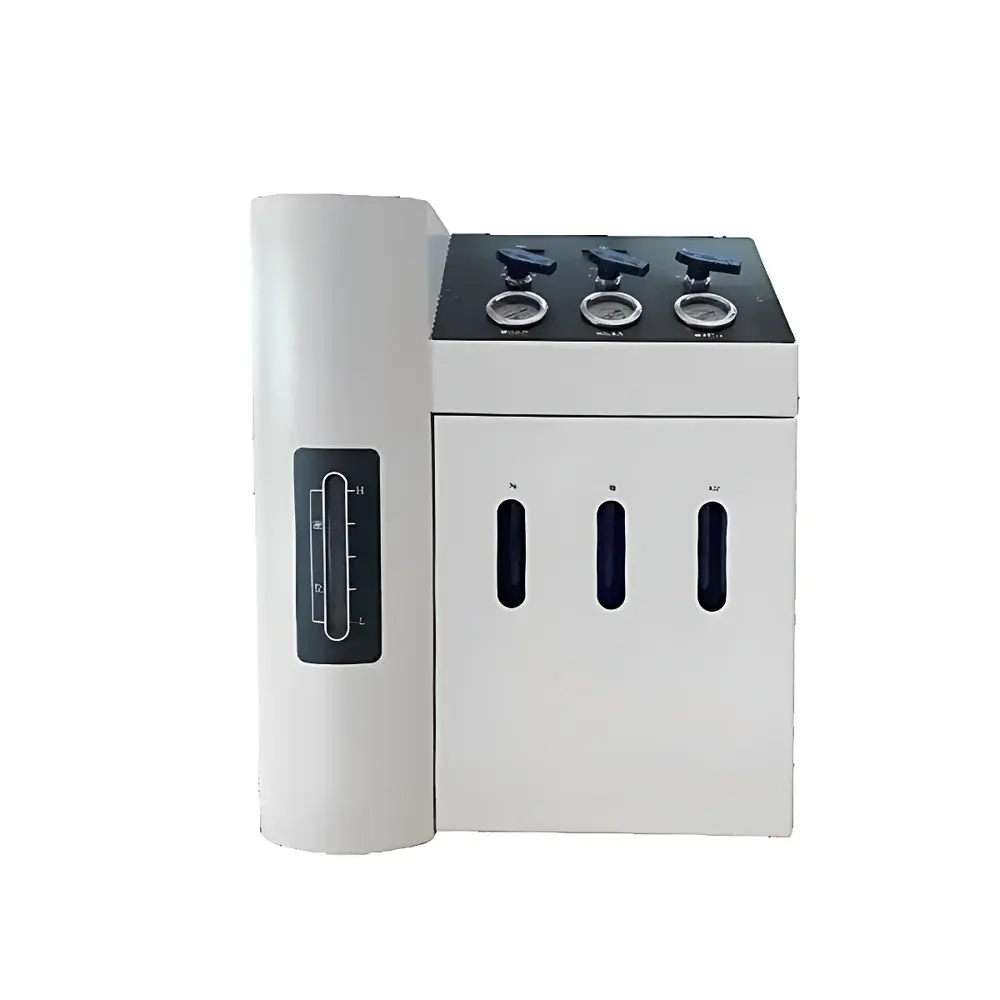
XIUILAB XGT-300 / XGT-500 Nitrogen-Hydrogen-Air Integrated Gas Generator
| Brand | XIUILAB |
|---|---|
| Origin | Shanghai, China |
| Model | XGT-300 / XGT-500 |
| Output Pressure | 0.4 MPa |
| Nitrogen Purity | 99.99% (O₂ < 100 ppm) |
| Hydrogen Purity | 100.00% (O₂-free, oil-free) |
| Air Purity | Oil-free, Class 3 compressed air per ISO 8573-1 |
| N₂ Flow Range | 0–300 mL/min (XGT-300) / 0–500 mL/min (XGT-500) |
| H₂ Flow Range | 0–300 mL/min (XGT-300) / 0–500 mL/min (XGT-500) |
| Air Flow Range | 0–2 L/min (XGT-300) / 0–5 L/min (XGT-500) |
| Power Supply | 220 V ±10%, 50 Hz |
| Max. Power Consumption | 350 W (XGT-300) / 450 W (XGT-500) |
| Operating Temperature | 0–45 °C |
| Relative Humidity | <85% RH (non-condensing) |
| Dimensions (L×W×H) | 500 × 400 × 450 mm |
| Weight | 40 kg (XGT-300) / 42 kg (XGT-500) |
| Pressure Stability | ≤ ±0.01 MPa |
Overview
The XIUILAB XGT-300 and XGT-500 are compact, integrated gas generators engineered to supply high-purity nitrogen, hydrogen, and zero-air simultaneously from ambient air and deionized water—eliminating the need for high-pressure gas cylinders in analytical laboratories. These systems operate on three parallel, independently controlled electrochemical and membrane separation principles: pressure swing adsorption (PSA) for nitrogen generation, proton exchange membrane (PEM) electrolysis for hydrogen production, and multi-stage oil-free compression with desiccant and carbon filtration for clean, dry air. Designed for continuous operation in GC-FID, GC-TCD, GC-MS, and elemental analyzers, the XGT series delivers stable, on-demand gases at a regulated 0.4 MPa output pressure—optimized for compatibility with standard pneumatic interfaces of major instrument OEMs including Agilent, Thermo Fisher, Shimadzu, and PerkinElmer.
Key Features
- Triple-gas integration: Simultaneous, independent control of N₂, H₂, and zero-air outputs via dedicated flow regulators and digital pressure monitoring.
- Electrochemical hydrogen generation: PEM-based electrolyzer produces 100.00% pure, oil-free H₂ with no metal catalyst leaching or alkaline electrolyte contamination—critical for flame ionization detectors (FID) and reducing gas applications.
- PSA nitrogen module: Carbon molecular sieve (CMS) technology achieves 99.99% N₂ purity (O₂ ≤ 100 ppm), verified by built-in electrochemical oxygen sensor and traceable calibration protocol.
- Zero-air system: Three-stage filtration (particulate → activated carbon → desiccant) ensures ISO 8573-1 Class 3 air quality (≤ 0.1 µm particles, ≤ 0.1 mg/m³ oil aerosol, dew point ≤ −40 °C).
- Real-time stability assurance: Pressure regulation accuracy maintained within ±0.01 MPa under dynamic load conditions; flow consistency validated per ISO 6145-7 for gas mixing applications.
- Compact benchtop architecture: All-in-one housing (500 × 400 × 450 mm) minimizes footprint while accommodating internal heat dissipation and acoustic dampening for low-noise (<55 dB(A)) operation.
Sample Compatibility & Compliance
The XGT-300/XGT-500 is designed for use with gas chromatography detectors requiring carrier, fuel, and make-up gases—including FID (H₂ + air), TCD (N₂ or H₂ carrier), ECD (high-purity N₂), and MS transfer lines (N₂ curtain gas). It meets essential safety and performance benchmarks for laboratory gas supply: CE marking per Machinery Directive 2006/42/EC and Low Voltage Directive 2014/35/EU; compliance with IEC 61010-1 for electrical safety in measurement/control equipment; and adherence to ISO/IEC 17025:2017 requirements for in-house gas purity verification protocols. While not certified to FDA 21 CFR Part 11, the generator supports GLP/GMP workflows through documented maintenance logs, pressure/flow audit trails (via optional RS-232/USB data export), and traceable calibration certificates for O₂ sensors.
Software & Data Management
The XGT series incorporates an embedded microcontroller with dual-mode interface: LED status panel (real-time pressure, flow, fault codes) and optional PC connectivity via USB or RS-232. Firmware v2.1 enables time-stamped event logging (startup/shutdown, pressure deviations >±0.005 MPa, filter saturation alerts), exportable as CSV for integration into LIMS or electronic lab notebooks (ELN). No proprietary software is required; configuration is performed via physical push-button menu navigation. All operational parameters—including default H₂ pressure setpoint (factory-fixed at 0.4 MPa per UL 2201 compliance)—are locked to prevent unauthorized modification, ensuring consistent gas delivery across shifts and users.
Applications
- Gas chromatography: N₂ as carrier gas for TCD and ECD; H₂ as fuel gas for FID; zero-air as combustion air for FID and oxidant in chemiluminescence NOx analyzers.
- Elemental analysis: High-purity H₂ for reduction furnaces (e.g., CHNS/O analyzers); N₂ purge gas for thermal conductivity cells.
- Calibration gas blending: Stable, metered N₂/H₂/air streams serve as base gases for dynamic dilution systems (e.g., permeation tubes, mass flow controllers).
- QA/QC labs: Eliminates cylinder logistics, rental fees, and hydrostatic testing overhead—reducing total cost of ownership (TCO) by >60% over 5 years versus bulk gas contracts.
- Teaching laboratories: Safe, transparent gas generation platform for demonstrating electrochemical and adsorption separation fundamentals.
FAQ
Is hydrogen generation safe in standard laboratory environments?
Yes. The PEM electrolyzer operates below 2 bar internal pressure, includes redundant overpressure relief valves (set at 0.55 MPa), automatic shutdown on electrolyte level drop or temperature excursion (>55 °C), and complies with EN 62282-5-1 for stationary fuel cell safety.
Can the nitrogen purity be verified without external analyzers?
Yes. Each unit integrates an electrochemical O₂ sensor (0–1000 ppm range, ±5% FS accuracy) with auto-zeroing cycle; raw sensor output and alarm thresholds are accessible via serial command protocol.
What maintenance intervals are recommended?
Desiccant and particulate filters require replacement every 6 months under continuous use; CMS columns are rated for 15,000 hours; PEM stacks carry a 2-year limited warranty. Full service history tracking is supported via QR-coded consumables and firmware log export.
Does the system support variable flow demand from multiple instruments?
Yes. Independent mass flow control per gas line accommodates simultaneous draw from up to three instruments (e.g., one GC-FID + one GC-TCD + one TOC analyzer), with pressure hold capability during transient flow changes.



