
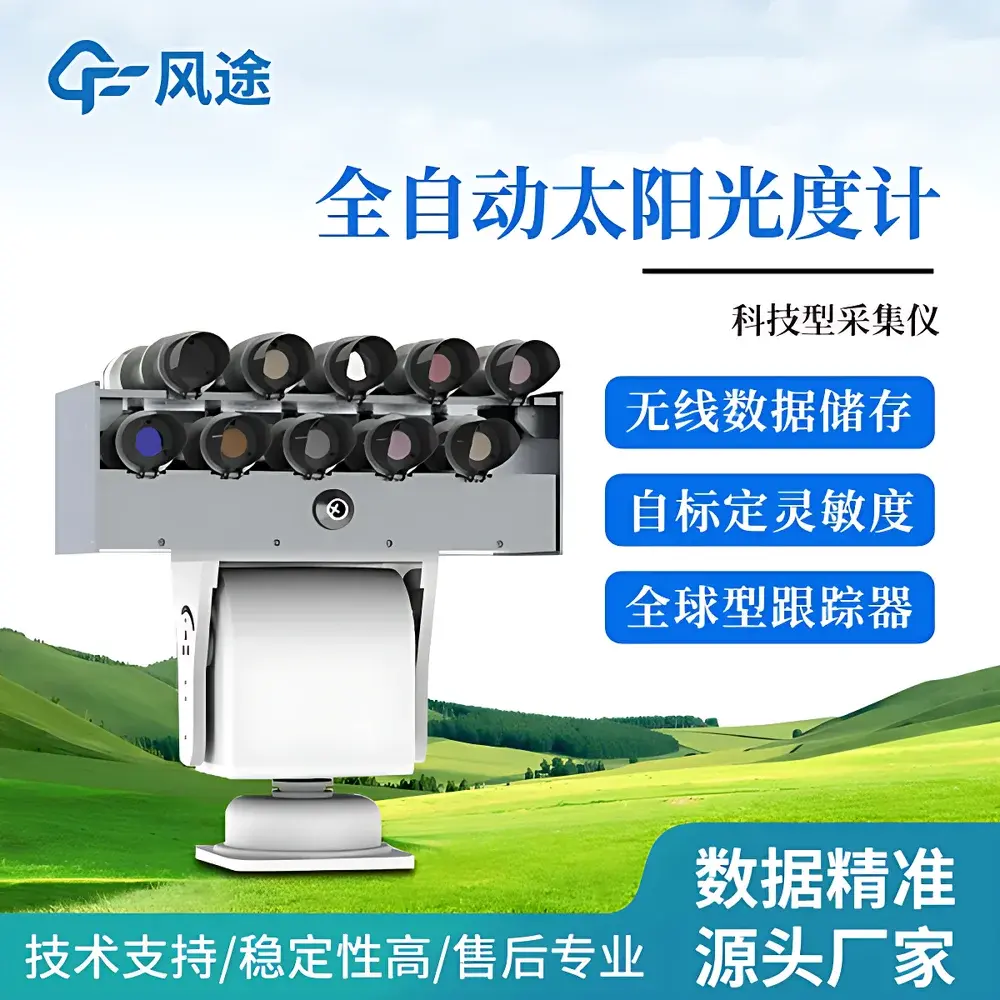
Fengtu FT-GD1 Fully Automated Sun Photometer / Multi-Band Solar Spectroradiometer
| Brand | Fengtu |
|---|---|
| Origin | Shandong, China |
| Manufacturer Type | Authorized Distributor |
| Country of Manufacture | China |
| Model | FT-GD1 |
| Price | USD 10,800 (FOB) |
Overview
The Fengtu FT-GD1 Fully Automated Sun Photometer is a field-deployable, multi-band solar spectroradiometer engineered for continuous, unattended measurement of spectral solar irradiance across ten discrete wavelength channels. Operating on the principle of filtered thermopile detection, the instrument combines precision optical bandpass filters with calibrated thermopile sensors to quantify direct normal irradiance (DNI), global horizontal irradiance (GHI), diffuse horizontal irradiance (DHI), albedo, photosynthetically active radiation (PAR), ultraviolet A/B irradiance (UVA/UVB), and net all-wave radiation. Designed for long-term outdoor deployment in meteorological observatories, solar resource assessment sites, atmospheric research stations, and photovoltaic (PV) performance monitoring platforms, the FT-GD1 delivers traceable, physically consistent radiometric data aligned with ISO 9060:2018 classification for secondary standard pyranometers and pyrheliometers. Its architecture supports autonomous operation under variable environmental conditions—enabling high-temporal-resolution spectral monitoring without manual intervention or scheduled recalibration cycles.
Key Features
- Multi-spectral band detection: Simultaneous acquisition across ten user-defined spectral bands (e.g., 305 nm, 340 nm, 380 nm, 415 nm, 500 nm, 670 nm, 780 nm, 870 nm, 940 nm, 1020 nm), each equipped with narrowband interference filters and NIST-traceable thermopile detectors.
- Integrated sun-tracking system: Dual-axis, GPS-synchronized automatic solar tracker compliant with IEC 61724-1:2021 Annex B; operational across latitudes ±60°, temperature range −40 °C to +60 °C, with pointing accuracy ≤0.1° RMS.
- Embedded data acquisition unit: 32-bit ARM Cortex-M7 MCU with onboard high-precision GPS timing (±10 ms UTC sync), GPRS cellular telemetry, and Bluetooth 5.0 for local configuration and firmware updates.
- Self-calibration capability: Onboard reference channel and temperature-compensated gain correction algorithm enables automated sensitivity drift compensation—reducing dependency on biennial laboratory recalibration per JJG 458–1996 and supporting ISO/IEC 17025-compliant uncertainty budgets.
- Dual-power architecture: Automatic switchover between AC 220 V (50 Hz) and DC 12 V input with intelligent power management, including low-voltage cutoff, surge protection, and battery-backed real-time clock.
- Modular mechanical design: Integrated mounting frame with pre-aligned sensor ports, quick-release leveling base, and corrosion-resistant anodized aluminum housing rated IP67 for dust/water ingress protection.
Sample Compatibility & Compliance
The FT-GD1 is validated for outdoor deployment in diverse climatic zones—from arid deserts to humid subtropical regions—and meets structural and electrical safety requirements per IEC 61000-6-2 (immunity) and IEC 61000-6-4 (emissions). Radiometric calibration adheres to ASTM E892–22 (Standard Test Method for Spectral Irradiance Measurements) and supports data traceability to WRR (World Radiometric Reference) via factory-applied calibration coefficients. The system’s data output format conforms to CF Standard Names (Climate and Forecast Metadata Conventions) and is compatible with PVsyst, SAM (System Advisor Model), and NOAA SURFRAD ingestion pipelines. All firmware and cloud communication protocols comply with IEC 62443-3-3 for industrial cybersecurity baseline requirements.
Software & Data Management
Data is stored locally on removable microSD card (up to 128 GB) with timestamped binary logging at user-configurable intervals (1 s to 15 min). GPRS transmission supports MQTT and HTTP(S) protocols for secure push to private or public cloud platforms—including Fengtu’s proprietary SolarInsight™ analytics portal, which provides real-time anomaly detection, spectral ratio trending (e.g., UV/visible, NIR/visible), and automated QA/QC flagging per BSRN (Baseline Surface Radiation Network) criteria. Audit trails, user access logs, and electronic signatures satisfy FDA 21 CFR Part 11 requirements for regulated solar performance reporting. Firmware updates are delivered over-the-air with cryptographic signature verification.
Applications
- Solar resource assessment for utility-scale photovoltaic plant siting and yield modeling
- Atmospheric aerosol optical depth (AOD) retrieval using Langley plot methodology at multiple wavelengths
- Validation of satellite-derived surface irradiance products (e.g., CERES, CAMS, NSRDB)
- Long-term climate monitoring of UV index trends and stratospheric ozone proxy signals
- Photosynthetic photon flux density (PPFD) quantification for agrivoltaic system optimization
- Calibration transfer and intercomparison campaigns among ground-based radiometric networks
FAQ
What spectral resolution does the FT-GD1 achieve?
The instrument uses fixed interference filters with full width at half maximum (FWHM) bandwidths ranging from 2 nm (UV) to 10 nm (NIR), optimized for signal-to-noise ratio rather than continuous scanning.
Is the tracker compatible with third-party data loggers?
Yes—the tracker controller exposes Modbus RTU over RS-485, enabling integration with Campbell Scientific CR-series, Delta-T DL6, or other industry-standard loggers.
How often must the system be recalibrated?
Factory calibration is valid for 24 months under typical field conditions; the onboard self-correction function extends effective calibration stability by up to 6 months beyond that interval, per JJG 458–1996 guidance.
Does the system support remote firmware updates?
Yes—secure OTA updates are supported via GPRS or Bluetooth, with SHA-256 signature validation and rollback capability.
Can raw thermopile voltage outputs be accessed for custom processing?
Yes—binary data files include unscaled sensor voltages, ambient temperature, tracker azimuth/elevation, and GPS metadata, enabling full metrological reprocessing.







