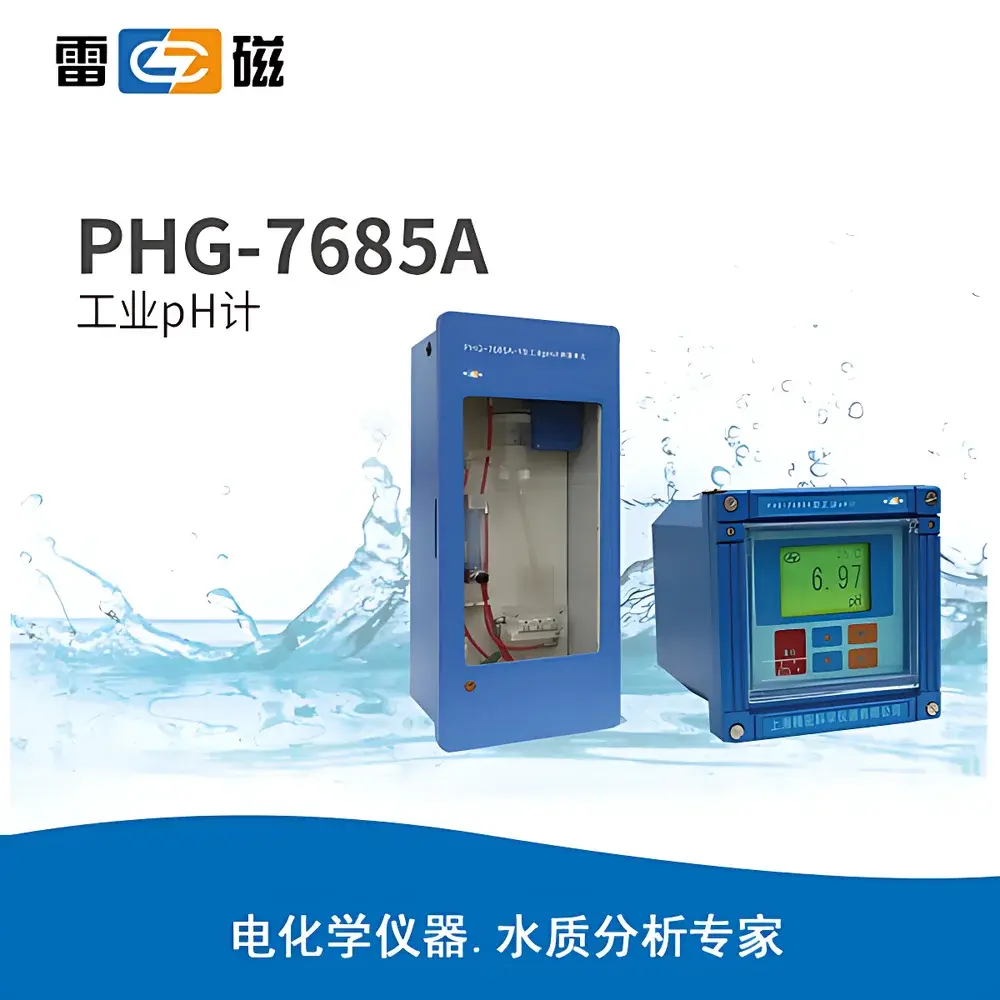
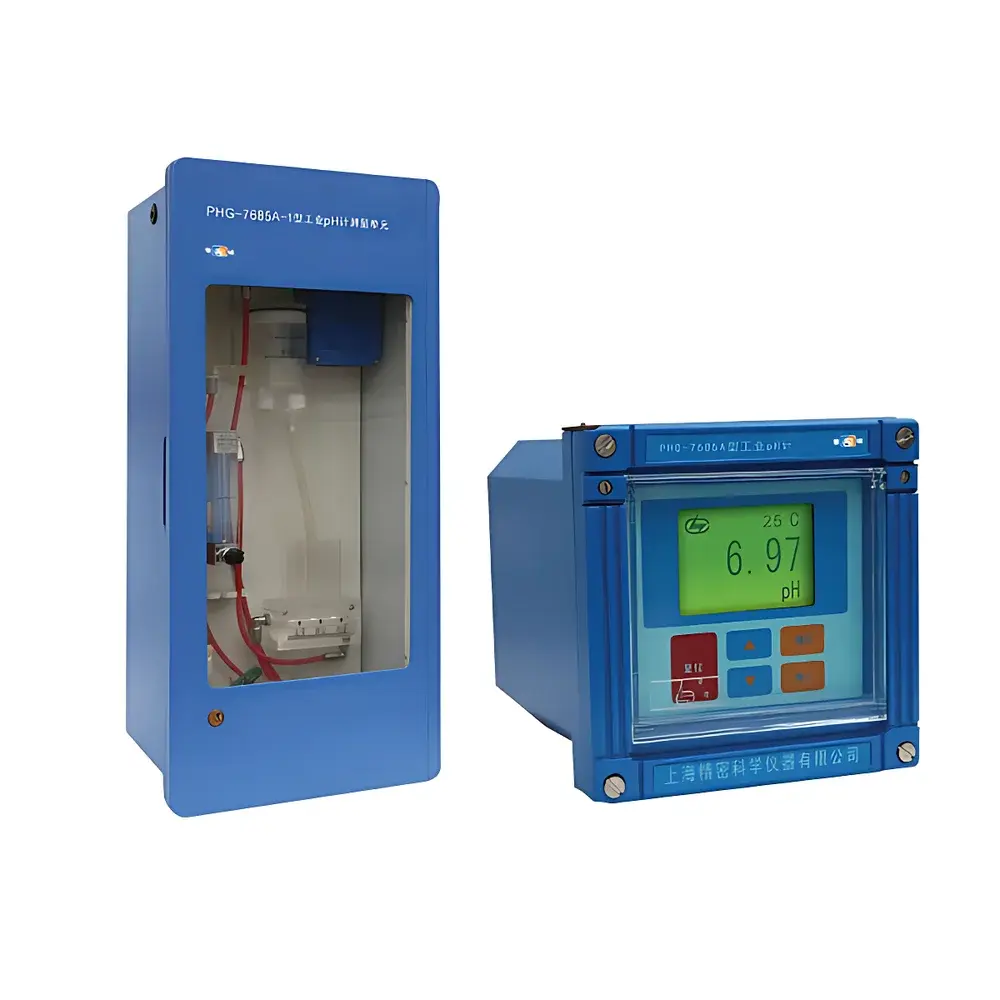
Leici PHG-7685A Online pH Meter for High-Purity Water Applications
| Key | Brand: Leici |
|---|---|
| Model | PHG-7685A |
| Measurement Range | 0.00–14.00 pH |
| Resolution | 0.01 pH |
| Accuracy | ±0.05 pH ±1 digit |
| Temperature Range | −10.0–120.0 °C |
| Temp. Resolution | 0.1 °C |
| Temp. Accuracy | ±0.5 °C (0.0–60.0 °C), ±1.0 °C (others) |
| Repeatability | 0.02 pH |
| Electronic Unit Error | ±0.03 pH ±1 digit |
| Stability | ≤±0.02 pH/24 h |
| Input Impedance | ≥1×10¹² Ω |
| Input Current | ≤2×10⁻¹² A |
| Output | 4–20 mA isolated analog output, RS-232 or RS-485 (user-selectable) |
| Enclosure Rating | IP65 |
| Power Supply | AC 220 V ±10 %, 50 Hz ±1 % |
| Dimensions | 628 × 288 × 224 mm |
| Weight | 10 kg |
Overview
The Leici PHG-7685A is an industrial-grade online pH meter engineered specifically for continuous, high-stability measurement in ultra-low-conductivity water systems. Designed around a high-input-impedance differential amplifier architecture and optimized electrode interface circuitry, it employs potentiometric measurement principles compliant with ISO 3696 (Grade 1 water specifications) and ASTM D1125 for pH determination in purified water streams. Its core application domain includes boiler feedwater, condensate, saturated steam, and drum water in thermal power plants—environments where conventional pH sensors suffer from unstable junction potentials, slow response, and calibration drift due to low ionic strength (<10 µS/cm). The instrument integrates dual-mode operation (pure water mode and ammonia-containing water mode), enabling automatic selection of reference electrode compensation algorithms and temperature-dependent Nernst slope correction to minimize liquid junction error and maintain traceable accuracy under dynamic process conditions.
Key Features
- High-impedance input circuitry (≥1×10¹² Ω) with ultra-low input current (≤2 pA) ensures minimal loading effect on high-resistance glass electrodes used in low-conductivity applications.
- Dual operational modes: Pure water mode applies enhanced asymmetric potential compensation; ammonia water mode adjusts for NH₃/NH₄⁺ buffer interference and non-linear temperature response.
- Backlit graphical LCD with Chinese-language interface supports intuitive navigation, real-time trend display, and multi-level parameter configuration without external software.
- Auto-temperature compensation (ATC) using Pt1000 sensor input with ±0.3 °C electronic unit accuracy and full-range validation per IEC 60751 Class B.
- Configurable 4–20 mA isolated analog output with user-defined pH span mapping (e.g., 4 mA = 5.00 pH, 20 mA = 9.00 pH), supporting integration into DCS/PLC systems with SIL 2 compatibility.
- RS-232 or RS-485 serial communication (jumper-selectable) enables Modbus RTU protocol for remote monitoring, data logging, and firmware updates via standard industrial gateways.
- IP65-rated NEMA 4X enclosure provides dust-tight and water-jet resistant protection suitable for installation in turbine halls, chemical dosing rooms, and outdoor meter skids.
- Built-in alarm logic supports programmable high/low pH limits with relay dry-contact outputs, plus non-volatile memory retention during power interruption (≥10 years data backup).
Sample Compatibility & Compliance
The PHG-7685A is validated for use with standard combination pH electrodes featuring double-junction reference systems and low-resistance glass membranes (e.g., Leici E-201-C, Hamilton H341, or Mettler Toledo InPro 3253). It meets the electrical safety requirements of GB 4793.1–2019 (equivalent to IEC 61010-1) and electromagnetic compatibility per GB/T 18268.1–2010 (IEC 61326-1). For regulated environments, its analog output stability (≤±0.02 pH/24 h) and calibration traceability support GLP-compliant recordkeeping when paired with documented electrode calibration procedures per USP and EP 2.2.3. The device does not include FDA 21 CFR Part 11-compliant audit trail functionality but supports external data acquisition systems meeting those requirements.
Software & Data Management
No embedded PC software is required for basic operation; all setup, calibration, and diagnostics are performed locally via front-panel keys. Calibration routines include both static (single-point or two-point) and dynamic (flow-through) methods, with automatic recognition of standard buffers (pH 4.01, 7.00, 9.21 at 25 °C). The instrument stores up to 100 calibration events with timestamps, electrode ID, slope, and offset values in non-volatile memory. Raw serial output (ASCII format) contains timestamped pH, temperature, mV, and status flags—enabling direct ingestion into SCADA historians or CSV-based QA databases. Optional Leici LabLink utility (Windows-based) permits batch export, report generation (PDF/Excel), and firmware version verification.
Applications
- Real-time pH monitoring in high-pressure boiler feedwater circuits where conductivity remains below 10 µS/cm and conventional meters exhibit >0.2 pH drift over 8-hour intervals.
- Condensate polishing loop control in nuclear and fossil-fueled power stations, ensuring compliance with ASME PTC 19.11 and EPRI guidelines for corrosion mitigation.
- In-line pH verification during ultrapure water (UPW) production for semiconductor fab make-up water, supporting TOC and silica speciation correlation studies.
- Ammonia-dosed steam-water cycles in combined-cycle plants, where the instrument’s adaptive slope compensation corrects for NH₃-induced alkalinity shifts across 20–100 °C operating ranges.
- Environmental compliance monitoring of treated effluent discharge points where regulatory reporting requires certified 0.05 pH accuracy per ISO 10523.
FAQ
What electrode types are recommended for use with the PHG-7685A in ultra-pure water?
Leici E-201-C low-conductivity combination electrodes or double-junction reference electrodes with KCl-free gel electrolyte (e.g., Hamilton Ref 201) are preferred to minimize diffusion potential errors.
Does the PHG-7685A support automatic calibration with standard buffer solutions?
Yes—it recognizes pH 4.01, 7.00, and 9.21 buffers at 25 °C and performs automatic temperature compensation during calibration using built-in Pt1000 sensing.
Can the 4–20 mA output be scaled to non-linear pH ranges?
No—the analog output is linearly mapped between two user-defined pH endpoints; non-linear scaling requires external signal conditioning or DCS-side configuration.
Is the instrument suitable for outdoor mounting in humid or saline environments?
With its IP65-rated enclosure and conformal-coated PCBs, it is rated for indoor or sheltered outdoor use—but extended exposure to salt fog requires additional weatherproof housing per IEC 60068-2-52.
How is measurement traceability maintained for audit purposes?
Calibration records—including date/time, buffer IDs, measured mV, slope (%), offset (mV), and operator ID—are stored internally and exportable via RS-485 for integration into LIMS or QA documentation workflows.