
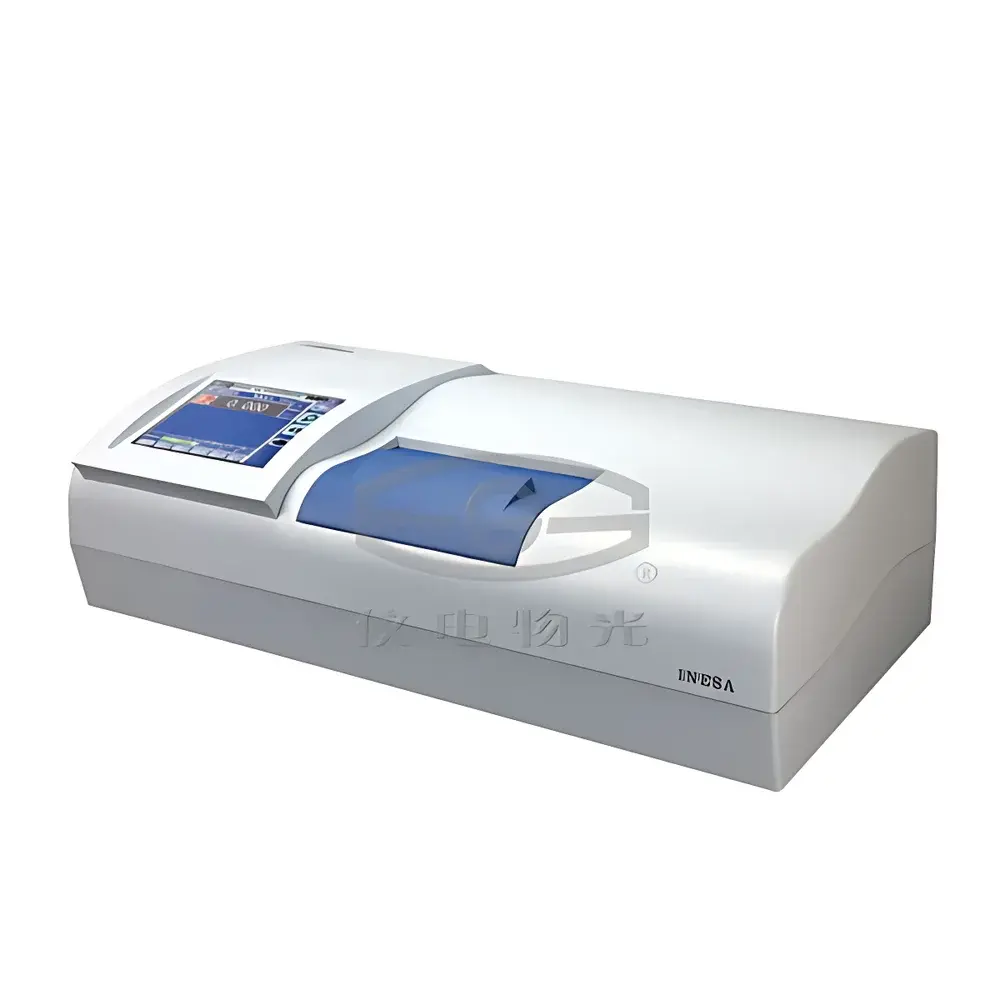
YDWG SGW®-531 Automatic High-Speed Polarimeter
| Brand | YDWG |
|---|---|
| Origin | Shanghai, China |
| Model | SGW®-531 |
| Product Type | Automatic Polarimeter |
| Temperature Control | None |
| Digital Display | Yes |
| Light Source | LED (589 nm, Na D-line equivalent) |
| Measurement Range | ±90° (optical rotation), ±259°Z (saccharimetric scale) |
| Minimum Readability | 0.001° |
| Accuracy | ±0.006° |
| Repeatability (Std. Dev. δ) | ≤0.002° |
| Zero Repeatability | 0.001° |
| Minimum Sample Transmittance | 0.1% |
| Response Speed | 8°/s (full scale) |
| Average Measurement Time | 26 s (6 measurements) |
| Data Storage Capacity | 10,000 records |
| Communication Interfaces | USB, RS232, dedicated printer port, USB flash drive support |
| Standard Cell Path Lengths | 100 mm and 200 mm |
| Optional Cells | 50 mm micro-cell |
| Power Supply | 220 V ±22 V, 50 Hz ±1 Hz, 200 W |
| Dimensions (L×W×H) | 702 × 376 × 240 mm |
| Net Weight | 21 kg |
| Compliance | JJG 536–2015 Class 0.01 |
Overview
The YDWG SGW®-531 Automatic High-Speed Polarimeter is a precision optical instrument engineered for rapid, high-resolution measurement of optical rotation in chiral substances—primarily used in pharmaceutical quality control, food & beverage analysis (especially sucrose quantification), fine chemical synthesis, and academic research laboratories. It operates on the fundamental principle of polarimetry: linearly polarized light passes through an optically active sample, and the plane of polarization rotates proportionally to the concentration, path length, and specific rotation of the analyte. The instrument employs a stable, long-life LED source centered at 589 nm—spectrally aligned with the sodium D-line—combined with a high-precision interference filter to ensure wavelength fidelity without thermal drift or lamp aging effects typical of traditional sodium vapor lamps. Its high-speed electro-optic detection system enables full-scale angular response at 8°/s and delivers repeatable results within an average cycle time of 26 seconds across six consecutive measurements. Designed for routine compliance-driven workflows, the SGW®-531 meets JJG 536–2015 Class 0.01 metrological requirements for accuracy and repeatability in China’s national verification regulations.
Key Features
- High-stability LED light source (589 nm) with >100,000-hour operational lifetime—eliminates lamp replacement cycles and spectral instability associated with sodium lamps
- 8-inch full-color capacitive touchscreen interface with intuitive icon-based navigation and real-time parameter feedback
- Multi-mode measurement capability: optical rotation (α), specific rotation ([α]), concentration (g/100 mL), saccharimetric scale (°Z), and sucrose content (%)—with 30 pre-programmed method templates
- Automatic multi-point zero calibration and dynamic baseline correction to minimize instrumental drift during extended operation
- Quiet mechanical design with low-vibration optical path alignment—optimized for shared lab environments and vibration-sensitive installations
- Robust data integrity architecture: timestamped measurements, operator ID logging (via optional login module), and audit-ready storage of up to 10,000 result sets
Sample Compatibility & Compliance
The SGW®-531 accommodates standard 100 mm and 200 mm path-length cells for routine liquid-phase analysis, and supports optional 50 mm micro-cells for limited-volume or high-value samples (e.g., purified enantiomers or concentrated APIs). With a minimum transmittance threshold of 0.1%, it reliably measures highly absorbing or turbid solutions common in crude sugar extracts, syrup matrices, and pharmaceutical suspensions. While the instrument lacks active temperature regulation, its internal temperature sensor (0–100 °C range) logs ambient thermal conditions for post-acquisition correction per ISO 11287 and USP . It complies with JJG 536–2015 Class 0.01 performance criteria for optical rotation instruments in China and supports traceable calibration using NIST-traceable quartz control plates. Though not inherently 21 CFR Part 11 compliant, its data export architecture (CSV via USB/RS232) enables integration into validated LIMS or ELN systems under GLP/GMP frameworks when paired with appropriate procedural controls.
Software & Data Management
Data acquisition, processing, and reporting are managed entirely through the embedded firmware—no external PC required for basic operation. All measurements include automatic averaging, statistical deviation calculation (δ ≤ 0.002°), and zero-point stability verification (repeatability 0.001°). Results are stored locally with full metadata: date/time stamp, operator ID (if enabled), cell path length, wavelength, ambient temperature, and raw angular values. Export options include direct printing via dedicated thermal printer interface, USB flash drive dump (CSV format), or serial transmission (RS232/USB virtual COM) for integration with laboratory informatics platforms. Firmware supports user-defined report templates and batch ID tagging—critical for QC batch release documentation in regulated environments.
Applications
- Pharmaceutical manufacturing: identity testing and assay of chiral active pharmaceutical ingredients (APIs) such as levofloxacin, ibuprofen, and escitalopram per EP/USP monographs
- Sugar industry: rapid determination of sucrose concentration in cane juice, beet extracts, syrups, and refined white sugar per ICUMSA Method GS3/4-11
- Food & beverage QA/QC: verification of honey authenticity, maple syrup grading, and fruit juice adulteration screening
- Academic research: kinetic studies of enzymatic resolution, monitoring asymmetric synthesis progress, and stereochemical characterization of natural products
- Chemical manufacturing: batch-to-batch consistency checks for chiral intermediates and catalyst evaluation in asymmetric catalysis
FAQ
Does the SGW®-531 support temperature-controlled measurements?
No—the instrument does not integrate Peltier or circulating water jacket temperature control. Ambient temperature is monitored and logged, but users must perform manual thermal correction or conduct analyses in climate-stabilized labs per ISO 11287 guidelines.
Can the SGW®-531 be validated under FDA 21 CFR Part 11?
The device itself is not Part 11–certified; however, its data export architecture and audit trail features (timestamped records, operator ID, and immutable CSV output) allow it to function within a Part 11–compliant environment when deployed with documented SOPs, access controls, and electronic signature protocols.
What calibration standards are recommended for routine verification?
NIST-traceable quartz rotatory standard plates (e.g., +34.0°, −34.0° at 589 nm) are recommended for daily system suitability checks. Sucrose solution standards (e.g., 10–50% w/w) may be used for saccharimetric scale verification per ICUMSA protocols.
Is the 50 mm micro-cell included in the base configuration?
No—the 50 mm micro-cell is an optional accessory. The standard delivery includes 100 mm and 200 mm cells with screw-cap closures and precision-ground optical windows.
How is measurement uncertainty estimated for regulatory submissions?
Uncertainty budgeting should include contributions from instrument accuracy (±0.006°), repeatability (≤0.002°), cell path-length tolerance (±0.1 mm), temperature effect (±0.01°/°C), and operator reading variability—per GUM (JCGM 100:2008) methodology.






