
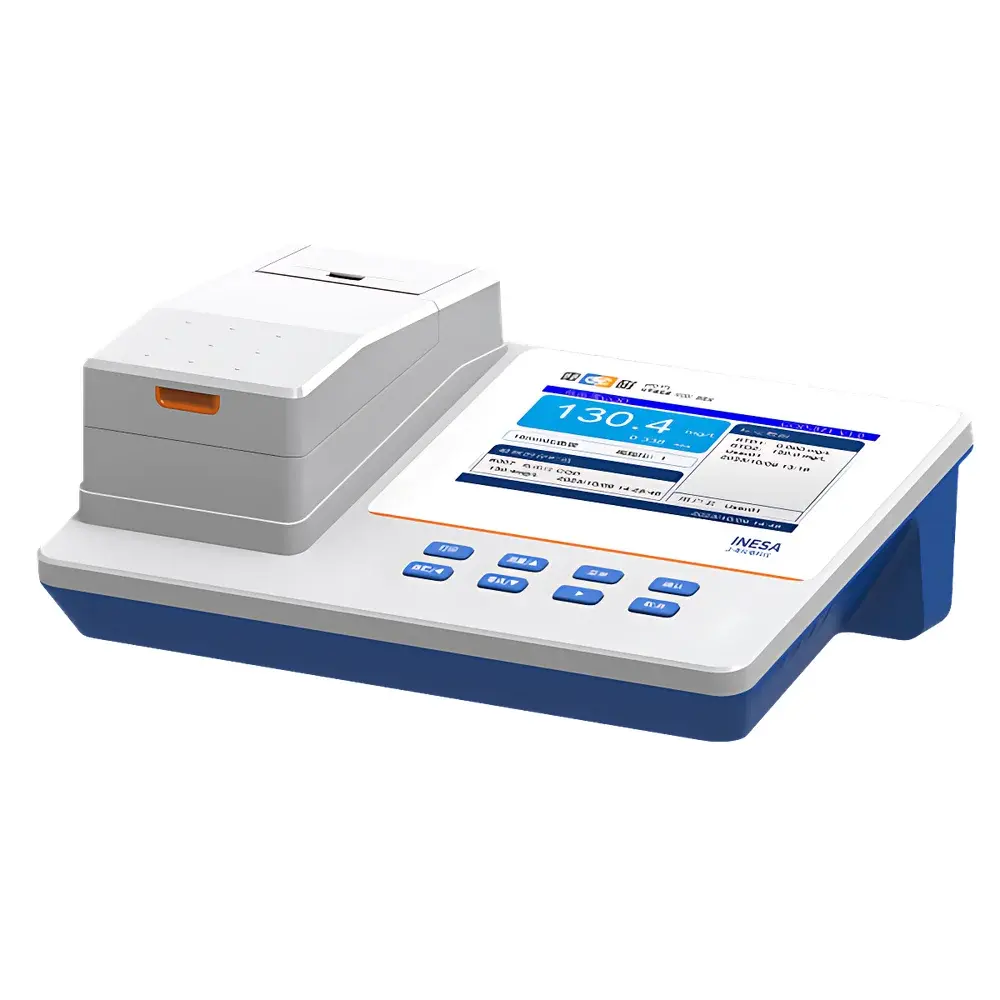
Leici COD-571 Chemical Oxygen Demand Analyzer
| Brand | Leici |
|---|---|
| Origin | Shanghai, China |
| Model | COD-571 |
| Instrument Type | Benchtop Laboratory Analyzer |
| Measurement Principle | Dichromate Digestion Method (2-hour reflux) |
| Wavelengths | 420 nm and 620 nm |
| Measurement Ranges | 0–150 mg/L (low-range), 0–1500 mg/L (high-range) |
| Accuracy | ±8% of reading |
| Repeatability | ≤3% RSD |
| Measurement Time | 20 min per sample (post-digestion) |
| Photometric Range | 0.000–2.000 Abs |
| Absorbance Accuracy | ±0.01 Abs or ±5% |
| Wavelength Accuracy | ±4 nm |
| Transmittance Error | ±2% |
| Photometric Repeatability | ≤0.005 Abs or 2% |
| Sample Throughput | Batch processing for multiple water samples |
| Cuvette Format | 10 mm square cuvettes and 16 mm round test tubes |
| Data Storage | 2000 measurement records |
| Connectivity | RS-232, USB, U-disk export |
| Power Supply | AC 100–240 V input / DC 24 V output |
| Dimensions (W×D×H) | 302 × 205 × 122 mm |
| Weight | 1.33 kg |
| Ingress Protection | IP65 |
| Compliance | GLP-compliant data traceability, audit-ready logging |
Overview
The Leici COD-571 Chemical Oxygen Demand Analyzer is a benchtop photometric instrument engineered for precise, standardized determination of chemical oxygen demand in aqueous environmental samples—primarily wastewater, surface water, and treated effluents. It operates on the internationally recognized dichromate oxidation method (ISO 6060, APHA 5220 B, and EPA 410.4), wherein organic matter in the sample is oxidized under acidic, high-temperature reflux conditions using potassium dichromate as the oxidant. Following digestion, the residual dichromate is quantified spectrophotometrically at two discrete wavelengths—420 nm for low-concentration COD (0–150 mg/L) and 620 nm for high-concentration COD (0–1500 mg/L, scalable to 15,000 mg/L via programmable dilution). This dual-wavelength design mitigates interferences from colored matrices and turbidity, improving analytical robustness across heterogeneous sample types.
Key Features
- Dual high-stability LED light sources (420 nm and 620 nm) with calibrated spectral bandwidth and ≥50,000-hour operational lifetime, ensuring long-term photometric consistency without lamp replacement.
- Integrated digestion protocol management: pre-programmed methods for both low- and high-range COD analysis, aligned with standard reference procedures including ISO 6060 and US EPA Method 410.4.
- High-resolution graphical LCD interface with intuitive icon-driven navigation, supporting multilingual prompts (English default), contextual help, and real-time status feedback during measurement cycles.
- Automated endpoint detection algorithm that evaluates kinetic absorbance stabilization over time, eliminating subjective visual interpretation and enabling reliable auto-read functionality.
- Programmable dilution factor application: users define dilution ratios directly; the instrument automatically calculates and reports original sample concentration, reducing manual error in post-analysis computation.
- Flexible calibration architecture: supports 1–5 point calibration for high-range mode and 2–5 point for low-range mode, with option to re-calibrate individual standards without resetting full curve.
- IP65-rated enclosure for dust- and splash-resistant operation in shared laboratory environments with variable ambient humidity and incidental liquid exposure.
Sample Compatibility & Compliance
The COD-571 accepts standard 10 mm square quartz or optical-grade glass cuvettes and 16 mm round borosilicate test tubes—compatible with common digestion vial formats used in accredited environmental labs. It accommodates raw influent, secondary effluent, industrial discharge, and potable source waters, provided samples are homogenized and free of suspended solids that exceed filtration limits (recommended pre-filtration ≤0.45 µm for turbid samples). All data handling conforms to Good Laboratory Practice (GLP) requirements: timestamps, operator ID (configurable), method version, calibration history, and raw absorbance values are embedded in each record. Audit trails support retrospective verification and are exportable in CSV or PDF format for regulatory submission.
Software & Data Management
Data integrity is maintained through embedded non-volatile memory storing up to 2000 complete measurement records—including sample ID, date/time stamp, wavelength used, measured absorbance, calculated COD value, dilution factor, calibration curve ID, and operator tag. Internal thermal printer provides immediate hardcopy output with user-selectable formats (summary report, full trace record, or calibration log). Data export is supported via USB host port (U-disk), RS-232 serial link, or USB-to-PC connection using Leici’s certified communication software—enabling integration into LIMS platforms and compliance with FDA 21 CFR Part 11 when paired with appropriate system-level access controls and electronic signature modules.
Applications
The COD-571 serves routine and regulatory monitoring needs across municipal wastewater treatment plants, industrial pretreatment facilities, environmental consulting laboratories, and academic research groups. Typical use cases include daily effluent compliance testing against discharge permits (e.g., NPDES), process optimization in activated sludge systems, evaluation of biodegradability indices (BOD5/COD ratio), validation of advanced oxidation processes, and quality assurance for drinking water source protection programs. Its dual-range capability eliminates the need for separate instruments when analyzing both upstream influent (often >500 mg/L) and polished effluent (often <30 mg/L).
FAQ
Does the COD-571 perform digestion internally?
No. The COD-571 is a photometric analyzer only. Sample digestion must be carried out externally using a certified heating block or reflux apparatus per ISO 6060 or EPA 410.4 protocols.
What digestion time does the instrument assume?
It is designed for compatibility with the standard 2-hour reflux method; however, it fully supports alternative digestion durations (e.g., 15-min rapid digestion) if validated and documented per laboratory SOP.
Can calibration curves be imported from external sources?
Yes—calibration parameters may be loaded via USB or configured manually. Custom curves remain stored even after firmware updates.
Is the built-in printer compatible with third-party label stock?
The thermal printer uses standard 57 mm width roll paper; custom formatting requires configuration via PC software—not direct hardware modification.
How is GLP compliance implemented?
Each measurement entry includes immutable metadata: timestamp, operator ID, method name, calibration ID, and raw absorbance—retained in internal memory and exported verbatim without post-hoc editing capability.
Related Products







