
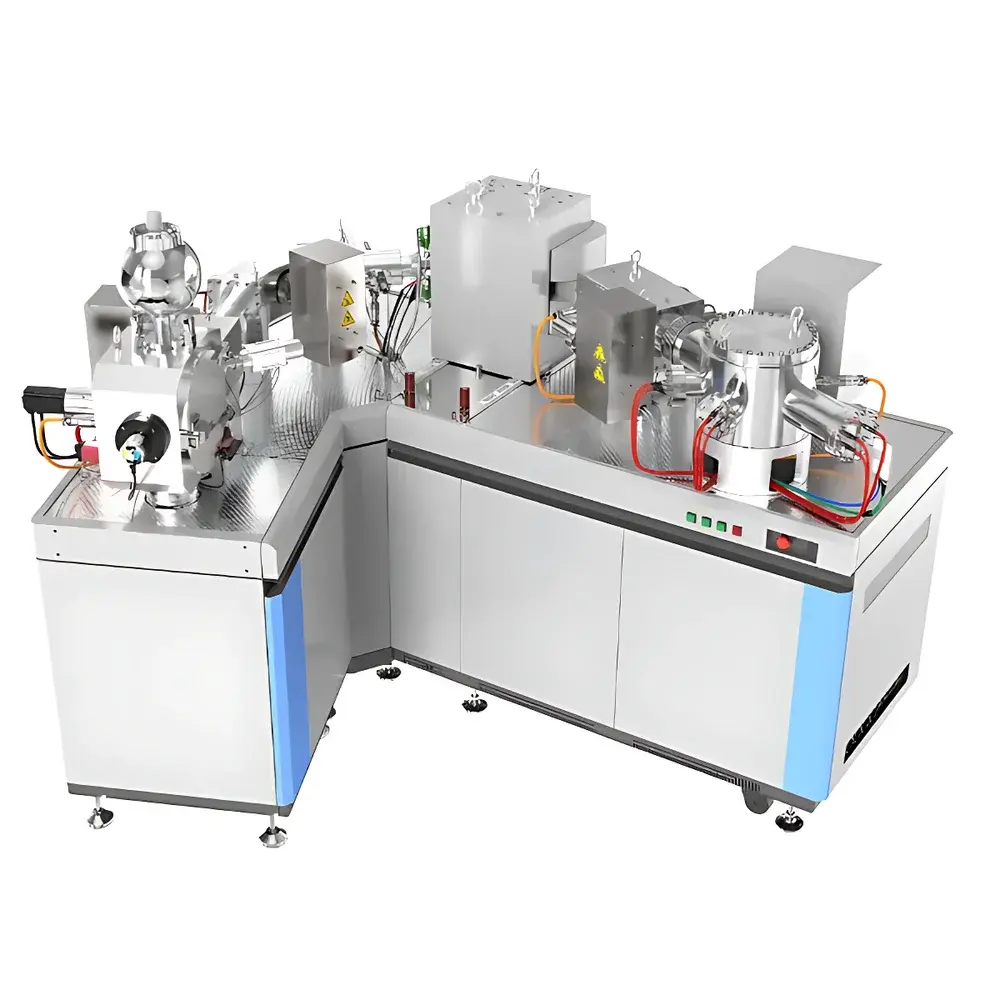
Gaia Dual-Focusing Thermal Ionization Mass Spectrometer
| Brand | Kunyuan Instruments |
|---|---|
| Origin | Tianjin, China |
| Model | Gaia |
| Acceleration Voltage | ±10 kV |
| Sample Carousel Capacity | 21 filament positions (single/dual filament) |
| Mass Analyzer Type | Nier-Johnson geometry |
| Mass Dispersion | 560 mm |
| Magnetic Field Control | Hall-effect sensor with closed-loop feedback |
| Polarity Switching | Computer-controlled for positive/negative ion mode |
| Detector Configuration | Up to 16 Faraday cups + 4-channel discrete-dynode electron multiplier |
| RPQ Energy Filter | Optional |
| Preamp Capacity | Up to 32 units |
| Gain Range | 10¹⁰–10¹³ Ω selectable |
| Data Acquisition | 24-bit synchronized ADC, ppm-level precision |
| Dimensions (L×W×H) | 2160 × 1840 × 1810 mm |
| Power Supply | AC 220 V / 50 Hz, grounding resistance < 2 Ω |
| Cooling | Dedicated 500 W chiller for turbo pumps & magnet |
| Ambient Requirements | 18–24 °C, 40–60 % RH |
Overview
The Gaia Dual-Focusing Thermal Ionization Mass Spectrometer (TIMS) is a high-precision inorganic mass spectrometer engineered for ultra-trace isotopic ratio measurements in geological, nuclear, and geochemical laboratories. It operates on the principle of thermal surface ionization—where solid samples loaded onto refractory metal filaments (e.g., Re, Ta, Pt) are resistively heated to >1300 °C under ultrahigh vacuum (UHV, ≤1×10⁻⁹ mbar), inducing efficient ionization of elements with low ionization potentials (e.g., Sr, Nd, Pb, Hf, U, Pu). The instrument integrates a dual-focusing magnetic sector mass analyzer with electrostatic energy filtering to achieve high mass resolution (M/ΔM > 10,000 at 10% peak height) and exceptional mass accuracy (<1 ppm). Its Nier-Johnson configuration provides optimal transmission efficiency and spatial focusing across wide mass ranges (from 6Li to 244Pu), enabling robust long-term stability required for high-precision radiogenic isotope geochronology and nuclear forensic analysis.
Key Features
- Thermal Ionization Source: Optimized ±10 kV acceleration voltage for maximum ion transmission and signal-to-noise ratio; compatible with both single- and dual-filament configurations.
- Computer-Controlled Filament Carousel: 21-position sample stage with automated positioning and thermal ramp sequencing; supports rapid multi-sample throughput without venting.
- Gas Introduction Option: Integrated micro-leak valve for controlled O₂ or SiF₄ gas dosing during negative-ion mode operation (e.g., for enhanced PO₂⁻ or SiF₃⁻ yields).
- Dual-Focusing Mass Analyzer: Nier-Johnson geometry with 560 mm focal length; Hall-probe-based magnetic field monitoring enables real-time closed-loop correction of hysteresis and drift.
- Bi-Polar Field Switching: Fully software-driven reversal of magnetic and electrostatic field polarities to alternate between positive- and negative-ion detection within a single analytical session.
- Multi-Collector Detection System: Modular array supporting up to 16 Faraday cup detectors and 4 discrete-dynode electron multipliers; optional Retarding Potential Quadrupole (RPQ) energy filter reduces background noise and improves abundance sensitivity by two orders of magnitude.
- Low-Noise Electronics: Vacuum-enclosed, temperature-stabilized preamplifier chamber housing up to 32 programmable gain amplifiers (10¹⁰–10¹³ Ω); automatic gain calibration ensures traceable linearity over 12 orders of magnitude.
Sample Compatibility & Compliance
The Gaia TIMS accommodates a broad spectrum of inorganic sample forms—including purified element separates (e.g., Sr, Nd, Hf cut from column chromatography), mineral digests, uranium oxide powders, and nuclear fuel particles. Filament loading follows standardized protocols aligned with ASTM D7922–22 (standard test method for isotopic analysis of uranium by TIMS) and ISO/IEC 17025:2017 requirements for testing laboratories. All detector gain calibrations are traceable to NIST SRM 997 (strontium carbonate) and certified reference materials (e.g., NIST SRM 3100 series). The system architecture supports audit-ready data logging compliant with FDA 21 CFR Part 11 and GLP/GMP environments when integrated with validated LIMS interfaces.
Software & Data Management
Control and data acquisition are managed via the proprietary GaiaControl Suite—a Windows-based platform offering real-time beam monitoring, automated filament heating profiles, multi-collector synchronization, and dynamic baseline subtraction. Raw data are stored in vendor-neutral HDF5 format with embedded metadata (instrument parameters, filament history, vacuum status, temperature logs). Quantitative isotope ratio calculations employ standard bracketing (e.g., using NBS 987 for Sr), exponential law correction, and mass bias modeling (e.g., Russell’s law or power law). Export modules support direct integration with IsoplotR, TRIPOLI, and MATLAB-based reduction pipelines. Full electronic signature capability, user access levels, and change audit trails satisfy regulatory documentation requirements.
Applications
- High-precision U–Pb, Pb–Pb, Sm–Nd, Lu–Hf, and Rb–Sr geochronology in zircon, apatite, and garnet.
- Nuclear safeguards and non-proliferation analysis: isotopic fingerprinting of uranium and plutonium materials.
- Planetary science: isotopic characterization of extraterrestrial samples (e.g., lunar regolith, meteoritic Ca–Al-rich inclusions).
- Environmental tracer studies: anthropogenic Pb source apportionment in sediments and aerosols.
- Geochemical standard certification: value assignment of isotopic reference materials under ISO Guide 35.
FAQ
What vacuum level is required for stable TIMS operation?
The ion source and mass analyzer require sustained pressure ≤1×10⁻⁹ mbar, achieved via a combination of turbomolecular pumping (with active water-cooling) and non-evaporable getter (NEG) pumping. Base pressure is continuously monitored and logged.
Can the Gaia system perform simultaneous multi-isotope detection?
Yes—its configurable multi-collector array allows concurrent measurement of up to 20 isotopes (via Faraday cups and EM channels), eliminating time-dependent instrumental drift during ratio calculation.
Is remote diagnostics supported?
The GaiaControl Suite includes secure TLS-encrypted remote access for technical support, firmware updates, and performance diagnostics—subject to customer-configured firewall policies.
What maintenance intervals are recommended for the filament carousel and ion optics?
Filament alignment verification is advised every 200 operating hours; ion lens cleaning and recalibration are scheduled biannually or after exposure to high-salt matrices.
Does the system comply with electromagnetic compatibility (EMC) standards for laboratory deployment?
Yes—the Gaia meets IEC 61326-1:2013 Class A emission limits and EN 61000-6-2:2019 immunity requirements for industrial environments.





