
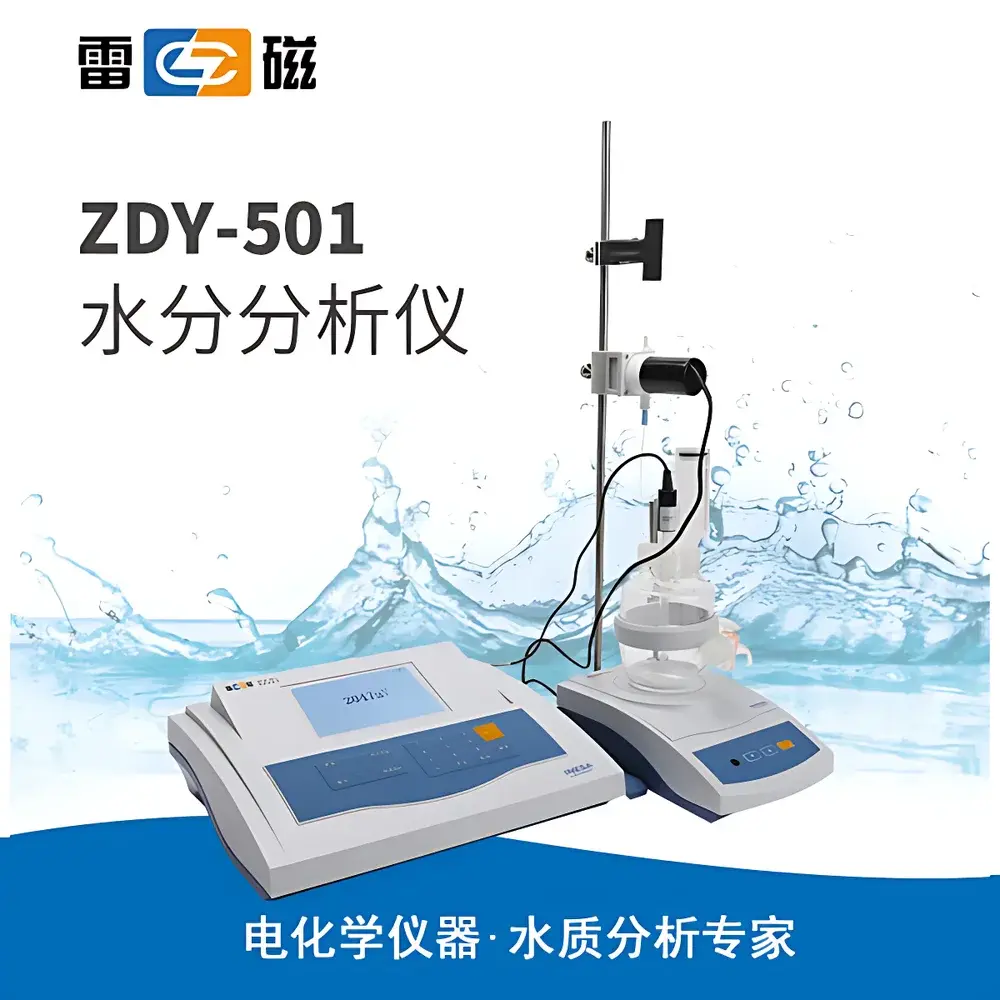
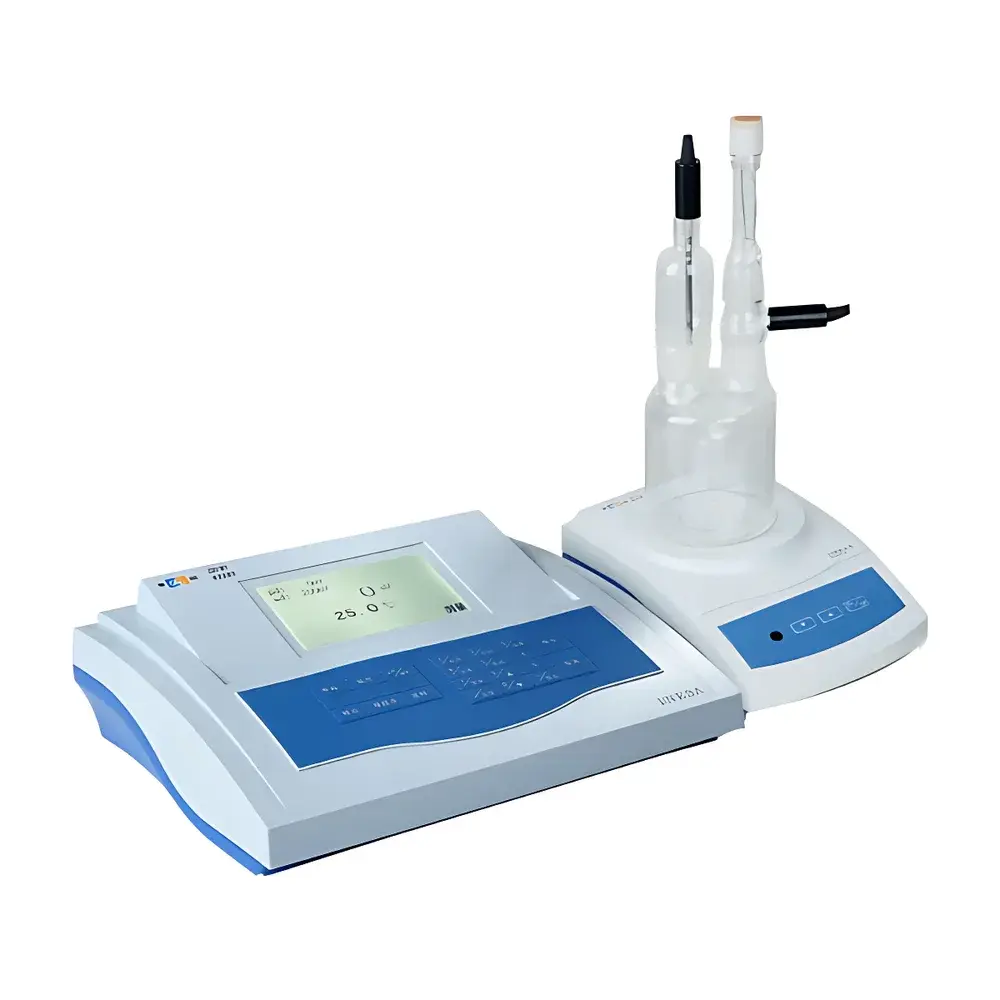
Leici ZDY-501 Karl Fischer Moisture Analyzer
| Brand | Leici |
|---|---|
| Origin | Shanghai, China |
| Manufacturer Type | Authorized Distributor |
| Country of Origin | China |
| Model | ZDY-501 |
| Pricing | USD 680 (FOB Shanghai) |
| Titration Mode | Fully Automatic Volumetric and Coulometric Dual-Mode |
| Instrument Type | Dual-Principle Karl Fischer Moisture Analyzer (Volumetric + Coulometric) |
| Water Content Range | 0.1 mg to 250 mg |
| Measurement Accuracy | ±3% RSD |
| Minimum Dispensing Resolution | 1/20,000 of full-scale burette volume |
| Polarization Current | 1 µA |
| Endpoint Detection Voltage Range | 40–120 mV |
| Sample Temperature Range | 5–30 °C |
| Dimensions (W×D×H) | 280 × 210 × 120 mm |
| Net Weight | 5 kg |
Overview
The Leici ZDY-501 Karl Fischer Moisture Analyzer is a dual-principle laboratory instrument engineered for precise quantitative determination of water content in solid, liquid, and gaseous samples using both volumetric and coulometric Karl Fischer titration methods. Based on the stoichiometric reaction between iodine and water in anhydrous methanol-based electrolyte media, the system detects endpoint electrochemically via bi-directional polarization current monitoring (1 µA threshold sensitivity). Unlike single-mode analyzers, the ZDY-501 enables method selection based on sample water concentration: volumetric mode for higher water loads (0.1–250 mg), and coulometric mode—when configured with optional coulometric cell—for trace-level analysis down to sub-10 µg. Its architecture complies with fundamental requirements of ISO 8533:2017 (Karl Fischer titration — General principles) and supports method validation per USP and EP 2.5.32. The analyzer is designed for routine QC laboratories in pharmaceuticals, fine chemicals, polymers, and battery electrolyte manufacturing where regulatory traceability and reproducible moisture quantification are critical.
Key Features
- Fully automatic titration control with adaptive dosing algorithm: real-time current fluctuation monitoring triggers dynamic transition from fast to slow titrant delivery near endpoint, minimizing overshoot and improving repeatability.
- Dual-mode operational flexibility: switch seamlessly between volumetric and coulometric KF methodologies using standardized reagent kits and interchangeable electrode assemblies.
- Leici proprietary low-toxicity, low-volatility KF reagent formulation (non-odorous, stabilized iodine source) certified for ≥5 reuse cycles without significant drift in titer stability.
- High-resolution burette drive system with 1/20,000 step precision ensures accurate reagent dispensing across full dynamic range, supporting GLP-compliant volumetric calibration verification.
- Backlit graphical LCD interface with intuitive menu navigation; no PC dependency for basic operation, yet fully compatible with external data logging via RS-232 serial port.
- Endpoint detection configurable within 40–120 mV polarization window, accommodating variable sample matrix conductivity and solvent systems (e.g., chloroform/methanol blends).
Sample Compatibility & Compliance
The ZDY-501 accommodates diverse sample types—including hygroscopic powders (e.g., APIs, excipients), viscous liquids (e.g., silicone oils, resins), and volatile solvents—via standard 10–50 mL glass titration vessels with septum-sealed lids. Sample introduction is manual or semi-automated using optional syringe adapters. All wetted parts are chemically resistant (glass, PTFE, borosilicate), ensuring compatibility with common KF solvents (e.g., Hydranal®-Composite 5, Aquastar®). The instrument meets electrical safety requirements per GB 4793.1–2019 (equivalent to IEC 61010-1) and supports audit-ready documentation when integrated into validated workflows compliant with FDA 21 CFR Part 11 (with optional electronic signature module and audit trail logging software).
Software & Data Management
While standalone operation is fully functional, the ZDY-501 supports optional Leici KF-Link PC software (Windows 10/11) for advanced method storage, multi-sample batch reporting, and export of CSV/Excel-formatted results with timestamps, operator ID, and raw current vs. time curves. Data integrity safeguards include password-protected method editing, immutable result archives, and configurable electronic signatures aligned with ALCOA+ principles. Raw measurement logs retain all intermediate polarization current values at 100 ms intervals, enabling retrospective endpoint re-evaluation and uncertainty budgeting per GUM (JCGM 100:2008).
Applications
- Pharmaceutical quality control: water content verification of lyophilized products, active pharmaceutical ingredients (APIs), and excipients per USP and Ph. Eur. 2.5.32.
- Electrolyte purity assessment in lithium-ion battery manufacturing, where residual water >20 ppm degrades SEI formation.
- Moisture specification testing of catalysts, molecular sieves, and desiccants in petrochemical R&D.
- Stability-indicating assay support during accelerated aging studies of polymer films and coatings.
- Educational use in analytical chemistry laboratories for teaching redox titration fundamentals and electrochemical endpoint theory.
FAQ
Does the ZDY-501 support both volumetric and coulometric titration natively?
Yes—the base configuration includes volumetric capability; coulometric operation requires optional coulometric cell assembly (ZDY-C1) and dedicated generator electrode.
What is the recommended calibration frequency for routine use?
Daily verification with certified 1.00 mg water standard (e.g., Hydranal® Water Standard) is advised; full volumetric calibration every 30 days or after reagent replacement.
Can the instrument be integrated into a LIMS environment?
Yes—via RS-232 ASCII protocol with configurable delimiter and handshake settings; custom drivers available upon request for LabWare, STARLIMS, and Thermo Fisher SampleManager.
Is the reagent compatible with halogenated solvents?
Yes—Leici’s low-toxicity KF reagent demonstrates stable performance in dichloromethane and chloroform-based matrices, provided anhydrous conditions are maintained.
What environmental conditions are required for optimal accuracy?
Ambient temperature 15–25 °C, relative humidity <60%, and minimal air currents around the titration vessel to prevent atmospheric moisture ingress during analysis.




