
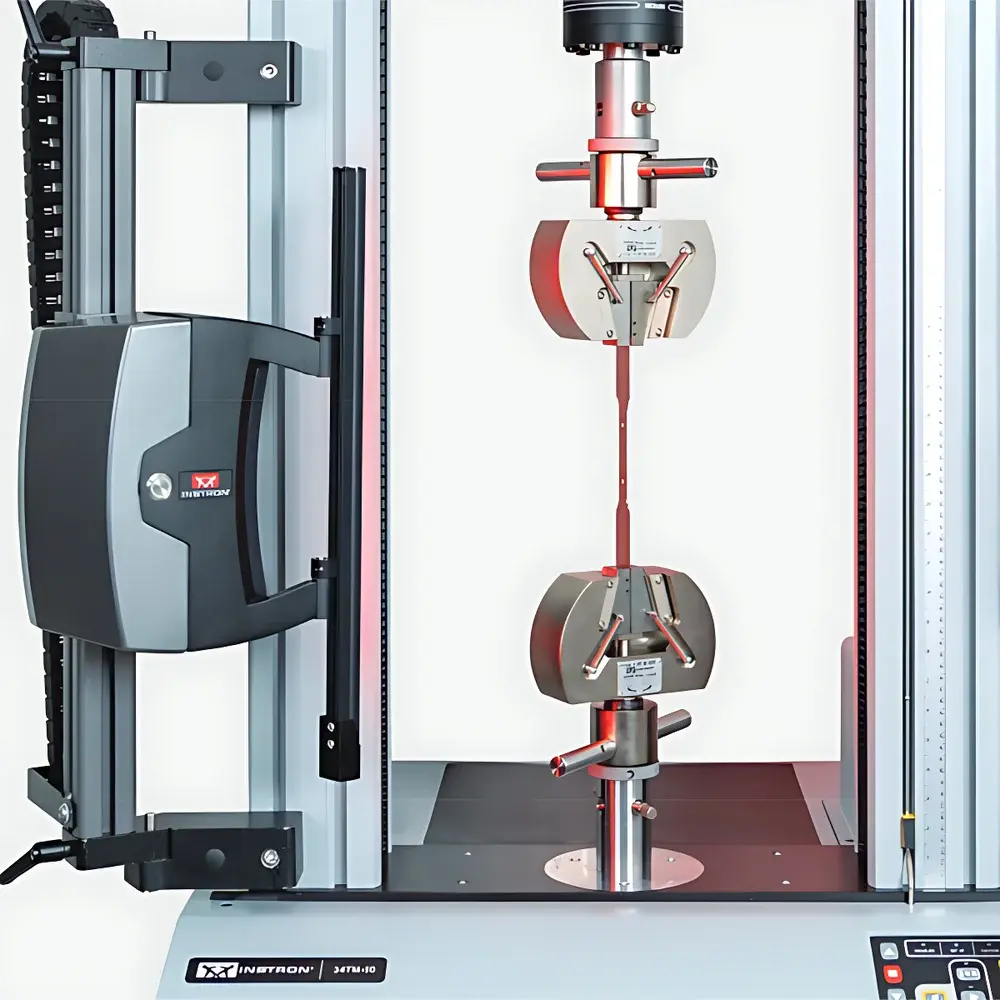
Instron SVE3 Standard Non-Contact Video Extensometer
| Brand | INSTRON |
|---|---|
| Origin | USA |
| Manufacturer | INSTRON Corporation |
| Product Type | Imported |
| Model | SVE3 |
| Pricing | Upon Request |
Overview
The Instron SVE3 Standard Non-Contact Video Extensometer is an engineered solution for high-reproducibility axial strain measurement in mechanical testing laboratories. Based on digital image correlation (DIC) principles, the SVE3 captures real-time video of specimen surface features—such as natural texture or applied speckle patterns—and computes displacement and strain by tracking pixel-level motion between successive frames. Unlike contact-based extensometers, it eliminates mechanical interaction with the specimen, thereby removing sources of error including knife-edge slippage, operator-dependent alignment variability, damage during specimen fracture, and mechanical wear of moving parts. Designed to meet ISO 9513 Class 1 or ASTM E83 Class B-2 accuracy requirements, the SVE3 delivers traceable, calibration-certified strain data across a broad range of materials—including elastomers, thermoplastics, thin films, metallic foils, and sheet metal—under ambient, elevated, or sub-ambient temperature conditions when used with environmental chambers.
Key Features
- Patented cross-polarized LED illumination system (US Pat. Nos. 7,047,819 B2; 7,610,815 B2; EP 1,424) minimizes glare and reflection artifacts under variable ambient lighting, ensuring consistent contrast for robust feature tracking.
- Magnetic mounting base enables rapid, repeatable positioning on Instron test frames (e.g., 334X, 34SC, 336X, 34TM, 594X, 68SC, 596X, 68TM, 3382, 5982–5985, 34FM, 68FM) and seamless transfer to thermal chambers without recalibration.
- Modular lens system supports four fixed focal lengths (35 mm, 16 mm, 9 mm, 6 mm) to accommodate diverse gauge lengths (from 10 mm to 200 mm) and total elongation ranges (up to >1000% for elastomers).
- Onboard image processing engine performs real-time displacement computation at up to 120 fps, reducing host PC computational load and enabling low-latency feedback for closed-loop control applications.
- Fully integrated with Bluehill® Universal software (v4.4+), supporting synchronized acquisition of force, displacement, and video-derived strain within a single test method—no third-party drivers or external synchronization hardware required.
- Compliant with GLP/GMP data integrity expectations: audit trail logging, electronic signatures, and user-access controls are enforced via Bluehill® Universal’s 21 CFR Part 11-compliant configuration.
Sample Compatibility & Compliance
The SVE3 supports standardized mechanical tests per ASTM D412 (rubber vulcanizates), ISO 37 (rubber—determination of tensile stress-strain properties), ASTM D638 (plastics—tensile properties), ISO 6892-1 (metallic materials—tensile testing, Method A2 or B), and ASTM E8/E8M (metal tension testing, Method A or C). It accommodates flat, round, and notched specimens in tension, compression, and three-point/four-point bending configurations. Specimen surface preparation is minimal—natural texture suffices for most polymers and metals; optional spray-on speckle patterns enhance tracking fidelity for highly reflective or optically uniform surfaces (e.g., polished aluminum, transparent PET film). Calibration verification follows ISO 9513 Annex B procedures using certified reference rulers traceable to NIST or UKAS-accredited standards.
Software & Data Management
SVE3 operation is natively embedded in Bluehill® Universal software, eliminating standalone applications or post-processing workflows. Strain data is acquired, filtered (moving average, low-pass), and exported in synchronized time-series format alongside force and crosshead displacement. Raw video streams are stored losslessly in AVI or MP4 containers with embedded metadata (timestamp, lens ID, calibration matrix, lighting mode). All measurement parameters—including ROI definition, filtering coefficients, and threshold settings—are saved as part of the test method file, ensuring full method reproducibility across instruments and operators. Data export supports CSV, Excel (.xlsx), and universal formats compatible with MATLAB®, Python (via pandas), and statistical analysis platforms such as JMP or Minitab.
Applications
- Tensile characterization of elastomeric compounds (e.g., silicone, EPDM, TPU) where high extension (>300%) and low modulus require non-contact measurement stability.
- Thin-film and foil testing (e.g., PET, aluminum, copper) where contact extensometers induce local stress concentrations or fail to maintain grip.
- High-temperature tensile testing (−70 °C to +300 °C) using environmental chambers, where thermal expansion of mechanical linkages compromises contact extensometer accuracy.
- Quality control labs performing routine ASTM/ISO compliance testing on incoming polymer pellets, extruded profiles, or stamped metal components.
- Educational labs requiring intuitive, maintenance-free strain measurement tools that reduce training overhead and equipment downtime.
FAQ
Does the SVE3 require specimen surface preparation?
Surface preparation is optional. Most textured or matte-finish specimens provide sufficient contrast for reliable tracking. For specular or transparent materials, a fine-grained speckle pattern applied via airbrush or aerosol spray is recommended.
Can the SVE3 be used with non-Instron test systems?
The SVE3 is designed for native integration with Instron electromechanical and hydraulic test frames via Bluehill® Universal. Third-party system integration is not supported out-of-the-box and requires custom API development and validation.
What computing resources are required to run the SVE3?
A dedicated Windows 10/11 (64-bit, Pro or Enterprise edition) PC with Intel Core i3 @ 3.0 GHz minimum, 16 GB RAM, and integrated or discrete GPU supporting DirectX 12 is required. The system must host both Bluehill® Universal and the SVE3 video acquisition service.
Is calibration traceable to national standards?
Yes. Each SVE3 shipment includes a factory calibration certificate referencing NIST-traceable dimensional standards. Periodic verification follows ISO 9513 procedures using certified gauge blocks or line-scale rulers.
How does the magnetic mounting ensure repeatability?
The base incorporates precision-ground rare-earth magnets aligned to machined registration surfaces on Instron frames and environmental chambers. Lens assemblies lock into pre-calibrated positions, eliminating manual alignment drift and ensuring identical field-of-view geometry across installations.



