
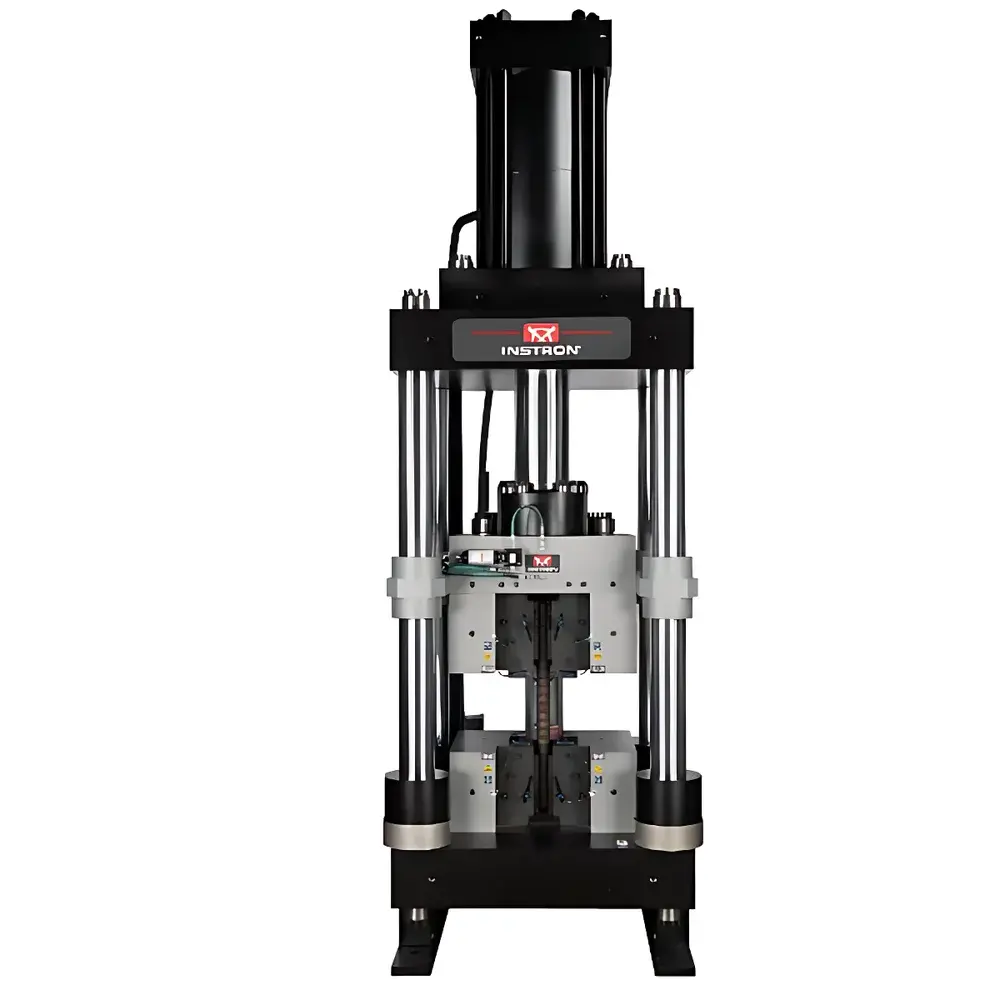
Instron KPX Series Hydraulic Universal Testing Machine
| Brand | Instron |
|---|---|
| Origin | USA |
| Manufacturer Type | Manufacturer |
| Origin Category | Imported |
| Model | KPX |
| Instrument Type | Hydraulic Universal Testing Machine |
| Load Capacity Options | 600 kN, 1500 kN, 2000 kN, 3500 kN |
| Actuator Speed | High-speed hydraulic actuation |
| Test Space | Single-column, single-test-space architecture |
| Stroke Length | Extended travel for large-scale specimens |
Overview
The Instron KPX Series Hydraulic Universal Testing Machine is a heavy-duty, single-space structural testing system engineered for high-force static and quasi-static mechanical characterization of construction materials and industrial components. Based on proven hydraulic servo-control architecture, the KPX platform delivers precise force application and displacement control through a robust closed-loop hydraulic actuation system, enabling compliant load–displacement response in both tension and compression modes within one unified test space. Designed specifically for demanding applications in civil engineering laboratories, metallurgical quality control facilities, and independent certification centers, the KPX series supports standardized mechanical testing per ASTM E4, ASTM E8/E8M, ASTM E9, ISO 6892-1, ISO 15630-1, and EN 10002-1. Its extended crosshead stroke and high-speed actuator enable efficient evaluation of ductile and brittle specimens—including reinforcing bars, structural steel plates, seamless pipes, prestressed strands, anchor assemblies, and cured concrete cylinders—without reconfiguration or fixture swapping.
Key Features
- Single-test-space configuration eliminates need for dual-column or modular reassembly, reducing setup time and alignment variability between tension and compression tests.
- High-speed hydraulic actuation system enables rapid crosshead positioning and dynamic load ramping while maintaining sub-0.5% force linearity across full capacity range.
- Extended stroke length accommodates large-dimension specimens (e.g., 1-m-long rebar samples or 300-mm-diameter concrete cylinders) without compromising resolution or control fidelity.
- Integrated load cell with factory-calibrated traceability to NIST standards ensures long-term measurement stability and compliance with ISO/IEC 17025 requirements.
- Rigid, four-column monolithic frame structure minimizes deflection under peak loads, supporting high-reproducibility results even at maximum rated capacities (up to 3500 kN).
- Modular grip and fixture interface compatible with Instron’s full portfolio of wedge-action, pneumatic, and hydraulic grips—including specialized concrete compression platens and threaded rod adapters for anchor testing.
Sample Compatibility & Compliance
The KPX series is validated for testing metallic and quasi-brittle construction materials per international regulatory and industry-standard protocols. It supports standard specimen geometries defined in ASTM A615/A615M (deformed steel bars), ASTM A53 (welded and seamless pipe), ASTM A1061 (prestressing strand), and ASTM C39/C39M (concrete compressive strength). All models comply with mechanical safety requirements outlined in ISO 12100 and carry CE marking under EU Machinery Directive 2006/42/EC. Force verification procedures align with ASTM E4 and ISO 7500-1 Class 1 accuracy classification. Optional calibration documentation packages support GLP/GMP audit readiness and FDA 21 CFR Part 11–compliant data integrity workflows when paired with Bluehill Universal software.
Software & Data Management
Control and analysis are performed via Bluehill Universal software—a validated, Windows-based platform supporting method-driven test execution, real-time curve overlay, and automated report generation. The software includes preconfigured test methods for tensile yield strength, ultimate tensile strength, elongation at break, modulus of elasticity, and compressive strength per ASTM and ISO standards. Audit trail functionality records all user actions, parameter changes, and calibration events with timestamped, non-erasable entries. Data export options include CSV, PDF, XML, and proprietary .iqw formats; integration with LIMS systems is supported via ODBC and REST API interfaces. Optional 21 CFR Part 11 compliance package provides electronic signatures, role-based access control, and encrypted database storage.
Applications
- Mechanical qualification of hot-rolled and cold-formed structural steels used in bridge and building frameworks.
- Quality assurance testing of welded joints, bolted connections, and shear studs per AWS D1.1 and EN 1090.
- Compressive strength validation of normal- and high-strength concrete mixtures at 7-, 28-, and 56-day curing intervals.
- Proof and ultimate load testing of post-tensioning systems, anchorages, and grouted duct assemblies.
- Research-grade stress–strain characterization of novel composite rebars (e.g., GFRP, CFRP) under monotonic and cyclic loading conditions.
- Third-party certification testing for ISO/IEC 17025-accredited laboratories performing EN 10080 or BS 4449 conformity assessments.
FAQ
What is the maximum test speed achievable on the KPX series?
Maximum crosshead speed varies by model and load rating but typically ranges from 5 mm/min (at full capacity) to 100 mm/min (at reduced loads), with high-speed actuation optimized for rapid positioning and controlled strain-rate testing.
Can the KPX be used for cyclic or fatigue testing?
The KPX is designed for static and quasi-static loading only; for fully reversed or high-cycle fatigue applications, Instron recommends the ElectroPuls or 8800 Series servo-hydraulic systems with dedicated waveform generation and thermal management.
Is third-party calibration included with purchase?
Each KPX system ships with a NIST-traceable factory calibration certificate; optional on-site calibration and annual verification services are available through Instron’s global service network.
How does the single-space design affect test accuracy compared to dual-space machines?
The monolithic single-space architecture eliminates alignment errors associated with moving upper/lower crossheads, delivering superior repeatability in both tension and compression—particularly critical for asymmetric specimens like concrete cores or irregular castings.
What software licenses are required for full functionality?
Bluehill Universal base license is included; advanced modules for fracture mechanics (KIc, J-integral), creep/stress relaxation, or custom scripting require separate activation keys purchased at time of order or via software upgrade path.



