High-Base-Matrix Trace Element Analysis Service
| Brand | Chemlab Pro |
|---|---|
| Origin | Shanghai, China |
| Manufacturer Type | Authorized Distributor |
| Product Origin | Domestic (China) |
| Model | High-Base-Matrix Trace Element Analysis |
| Quotation | Available Upon Request |
| Service Experience | 3–5 Years |
Overview
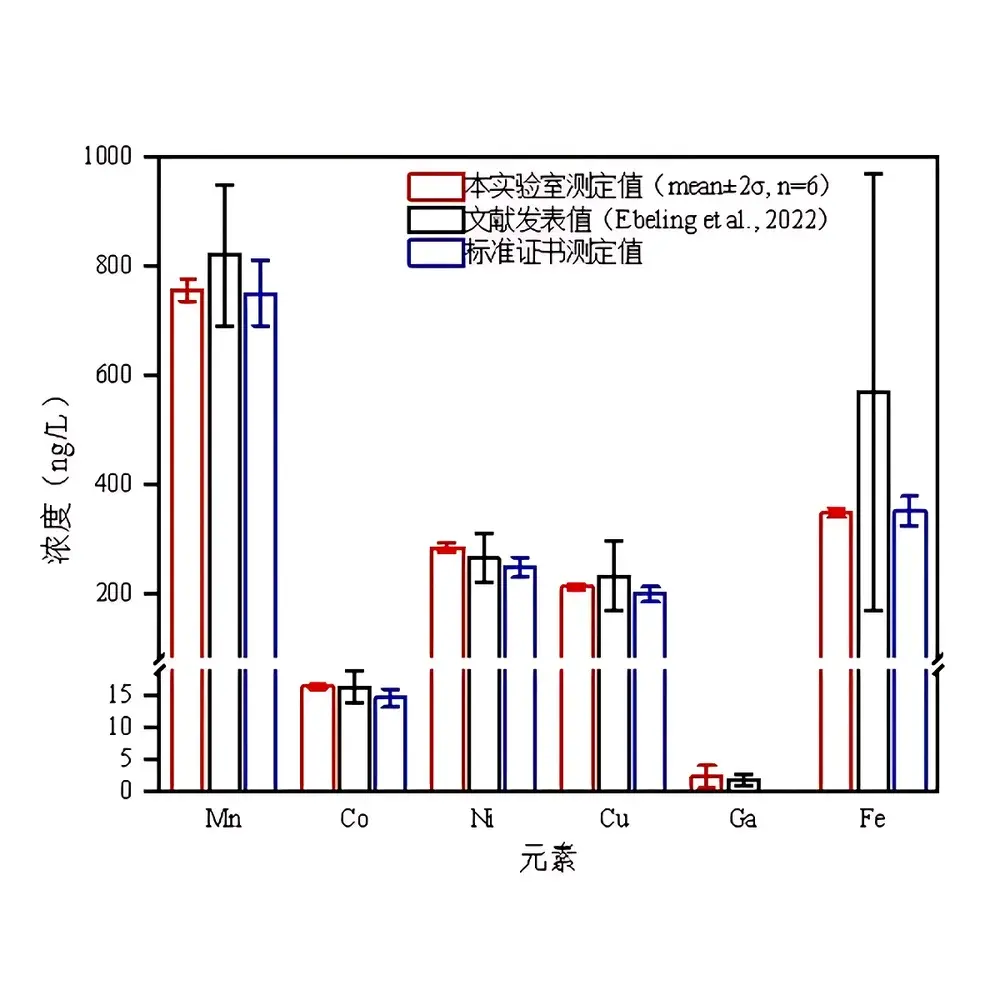
This high-base-matrix trace element analysis service is a specialized laboratory offering designed for the accurate quantification of ultra-trace elements—particularly rare earth elements (REEs), iron (Fe), and other transition metals—in complex aqueous matrices. It leverages the coupling of seaFAST® preconcentration technology with triple-quadrupole inductively coupled plasma mass spectrometry (ICP-QQQ-MS), enabling sub-picomolar detection sensitivity while effectively mitigating polyatomic interferences and matrix suppression effects inherent to high-salinity or organically enriched samples. The methodology is engineered for precision in environmental geochemistry, marine biogeochemistry, and regulatory monitoring contexts where conventional single-quadrupole ICP-MS fails to deliver reliable results due to spectral overlap or signal instability.
Key Features
- seaFAST®-ICP-QQQ-MS integration: Automated online preconcentration, matrix removal, and analyte elution minimizes contamination risk and improves reproducibility across replicate analyses.
- Matrix-tolerant methodology: Validated for seawater, porewater, river water, and other high-dissolved-solids aqueous samples—with salinity up to 35 g/kg and variable organic load.
- Rigorous sample preparation protocol: Includes mandatory acidification to pH 1–2 using ultrapure HNO₃, filtration through certified 0.45 µm membrane filters, and volume verification ≥8.5 mL per submission.
- Interference management: QQQ-based mass-shift and on-mass reaction modes (e.g., using O₂ or NH₃ gases) selectively resolve isobaric overlaps (e.g., 56Fe+ vs. 40Ar16O+, 140Ce+ vs. 140Pr+) without compromising throughput.
- Traceable calibration framework: Calibration standards traceable to NIST SRMs; bracketing with matrix-matched calibrants ensures accuracy across multi-element panels.
Sample Compatibility & Compliance
The service accepts liquid environmental samples including but not limited to: coastal and open-ocean seawater, sediment porewater, estuarine river water, and groundwater with elevated dissolved metal content. All sample submissions must comply with ISO/IEC 17025:2017 requirements for sampling integrity, chain-of-custody documentation, and container certification (e.g., fluoropolymer or high-purity HDPE bottles pre-cleaned via acid leaching). Analytical reporting includes uncertainty estimation per EURACHEM/CITAC Guide and conforms to EPA Method 1640 and ISO 17294-2 for multi-element trace analysis. Data packages support GLP-compliant audit trails when requested.
Software & Data Management
Data acquisition and processing are performed using Thermo Fisher Scientific Qtegra™ Intelligent Scientific Data Solution (ISDS) v3.5 or later, configured for full QQQ method control, interference correction algorithms, and automated drift correction. Raw data files (.raw) and processed reports (.pdf, .xlsx) are delivered within 5–10 business days. Optional secure cloud portal access enables real-time status tracking, historical comparison, and version-controlled report archiving. All electronic records comply with FDA 21 CFR Part 11 requirements for electronic signatures and audit trail retention when enabled under client-specific validation protocols.
Applications
- Marine nutrient cycling studies (e.g., Fe, Zn, Cd bioavailability in phytoplankton blooms)
- REE fingerprinting of hydrothermal vent fluids and continental runoff sources
- Baseline monitoring for offshore mining impact assessments
- Validation of oceanographic sensor deployments (e.g., in situ ISE or colorimetric probes)
- Support for ISO/IEC 17025-accredited environmental testing laboratories requiring third-party verification of low-level metal concentrations
FAQ
What sample volume is required for reliable REE quantification?
A minimum of 8.5 mL of filtered, acidified sample is required to ensure sufficient analyte mass for seaFAST preconcentration and meet detection limit targets across the full REE suite.
Can samples containing particulates or suspended solids be analyzed?
No—samples must be clarified by 0.45 µm filtration prior to submission. Particulate-bound metals are excluded from this service scope; sequential extraction or total digestion protocols require separate quotation.
Is method validation documentation available upon request?
Yes—full validation reports including LOD/LOQ determination, spike recovery (n ≥ 6), repeatability (RSD < 5% for most elements), and CRM comparability (e.g., NASS-6, CASS-6, SLRS-6) are provided with final deliverables.
Do you offer isotopic ratio measurements (e.g., δ⁵⁶Fe, ε¹⁴³Nd)?
No—this service is optimized for concentration analysis only. Multi-collector ICP-MS (MC-ICP-MS) isotopic ratio services are available under a separate technical scope.
How are results reported and formatted?
Results are delivered as concentration values (pmol/kg or ng/L), expanded uncertainty (k = 2), detection limits, and reference material performance metrics—all in bilingual (English/Chinese) PDF and Excel formats unless otherwise specified.