
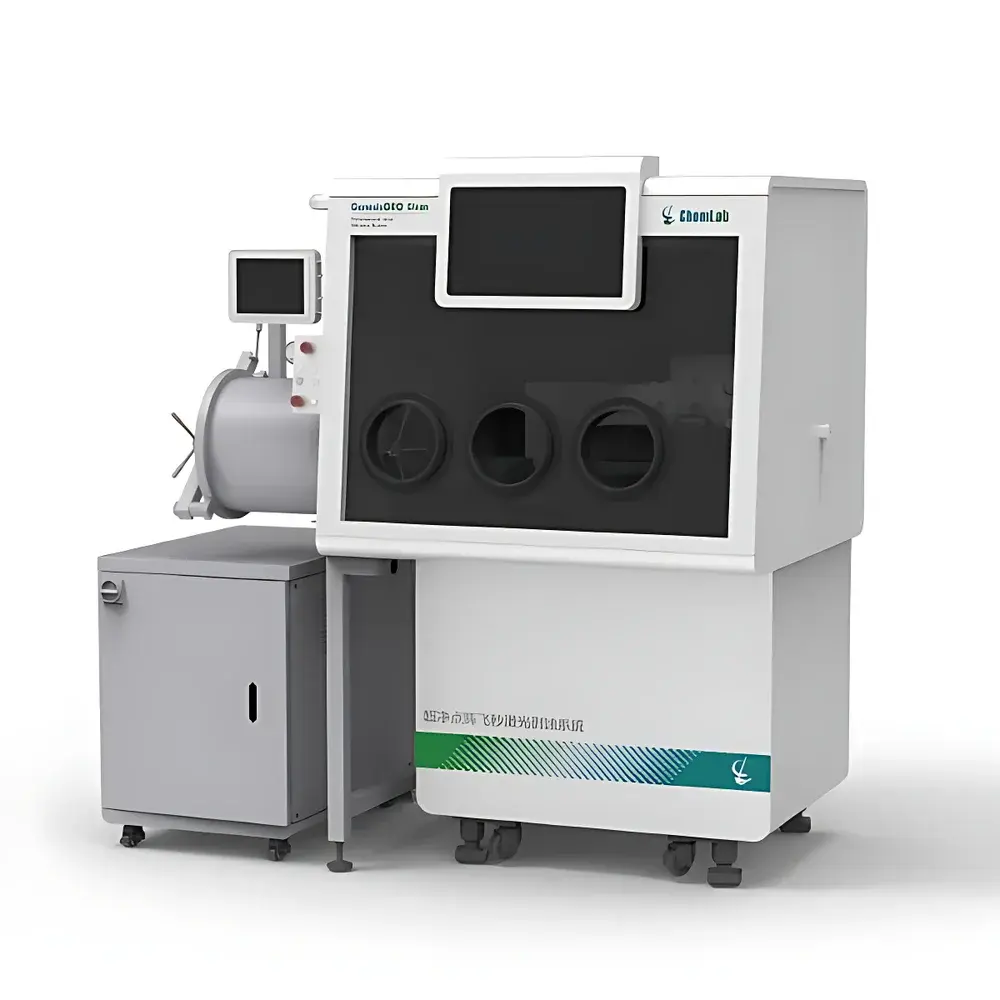
Chemlab GenesisGEO Clean Ultra-Clean Array Femtosecond Laser Ablation System
| Brand | Chemlab |
|---|---|
| Origin | Shanghai, China |
| Manufacturer Type | Original Equipment Manufacturer (OEM) |
| Region of Origin | Domestic (China) |
| Model | GenesisGEO Clean |
| Price Range | USD 480,000 – 550,000 |
Overview
The Chemlab GenesisGEO Clean Ultra-Clean Array Femtosecond Laser Ablation System is an engineered solution for high-precision, low-background laser ablation inductively coupled plasma mass spectrometry (LA-ICP-MS). It addresses the primary analytical limitation in ultra-trace elemental and isotopic analysis: environmental contamination introduced during sample ablation. Unlike conventional open or semi-sealed ablation cells, the GenesisGEO Clean implements a fully enclosed, dual-chamber architecture—comprising a load-lock sample buffer chamber and a hermetically isolated main ablation chamber—to eliminate exposure to ambient laboratory air. This design prevents introduction of airborne particulates (e.g., Na, K, Ca, Mg, Zn, Pb), hygroscopic surface adsorption, and humidity-driven background elevation. Operating under dynamically maintained inert gas (Ar or He) atmosphere with continuous vacuum-purge-and-refill cycles, the system ensures stable, reproducible aerosol generation and transport—critical for high-sensitivity U–Pb geochronology, nuclear forensics, environmental trace metal mapping, and isotopic microanalysis of heterogeneous solids.
Key Features
- Fully sealed dual-chamber architecture: Sample loading occurs in a vacuum-isolated buffer chamber, followed by inert gas purging and transfer to the main ablation chamber—ensuring zero ambient air ingress during analysis.
- Stable laminar aerosol transport: Enlarged chamber volume minimizes turbulent flow; integrated “mini-cup” aerosol delivery geometry optimizes particle transit time and reduces fractionation effects between ablation site and ICP-MS interface.
- No post-sample purge delay: Eliminates traditional 5–15 minute chamber flush cycles; full operational readiness is achieved within <60 seconds after sample exchange, enabling high-throughput sequential analysis.
- Extended spatial compatibility: Chamber internal dimensions support samples ranging from µm-scale mineral inclusions and thin-film coatings to decimeter-scale geological slabs, archaeological ceramics, and painted artifacts—without sectioning or conductive coating.
- Femtosecond laser integration: Compatible with commercial fs-laser sources (e.g., 200–500 fs pulse width, 1–10 kHz repetition rate, 193–1030 nm wavelength), enabling reduced thermal diffusion, minimized elemental fractionation, and high spatial resolution (<5 µm).
Sample Compatibility & Compliance
The GenesisGEO Clean accommodates diverse solid matrices—including silicates, oxides, metals, glasses, polymers, and biological tissues—without requiring matrix-matched standards for routine calibration. Its ultra-clean environment meets stringent requirements for low-blank geochemical laboratories conducting ISO/IEC 17025-accredited analyses. The system supports GLP-compliant workflows through hardware-integrated logging of chamber pressure, purge cycle count, gas composition, and laser firing events. While not inherently FDA 21 CFR Part 11-certified, its data audit trail architecture (via optional Chemlab LA-Log software module) facilitates validation for regulated environments where traceability of ablation conditions is required.
Software & Data Management
Control and monitoring are performed via Chemlab LA-Manager v4.x—a Windows-based application supporting synchronized laser triggering, stage motion, chamber pressure regulation, and real-time gas flow telemetry. All operational parameters—including ablation position coordinates, laser fluence, pulse count, dwell time, and chamber gas composition—are timestamped and embedded in raw data files (compatible with common ICP-MS vendor formats: Thermo .raw, Agilent .d, Nu .dat). Export options include CSV and HDF5 for downstream processing in Iolite, Glitter, or custom Python/MATLAB pipelines. Optional remote diagnostics and firmware update capability enable proactive maintenance planning without on-site service visits.
Applications
- High-precision U–Pb, Lu–Hf, and Sm–Nd isotopic dating of zircon, monazite, and apatite with sub-permil external reproducibility.
- In situ trace element mapping of meteoritic phases, nuclear fuel particles, and reactor-grade ceramics under cleanroom-equivalent ablation conditions.
- Quantitative multi-element analysis of atmospheric particulate matter collected on filters, with detection limits below 0.1 pg for heavy metals (Pb, Cd, As).
- Non-destructive compositional profiling of heritage materials—including pigment layers in Renaissance paintings and corrosion patinas on bronze artifacts.
- Depth-resolved analysis of thin-film solar cells, battery electrode cross-sections, and semiconductor heterostructures using line-scan or depth-stack protocols.
FAQ
Does the GenesisGEO Clean require external cleanroom infrastructure?
No. The system achieves Class 100 (ISO 5) equivalent cleanliness internally; no dedicated cleanroom space is needed. Standard laboratory HVAC suffices.
Can it be retrofitted to existing ICP-MS instruments?
Yes. The ablation cell features standardized 1/4″ Swagelok and CF-35 vacuum flanges, compatible with all major ICP-MS sample introduction systems (e.g., Thermo Neoma, Agilent 8900, Nu Instruments Attom).
What inert gases are supported?
Argon (standard), helium (for enhanced sensitivity), or mixed Ar/He—automatically regulated via integrated mass flow controllers.
Is laser alignment performed manually or automated?
Laser beam path alignment is factory-optimized and mechanically stabilized; user-level alignment is limited to coarse XY-stage positioning via software-guided fiducial targeting.
How is chamber cleanliness verified between runs?
Background spectra are acquired prior to each analysis sequence; real-time 208Pb, 232Th, and 238U intensities are logged and flagged if exceeding user-defined thresholds (default: <50 cps).





