
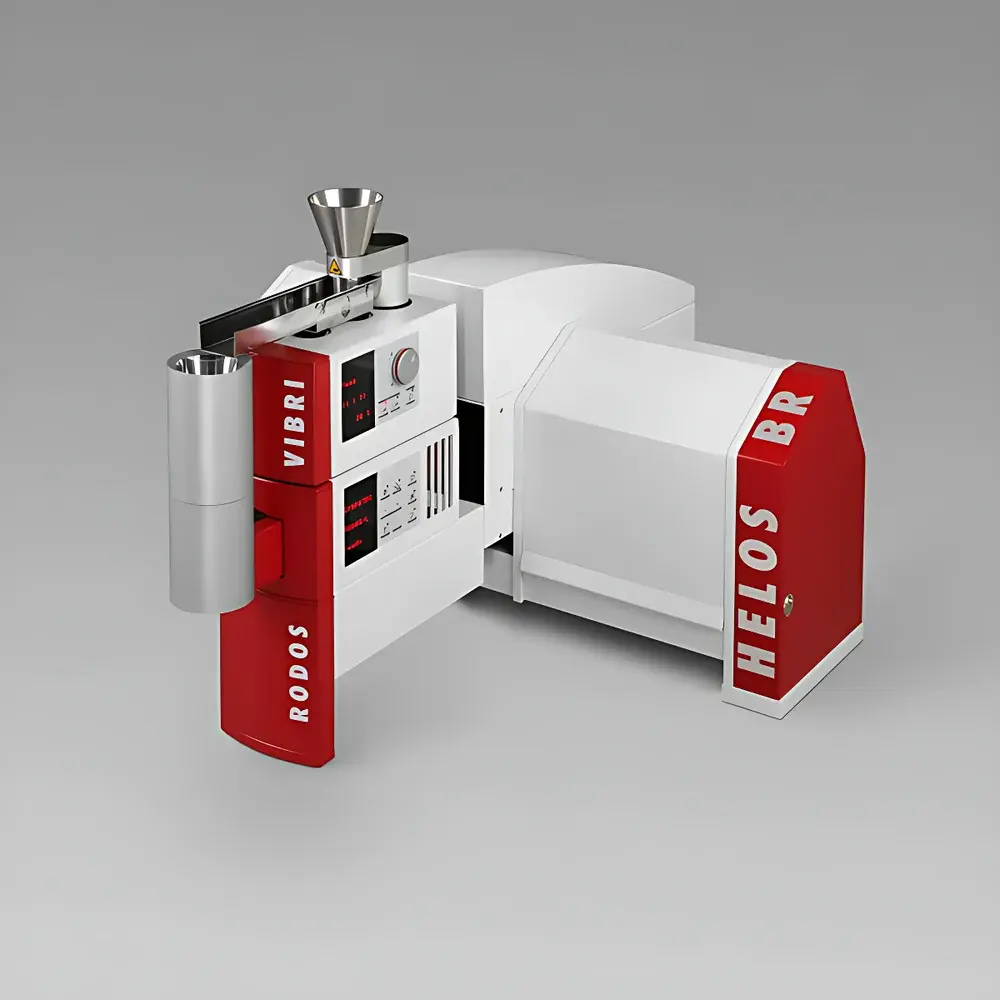
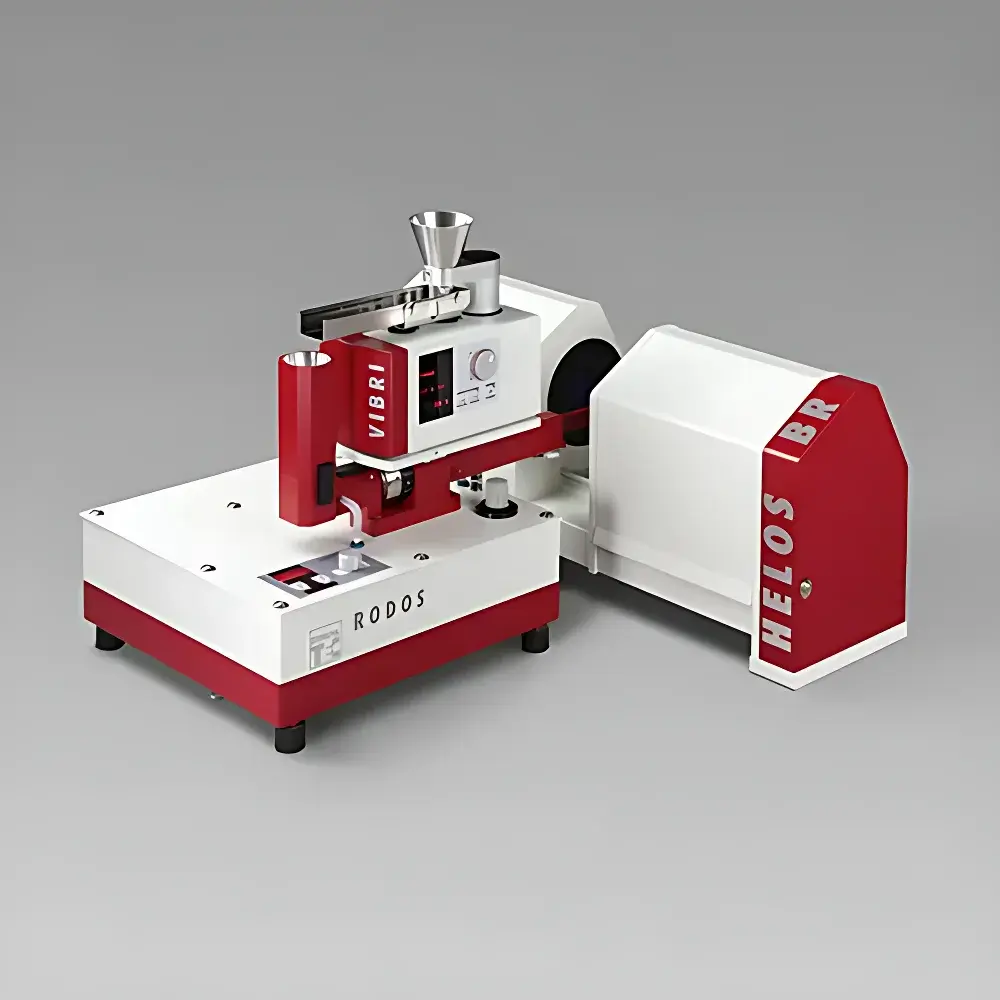
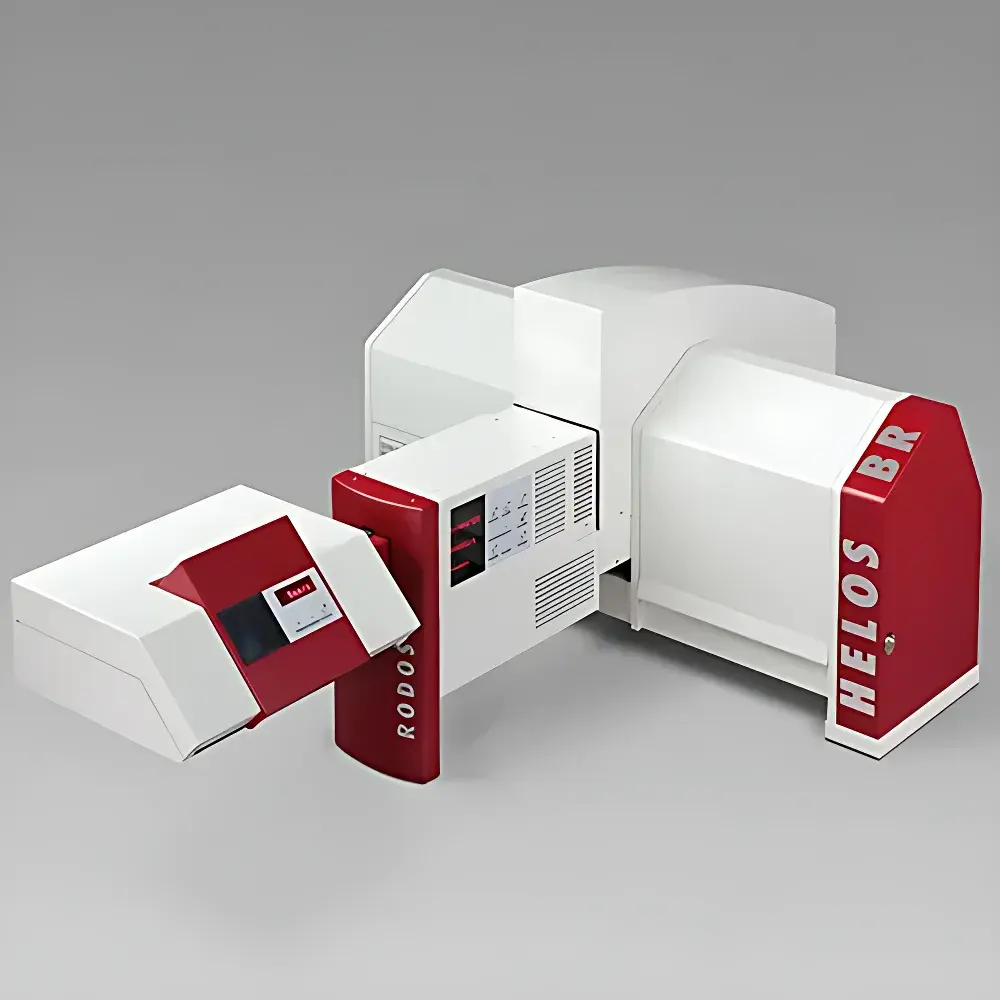
Sympatec HELOS & RODOS Dry-Dispersion Laser Diffraction Particle Size Analyzer
| Brand | Sympatec |
|---|---|
| Origin | Germany |
| Manufacturer Type | Original Equipment Manufacturer (OEM) |
| Product Category | Imported Instrument |
| Model | HELOS & RODOS |
| Dispersion Method | Dry Dispersion |
| Instrument Type | Laboratory Laser Diffraction Analyzer |
| Measurement Range | 0.1–3500 µm |
| Repeatability | ≤0.3% |
| Measurement Time | 10 s |
Overview
The Sympatec HELOS & RODOS is a high-precision, modular dry-dispersion laser diffraction particle size analyzer engineered for rigorous laboratory environments where representative sampling and complete deagglomeration of dry powders are critical to analytical validity. Based on the ISO 13320:2020 standard (Clause 6.2), accurate particle size distribution (PSD) determination requires both statistically representative sampling and full dispersion of agglomerates into primary particles prior to optical measurement. Unlike wet-dispersion systems that introduce solvent-dependent artifacts or compromise hygroscopic or reactive materials, the HELOS & RODOS implements a true “dry sample, dry measurement” paradigm—eliminating dispersants, solvents, and associated cleaning cycles while preserving intrinsic particle morphology and surface chemistry. Its optical core employs Mie theory-based laser diffraction with a fixed-focus, multi-angle detection array (17 angular sectors), enabling robust quantification across a dynamic range from 0.1 µm to 3500 µm in a single measurement. The system’s architecture integrates real-time scattering signal acquisition with synchronized pneumatic dispersion control, ensuring measurement integrity under GLP-compliant workflows.
Key Features
- Dry-only operation: No solvents, surfactants, or liquid media required—ideal for moisture-sensitive, pyrophoric, or thermally labile powders.
- RODOS high-efficiency dry dispersion unit: Utilizes three synergistic physical mechanisms—(1) velocity-gradient-induced shear forces within the dispersion tube, (2) inter-particle collision energy transfer between size-distributed particles, and (3) particle–wall impact attrition—to fully deagglomerate cohesive submicron powders down to 0.1 µm.
- Precisely adjustable dispersion energy: Compressed air pressure regulated from 0.1 to 6 bar, allowing method optimization for fragile vs. robust materials without mechanical grinding or ultrasonication.
- Self-cleaning dispersion pathway: Patented geometry and laminar flow design prevent cross-contamination; no manual disassembly required between samples—even across dissimilar chemistries (e.g., pharmaceutical APIs followed by battery cathode precursors).
- Modular scalability: HELOS optical platform supports seamless integration of GRADIS (gravity-fed dispersion), ASPIROS (sub-0.1 mg automated dosing), or VIBRI (vibrated bulk feeding) modules based on throughput and mass requirements.
- Stainless-steel construction: Fully welded AISI 316L housing and fluidic pathways ensure corrosion resistance, cleanability, and compliance with ISO 14644-1 Class 5 cleanroom-compatible installation.
Sample Compatibility & Compliance
The HELOS & RODOS accommodates sample masses ranging from <0.1 mg (ASPIROS module) to several kilograms (VIBRI), supporting regulatory-grade batch release testing and R&D screening. It complies with ISO 13320 for laser diffraction methodology, ASTM D4294 (for catalysts and pigments), and USP for pharmaceutical particulate characterization. Software validation packages include full 21 CFR Part 11 compliance (electronic signatures, audit trails, role-based access control), IQ/OQ documentation templates, and GMP-aligned calibration protocols traceable to NIST SRM 1963 and 2806. All dispersion and measurement parameters are logged with timestamped metadata, satisfying FDA and EMA data integrity expectations per ALCOA+ principles.
Software & Data Management
WINDOX 7 software provides instrument control, real-time scatter pattern visualization, and ISO-standard PSD reporting (D10, D50, D90, span, relative width). It supports customizable report generation—including overlay comparisons of up to 16 measurements, statistical process control (SPC) charts, and export to CSV, PDF, or LIMS-ready XML. Batch processing, method templating, and automated pass/fail evaluation against user-defined specification limits enhance throughput in QC labs. Raw scattering data (.wdf files) are stored with full parameter history, enabling retrospective reprocessing without re-measurement. Audit trail records all user actions, parameter changes, and calibration events—fully searchable and exportable for regulatory submissions.
Applications
The HELOS & RODOS is deployed across industries demanding high-fidelity dry-powder characterization: active pharmaceutical ingredient (API) crystallization monitoring, cathode/anode material QA in lithium-ion battery manufacturing, additive manufacturing feedstock qualification (Ti-6Al-4V, Inconel 718), ceramic green-body formulation, cement clinker fineness control, food powder flowability assessment (milk powder, cocoa), and geological sediment analysis. Its ability to resolve fine fractions (1000 µm) makes it uniquely suited for asymmetric distributions common in milling, spray drying, and mechanical alloying processes.
FAQ
How does RODOS achieve full dispersion without mechanical grinding?
RODOS relies exclusively on aerodynamic shear, inter-particle collisions, and wall impacts—no rotating blades or vibrating mills—preserving particle integrity and eliminating contamination from wear debris.
Can the system handle hazardous or toxic powders?
Yes—ASPIROS enables glove-box or isolator integration with sealed sample loading; all dispersion occurs within closed, negative-pressure pathways meeting OSHA PEL and EU REACH exposure limits.
Is method transfer possible between HELOS & RODOS and wet-dispersion systems?
Method equivalence studies per ISO 13320 Annex B are supported via WINDOX’s comparative analysis tools; however, dry results reflect inherent agglomeration state and are not mathematically convertible to wet data.
What maintenance is required for long-term operational reliability?
Annual optical alignment verification and biannual dispersion nozzle inspection are recommended; the stainless-steel fluidics require only periodic compressed-air filter replacement and no lubrication.
Does the system support automated unattended operation?
With VIBRI or ASPIROS modules and optional barcode reader, up to 96 samples can be queued and processed overnight with full electronic record retention and email alerts upon completion.



