
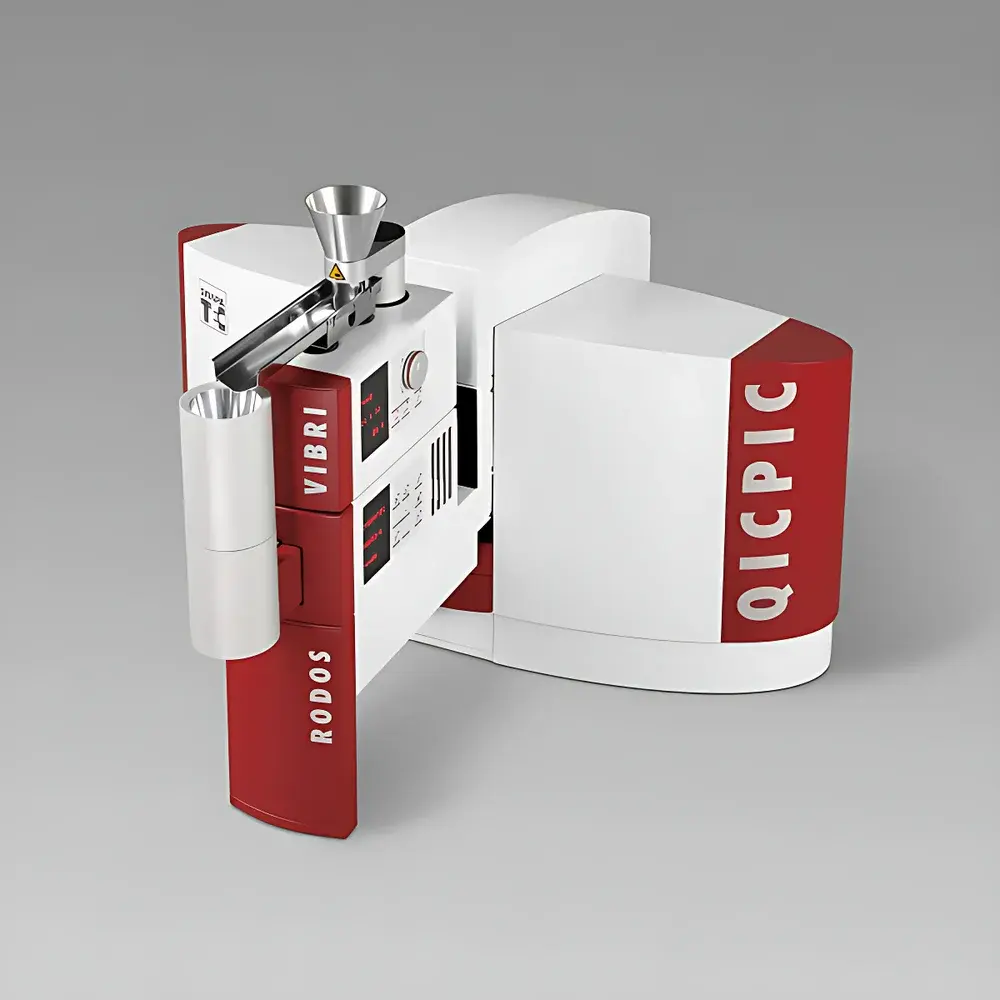
Sympatec QICPIC & RODOS Dry-Dispersion Dynamic Image Analysis System
| Brand | Sympatec |
|---|---|
| Origin | Germany |
| Manufacturer | Sympatec GmbH |
| Type | Import |
| Model | QICPIC & RODOS/L |
| Instrument Category | Dynamic Image-Based Particle Analyzer |
| Number of Lenses | 5 |
| Measurement Range | 1.8–33,792 µm |
| Dispersion Method | Pneumatic (Compressed Air) |
| Image Resolution | 4.2 MP |
| Measured Parameters | Chord Length, Feret Diameter (max/min/mean), Fiber Length, Fiber Diameter, Equivalent Circular Diameter, Sphericity, Aspect Ratio, Convexity, Flatness, Elongation, Perimeter-Weighted Diameter (PED), Length-to-Width Ratio (L/W), VBFD (Volume-Based Fiber Dimension), LEFI/DIFI |
Overview
The Sympatec QICPIC & RODOS is a high-speed, dry-dispersion dynamic image analysis system engineered for precise, statistically robust characterization of particle size and shape in free-flowing powders and granular materials. Operating on the principle of pulsed backlight illumination and high-frame-rate digital imaging, the system captures sharp silhouette images of individual particles as they pass through a defined measurement zone at velocities controlled by pneumatic dispersion. Unlike static or sedimentation-based methods, QICPIC employs true dynamic imaging—particles are analyzed *in motion*, eliminating settling artifacts and enabling representative sampling of heterogeneous bulk materials. The integrated RODOS dry disperser delivers consistent, reproducible de-agglomeration using controlled compressed air shear forces, ensuring primary particle liberation without mechanical attrition. This architecture aligns with ISO 13322-2:2020 (Particle Size Analysis — Image Analysis Methods — Part 2: Dynamic Image Analysis) and supports regulatory-compliant workflows in GMP environments where traceability and data integrity are mandatory.
Key Features
- Five-lens optical configuration enables simultaneous multi-angle imaging and depth-of-field optimization across the full 1.8–33,792 µm range, minimizing out-of-focus bias in elongated or irregular particles.
- High-speed imaging at up to 500 frames per second ensures capture of transient particle orientations during dispersion, improving statistical confidence for shape descriptors such as sphericity, convexity, and aspect ratio.
- RODOS dry disperser offers two interchangeable feed modules: VIBRI (vibratory feeder) for routine bulk powder analysis and ASPIROS (aspirator-based micro-feeder) for low-mass, toxic, or hygroscopic samples—both fully sealed and compatible with inert gas purging.
- 4.2-megapixel monochrome CMOS sensor delivers sub-pixel edge resolution, supporting accurate chord-length distribution and Feret-based dimensional analysis per ISO 9276-6:2008.
- Real-time particle classification allows user-defined logical filters (e.g., “sphericity 5”) to isolate and visualize morphologically distinct subpopulations directly from raw image data.
- System architecture supports 21 CFR Part 11-compliant audit trails, electronic signatures, and role-based access control when operated with Sympatec’s WINDOX 7 software platform.
Sample Compatibility & Compliance
QICPIC & RODOS is validated for dry, non-sticky, free-flowing particulates including metallic powders (e.g., Ni, Ti-6Al-4V), pharmaceutical excipients (microcrystalline cellulose, lactose, methylcellulose), food-grade powders (instant coffee, milk powder, cocoa), and tobacco cut filler. It excludes cohesive, electrostatically charged, or highly fibrous materials requiring wet dispersion or alternative preparation. The system complies with ISO 13322-2, ASTM E2457 (Standard Practice for Characterization of Particles by Dynamic Image Analysis), and supports GLP/GMP documentation requirements through automated metadata logging (dispersion pressure, feed rate, ambient temperature/humidity, calibration timestamp). No solvents, surfactants, or carrier liquids are introduced—eliminating contamination risk and simplifying cleaning validation per EU Annex 15.
Software & Data Management
WINDOX 7 serves as the unified software environment, providing ISO/IEC 17025-aligned reporting templates, customizable export formats (CSV, PDF, XML), and embedded uncertainty estimation per ISO/IEC Guide 98-3. All raw images, metadata, and processed results are stored in a relational database with version-controlled backups. Video playback mode allows frame-by-frame review of particle trajectories; the particle library supports annotation, batch reprocessing, and comparative overlay of multiple distributions. Data exports include full traceability: instrument ID, operator login, calibration certificate number, and environmental logs—essential for FDA inspection readiness and internal quality audits.
Applications
- Pharmaceutical solid dosage development: Quantifying fiber aspect ratio and surface roughness of HPMC in direct compression blends to predict tablet tensile strength and disintegration behavior.
- Food powder quality control: Detecting coffee chaff fragments (low sphericity, high aspect ratio) in roasted ground coffee using LEFI/VBFD thresholds to ensure sensory consistency.
- Advanced manufacturing: Monitoring metal powder morphology evolution after plasma atomization or ball milling to correlate particle shape with laser powder bed fusion (LPBF) flowability and porosity.
- Tobacco processing: Classifying cut filler morphology (Feret min vs. max) to optimize cigarette paper burn rate and tar delivery profiles.
- Regulatory submissions: Generating particle shape descriptors compliant with ICH Q5A(R2) and USP supplementary guidance for parenteral particulate matter assessment.
FAQ
What is the minimum detectable particle size under dry dispersion conditions?
The effective lower limit is application-dependent but typically stabilizes at ~1.8 µm for well-dispersed, high-contrast particles under optimal RODOS pressure and feed rate settings.
Can QICPIC distinguish between agglomerates and primary particles?
Yes—via high-resolution edge detection and convex hull analysis; however, complete de-agglomeration must be achieved physically via RODOS parameters prior to imaging.
Is wet dispersion supported?
No—QICPIC & RODOS is exclusively a dry-dispersion platform. For liquid-phase analysis, Sympatec’s FLEX and CAMSIZER X2 systems are recommended.
How is system calibration verified?
Using NIST-traceable glass microsphere standards (e.g., Duke Scientific 3000 series) imaged under identical optical and dispersion conditions; calibration certificates are generated and archived within WINDOX.
Does the system support automated pass/fail testing against specification limits?
Yes—customizable acceptance criteria can be programmed per parameter (e.g., “% particles with sphericity < 0.6 ≤ 5%”), triggering real-time alerts and report generation.



