
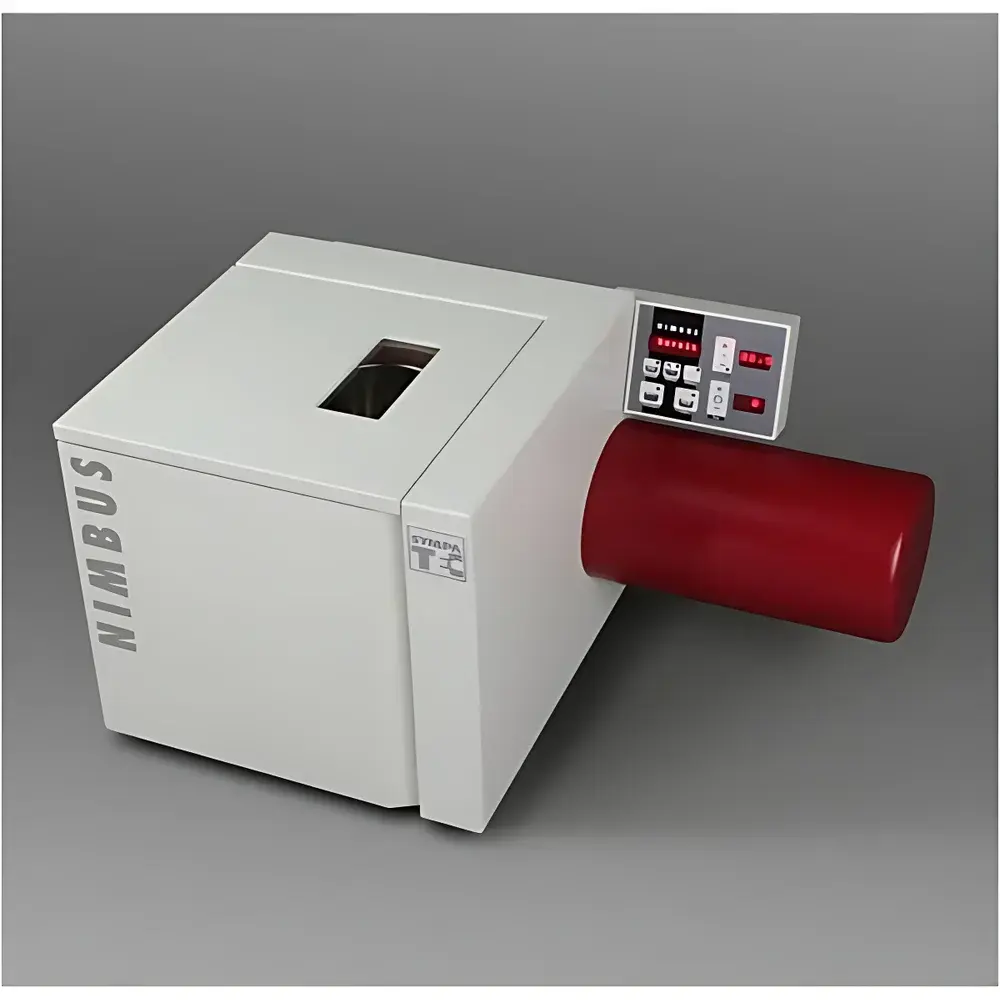
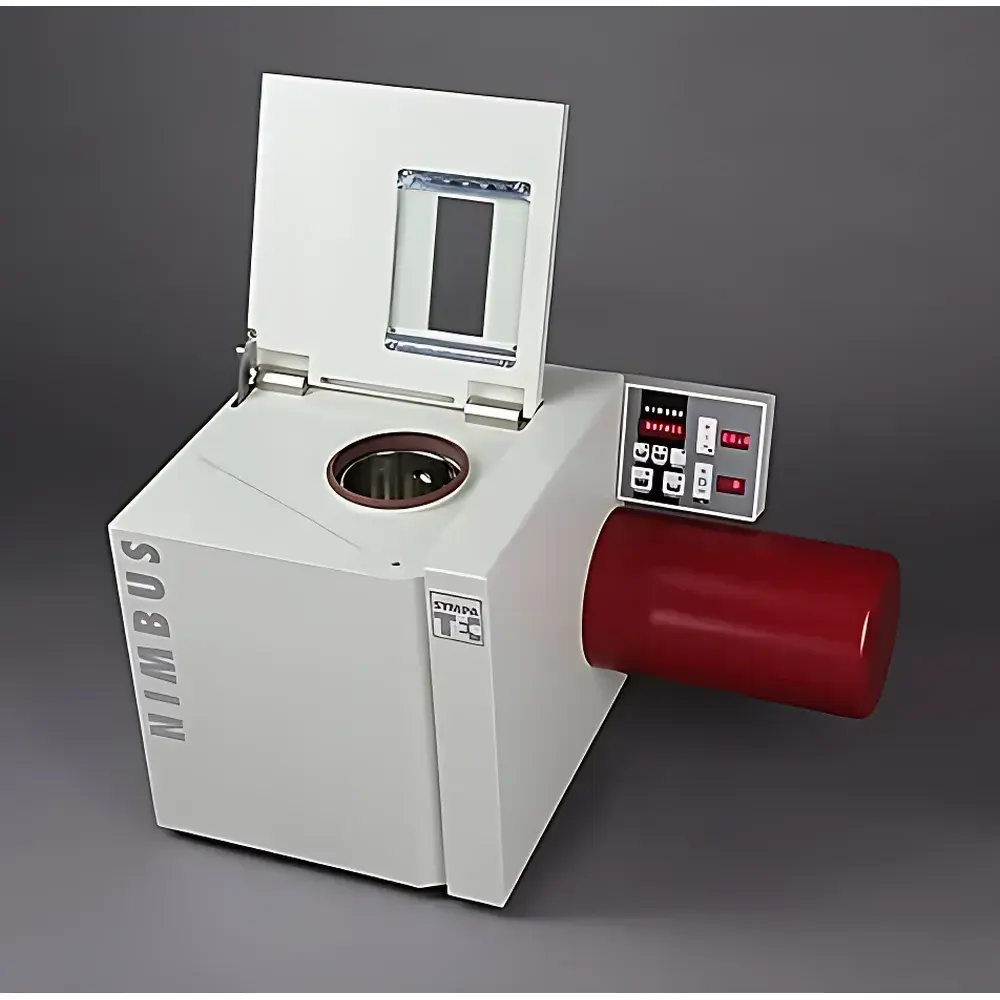
Sympatec NIMBUS Ultrasonic Attenuation Particle Size Analyzer
| Brand | Sympatec |
|---|---|
| Origin | Germany |
| Manufacturer Type | Original Equipment Manufacturer (OEM) |
| Country of Origin | Imported |
| Model | NIMBUS |
| Pricing | Upon Request |
Overview
The Sympatec NIMBUS Ultrasonic Attenuation Particle Size Analyzer is an industrial-grade, in-line and at-line measurement system engineered for robust, non-invasive characterization of particle size distribution (PSD) and volumetric concentration in highly challenging liquid-phase dispersions. Unlike optical techniques—such as laser diffraction or dynamic light scattering—the NIMBUS operates on the physical principle of ultrasonic attenuation spectroscopy (UAS). In this method, a broadband radio-frequency (RF) ultrasonic wave (typically 1–200 MHz) is transmitted through a sample cell; particles suspended in the medium interact with the acoustic field via mechanisms including viscous absorption, thermal conduction, and scattering. The resulting frequency-dependent attenuation spectrum is mathematically inverted using well-established physicoacoustic models (e.g., Epstein–Carhart–Allegra–Hawley formalism) to resolve the full PSD across a wide dynamic range—without assumptions about particle shape or optical properties. This makes the NIMBUS uniquely suited for opaque, colored, highly concentrated, or chemically aggressive systems where optical methods fail.
Key Features
- Ultrasonic attenuation spectroscopy enables direct, calibration-free quantification of both particle size distribution and volumetric concentration simultaneously.
- Robust wet-cell design accommodates suspension concentrations up to 70% v/v—far exceeding the practical limits of laser-based instruments.
- Chemically inert flow path constructed from stainless steel, SIGRADUR® (a high-performance graphite composite), and reinforced PTFE (Teflon®), ensuring compatibility with pH 1–14 media, strong acids/bases, oxidizers, and abrasive slurries.
- Temperature-stable operation up to 80 °C, supporting process monitoring under realistic industrial conditions.
- Typical measurement time <60 seconds per acquisition, enabling rapid batch qualification or real-time trend analysis.
- Modular cell geometry: interchangeable sample cells with volumes ranging from 250 mL to 1000 mL, optimized for laboratory R&D or pilot-scale validation.
Sample Compatibility & Compliance
The NIMBUS is routinely deployed in quality-critical environments governed by ISO 13320 (ultrasonic particle sizing), ASTM E2927 (standard guide for ultrasonic spectroscopy), and regulatory frameworks requiring auditable measurement traceability. Its material compatibility and absence of optical windows eliminate contamination risk and degradation in corrosive or particulate-laden streams—making it suitable for GMP-compliant pharmaceutical wet granulation monitoring, battery slurry QC (e.g., cathode/anode suspensions), catalyst slurry formulation in petrochemical refining, and pigment dispersion control in coatings manufacturing. All hardware and firmware comply with CE, EMC Directive 2014/30/EU, and RoHS 2011/65/EU requirements.
Software & Data Management
The instrument is controlled via Sympatec’s proprietary WINDOX 7 software platform, which provides full compliance with FDA 21 CFR Part 11 (electronic records/signatures) through role-based access control, automated audit trails, electronic signature workflows, and data integrity safeguards. Raw attenuation spectra, inverted PSDs (dV/dlogD, dQ/dlogD), concentration trends, and statistical repeatability metrics (e.g., σ < 0.5% for single-sample repeatability) are stored in vendor-neutral HDF5 format. Export options include CSV, XML, and PDF reports compliant with GLP documentation standards. Software includes built-in uncertainty estimation per ISO/IEC Guide 98-3 (GUM), and supports integration into MES/SCADA systems via OPC UA and Modbus TCP protocols.
Applications
- Real-time monitoring of ceramic, metal, and polymer nanoparticle dispersions during synthesis and stabilization.
- Concentration and agglomerate size tracking in lithium-ion battery electrode slurries (aqueous and NMP-based).
- Stability assessment of emulsions and microemulsions in personal care and food formulations.
- In-process control of crystallization endpoints in API manufacturing (e.g., paracetamol, ibuprofen).
- Characterization of abrasive mineral slurries in mining and tailings management.
- Validation of homogenization and milling efficiency in high-shear wet media milling processes.
FAQ
Does the NIMBUS require optical transparency of the sample?
No. Ultrasonic attenuation is insensitive to color, turbidity, or opacity—enabling measurements in black slurries, dyed emulsions, and carbon-loaded suspensions.
Can it distinguish between primary particles and agglomerates?
Yes. Frequency-resolved attenuation profiles contain distinct signatures for different scattering regimes; advanced inversion algorithms resolve multimodal distributions reflecting both primary and hydrodynamic agglomerate populations.
Is calibration with reference standards necessary?
No. The technique is first-principles-based and does not rely on empirical calibration curves; however, system verification using NIST-traceable polystyrene latex (PSL) suspensions is recommended for periodic performance qualification.
What maintenance is required for long-term operational reliability?
Minimal. No consumables or optical components are involved. Routine verification includes acoustic coupling fluid level check, temperature sensor calibration, and periodic cell cleaning with compatible solvents per SOP.
Can the NIMBUS be integrated into automated production lines?
Yes. It supports analog 4–20 mA output, digital I/O triggers, and industrial communication protocols—including EtherNet/IP and PROFINET—for seamless PLC integration and closed-loop process control.
Related Products



