
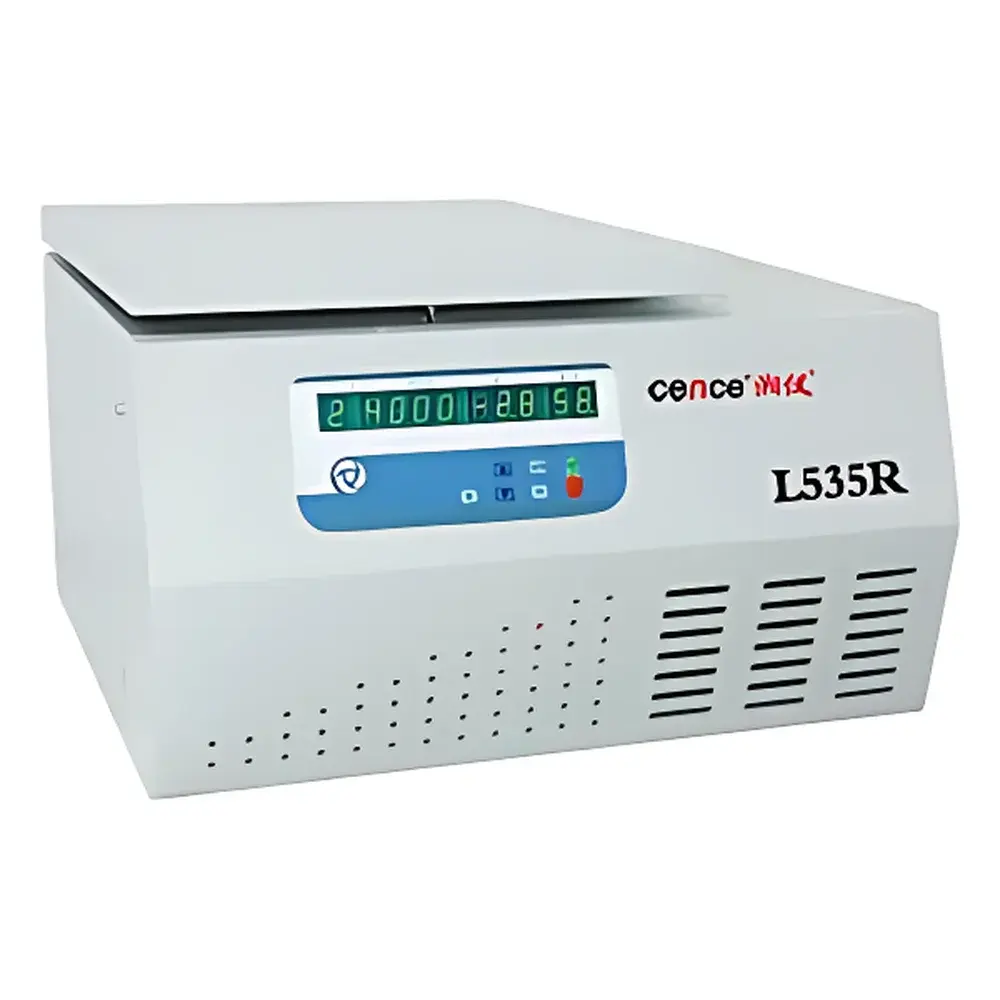
Xiangyi L535R Low-Speed High-Capacity Refrigerated Centrifuge
| Brand | Xiangyi |
|---|---|
| Origin | Hunan, China |
| Manufacturer Type | Direct Manufacturer |
| Instrument Type | Benchtop Centrifuge |
| Speed Range | Up to 5350 rpm |
| Max RCF | 5030 × g |
| Max Capacity | 4 × 750 mL |
| Temperature Range | −20 °C to +40 °C |
| Temp Control Accuracy | ±1 °C |
| Noise Level | <65 dB(A) |
| Power Supply | AC 220 V ±22 V, 50 Hz, 10 A |
| Dimensions | 710 × 630 × 440 mm |
| Weight | 75 kg |
| Refrigerant | R404A (environmentally compliant) |
| Drive System | AC Brushless Motor with Microprocessor Control |
| Acceleration/Deceleration Profiles | 9 ramp-up and 10 ramp-down curves |
| Safety Features | Overspeed, overtemperature, door interlock, imbalance detection, dual-stage damping |
Overview
The Xiangyi L535R Low-Speed High-Capacity Refrigerated Centrifuge is an engineered benchtop solution designed for routine and high-throughput separation tasks in life science laboratories, bioprocessing facilities, and clinical diagnostics environments. Operating on the principle of sedimentation under controlled gravitational force (RCF), the L535R delivers precise, reproducible separations of cells, bacteria, organelles, and large particulates from suspension media. Its refrigerated architecture—powered by a high-efficiency, environmentally compliant R404A compressor—maintains sample integrity by stabilizing temperature across the full operational range (−20 °C to +40 °C), with active cooling sustained even at maximum rotor speed (5350 rpm), ensuring thermal stability down to −4 °C during extended runs. The unit’s robust cast-aluminum housing, dual-stage mechanical damping system, and brushless AC motor eliminate carbon dust generation and reduce maintenance requirements—critical for GLP-compliant workflows where instrument traceability and long-term reliability are mandated.
Key Features
- Microprocessor-controlled operation with real-time RCF calculation and automatic conversion between rpm and ×g values.
- Programmable memory for up to multiple user-defined protocols—including time, speed, temperature, acceleration, and deceleration profiles.
- Configurable deceleration: 10 selectable braking curves to minimize resuspension of delicate pellets, especially critical for erythrocyte, lymphocyte, or bacterial pellet integrity.
- Comprehensive safety architecture: integrated overspeed protection, real-time rotor temperature monitoring, automatic door interlock, dynamic imbalance detection, and emergency brake activation.
- Low-noise design (<65 dB[A]) achieved through precision-balanced rotors, vibration-dampened suspension, and acoustic insulation—suitable for shared laboratory spaces.
- Energy-efficient 1600 W power consumption with stable performance under voltage fluctuation (±10 %).
Sample Compatibility & Compliance
The L535R supports broad sample format flexibility via six interchangeable rotor families—including fixed-angle, horizontal swing-out, microplate, and specialized blood-collection configurations. Standard rotor options accommodate volumes from 4 × 24 × 5 mL vacutainers (clinical hematology) to 4 × 750 mL bottles (cell culture harvest), with optional sealed buckets for biosafety level 2 (BSL-2) applications. All rotors are certified for autoclaving (121 °C, 20 min) and manufactured to ISO 13485-aligned quality standards. The centrifuge complies with IEC 61010-1 (safety of laboratory equipment), EN 61326-1 (EMC), and meets essential requirements for CE marking. While not FDA 21 CFR Part 11–validated out-of-the-box, its audit-ready event log (including timestamped run records, error codes, and parameter changes) supports retrospective validation for GMP/GLP documentation.
Software & Data Management
The embedded control interface provides intuitive menu navigation via a high-contrast LCD display with tactile keypad input. All operational parameters—including start/stop timestamps, setpoints, actual measured RCF, temperature drift, and fault logs—are stored internally for ≥1000 cycles. Data export is supported via USB port (CSV format) for integration into LIMS or ELN platforms. Optional PC-based software (Xiangyi CentriLink v3.x) enables remote monitoring, batch protocol deployment, electronic signature capture, and PDF report generation—facilitating alignment with ALCOA+ data integrity principles.
Applications
- Cell harvesting and washing in mammalian and microbial culture workflows.
- Plasma and serum separation from whole blood using standardized 5–15 mL tubes or high-volume 500–750 mL containers.
- Precipitation of subcellular fractions (e.g., nuclei, mitochondria) prior to downstream enzymatic or genomic analysis.
- Clarification of fermentation broths and bioreactor harvests in process development labs.
- High-capacity processing of diagnostic specimens in clinical core labs requiring CLIA-compliant centrifugation consistency.
- Preparative isolation of extracellular vesicles (EVs) when paired with density gradient media and appropriate swing-bucket rotors.
FAQ
What is the maximum permissible ambient temperature for continuous operation?
The L535R is rated for ambient temperatures up to 32 °C; operation above this may impair cooling efficiency and trigger thermal shutdown.
Can the L535R be used for radioactive samples?
Yes—when equipped with sealed, gamma-sterilizable rotors and buckets; users must verify compatibility with local radiation safety protocols and perform leak testing per ANSI N13.1.
Is rotor No.4 compatible with 750 mL disposable bottles from major suppliers (e.g., Corning, Thermo Fisher)?
Yes—rotor No.4 (4 × 750 mL horizontal) accepts standard conical-bottom polypropylene bottles with external diameters ≤110 mm and heights ≤220 mm.
Does the centrifuge support 21 CFR Part 11 compliance?
Out-of-the-box functionality does not include electronic signatures or audit-trail encryption; however, validated third-party middleware or Xiangyi’s optional CentriLink software package can be deployed to meet Part 11 requirements.
What maintenance intervals are recommended for the refrigeration system?
Compressor oil and filter inspection every 24 months; refrigerant pressure check annually; full system calibration (speed, temperature, timer) recommended biannually per ISO/IEC 17025 guidelines.



