
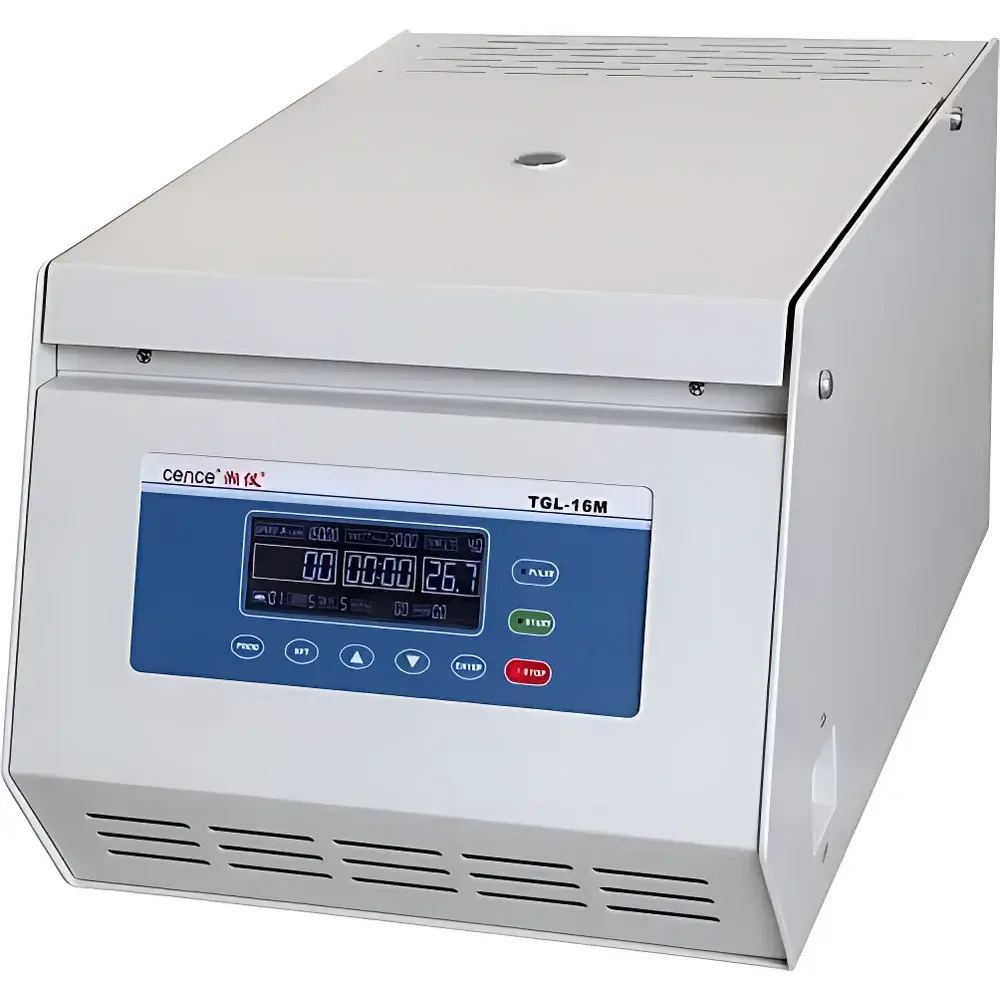
Xiangyi TGL-16M Benchtop High-Speed Refrigerated Centrifuge
| Brand | Xiangyi |
|---|---|
| Origin | Hunan, China |
| Manufacturer Type | Direct Manufacturer |
| Product Category | Domestic |
| Model | TGL-16M |
| Instrument Type | Benchtop Centrifuge |
| Speed Range | 10,000–30,000 rpm (operational max: 16,000 rpm) |
| Max Capacity | 4 × 100 mL |
| Max RCF | 21,532 × g |
| Dimensions (L×W×H) | 410 × 700 × 370 mm |
| Temperature Range | −20 °C to +40 °C |
| Temp Control Accuracy | ±1 °C |
| Noise Level | < 65 dB(A) |
| Power Supply | AC 220 V ± 22 V, 50 Hz, 10 A |
| Power Consumption | 1200 W |
| Weight | 85 kg |
| Refrigerant | R134a |
| Motor | Brushless DC Inverter Motor |
| Acceleration/Deceleration Profiles | 9 acceleration + 10 deceleration curves |
| Safety Features | Overspeed protection, overtemperature cutoff, auto-locking lid, stainless steel rotor chamber, triple-layer safety shielding |
| Programmability | Multi-step protocol storage, user-defined speed/time/ramp profiles |
Overview
The Xiangyi TGL-16M Benchtop High-Speed Refrigerated Centrifuge is engineered for precision separation of biological, clinical, and analytical samples under controlled low-temperature conditions. Utilizing a brushless DC inverter motor with direct drive architecture, it eliminates carbon brush wear and associated particulate contamination—ensuring long-term rotational stability and compliance with Good Laboratory Practice (GLP) requirements for reproducible sample processing. Its refrigerated operation maintains chamber temperatures between −20 °C and +40 °C, with active cooling sustaining ≤ −6 °C even at maximum rotational speeds (16,000 rpm), thereby preserving thermolabile macromolecules such as nucleic acids, enzymes, and membrane vesicles during high-g-force sedimentation. Designed as a compact benchtop platform, the TGL-16M delivers up to 21,532 × g relative centrifugal force (RCF) within a footprint of 410 × 700 × 370 mm—making it suitable for space-constrained biosafety cabinets, core facilities, and QC laboratories requiring routine high-speed pelleting or density gradient separations.
Key Features
- Brushless DC inverter motor with direct drive: Ensures precise speed control (±30 rpm), minimal vibration, and zero carbon dust generation—critical for sterile environments and extended rotor service life.
- High-efficiency refrigeration system: Equipped with an imported compressor and environmentally compliant R134a refrigerant; achieves rapid cooldown and maintains thermal stability across all operating speeds.
- Intuitive programmable interface: Large backlit LCD display enables real-time monitoring and independent adjustment of speed (100–16,000 rpm), time (1 min to 99 min 59 sec), and acceleration/deceleration profiles.
- Flexible rotor library: Supports 10 interchangeable rotors—including fixed-angle, swing-bucket, and microplate carriers—enabling scalable workflows from microliter-scale nucleic acid purification to 100 mL cell culture harvests.
- Multi-stage mechanical safety architecture: Includes automatic lid interlock, overspeed detection, real-time temperature monitoring, stainless-steel chamber lining, and triple-layer physical containment to meet IEC 61010-2-020 safety standards for laboratory centrifuges.
- Low-noise operation: Acoustic output maintained below 65 dB(A) at full load—compatible with open-plan lab environments and adjacent instrumentation sensitive to mechanical interference.
Sample Compatibility & Compliance
The TGL-16M accommodates a broad spectrum of sample formats including Eppendorf tubes (1.5–2.2 mL), conical centrifuge tubes (5–100 mL), microtiter plates (96-well and 48-well configurations), and specialized containers for density gradient media (e.g., sucrose, iodixanol). All rotors are balanced per ISO 1585:2017 and validated for continuous operation at rated speeds and loads. The unit complies with CE marking requirements (2014/30/EU EMC Directive and 2014/35/EU Low Voltage Directive), conforms to GB/T 19436.1–2013 (Chinese national standard for centrifuge safety), and supports audit-ready documentation for GLP and GMP-aligned quality systems. Optional traceable calibration certificates are available per ISO/IEC 17025 guidelines.
Software & Data Management
While the TGL-16M operates via embedded firmware without external PC dependency, its programmable memory retains up to 20 user-defined protocols—including multi-step ramp sequences and hold phases—with non-volatile storage ensuring persistence after power cycling. Timestamped operational logs record run parameters (speed, RCF, duration, temperature setpoint, actual chamber temp), supporting internal QA review and deviation investigations. For integration into LIMS or ELN ecosystems, optional RS-232 or USB-to-serial interfaces enable export of ASCII-formatted run reports compatible with common data analysis platforms. All firmware updates are delivered via secure offline firmware loader, maintaining integrity in regulated environments where network connectivity is restricted per FDA 21 CFR Part 11 Annex 11 principles.
Applications
- Cell fractionation: Isolation of nuclei, mitochondria, lysosomes, and plasma membranes via differential centrifugation protocols.
- Molecular biology: Rapid pelleting of plasmid DNA, RNA precipitates, and PCR products; preparation of competent cells.
- Clinical diagnostics: Serum/plasma separation from whole blood; isolation of exosomes and microvesicles using high-RCF protocols.
- Pharmaceutical QC: Clarification of protein formulations, virus-like particle (VLP) harvesting, and excipient removal prior to HPLC analysis.
- Environmental microbiology: Concentration of waterborne pathogens (e.g., E. coli, Legionella) from large-volume filtration eluates.
- Academic research: Routine purification of bacteriophage stocks, ribosomal subunits, and synthetic nanoparticles requiring consistent g-force application.
FAQ
What is the maximum allowable imbalance tolerance for the TGL-16M?
The centrifuge accepts a maximum load imbalance of ≤ 5 g per rotor position when using matched tubes; imbalance detection triggers immediate deceleration and audible alarm.
Can the TGL-16M operate continuously at −20 °C?
Yes—the refrigeration system sustains −20 °C setpoints during prolonged runs (up to 99 min 59 sec), though ambient lab temperature must remain ≤ 30 °C for optimal compressor performance.
Are rotors autoclavable?
Fixed-angle aluminum rotors (e.g., No.1–No.9) are not autoclavable; they are cleaned with 70% ethanol and air-dried. Stainless-steel horizontal buckets (No.5, No.6) may be sterilized via dry heat (160 °C, 2 h) only—autoclaving voids warranty.
Does the unit support validation documentation for ISO 13485 or FDA audits?
Yes—Xiangyi provides IQ/OQ templates, factory calibration records, and material certifications upon request; on-site PQ support is available through authorized service partners.
How often does the refrigerant require servicing?
Under normal use, R134a charge remains stable for ≥ 8 years; annual preventive maintenance includes leak testing, condenser cleaning, and thermal sensor verification per manufacturer-recommended schedule.



