
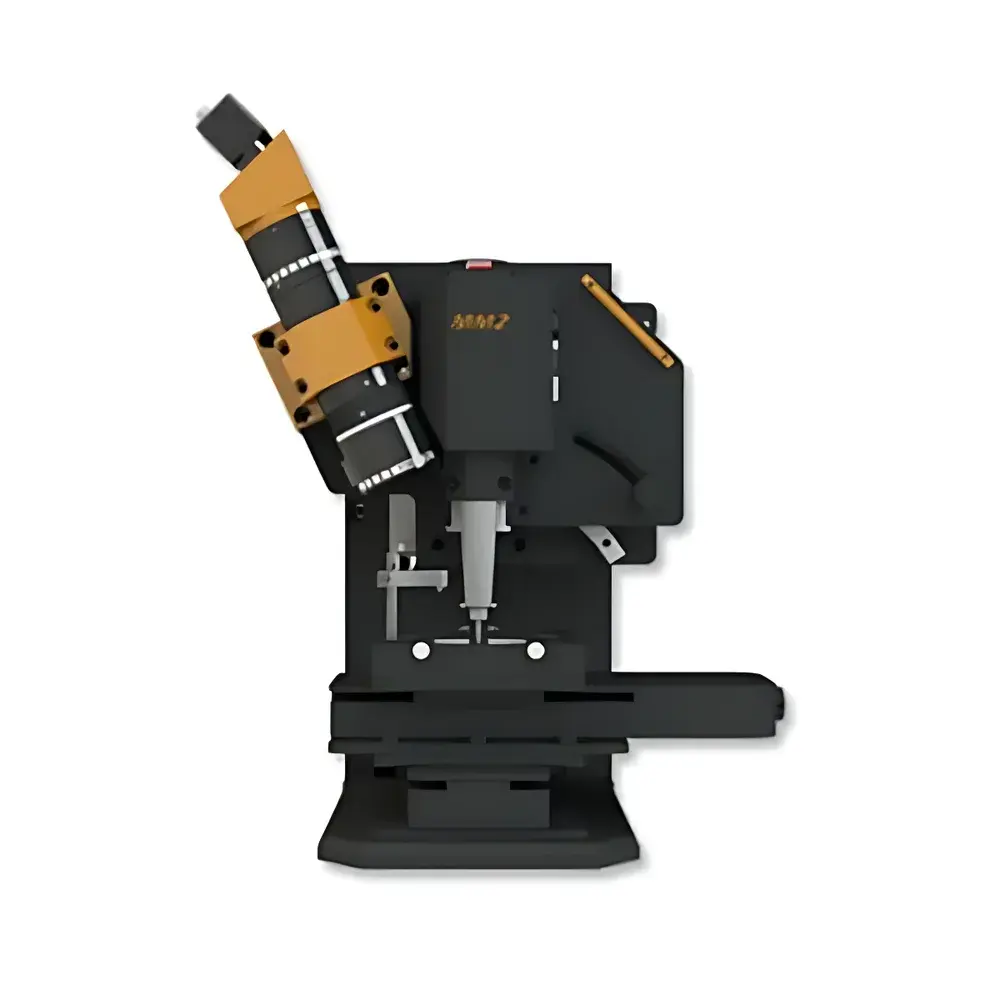
MicroMill2 Laser Ablation Micro-Sampling System by ESL (Elemental Scientific Lasers)
| Brand | ESL (Elemental Scientific Lasers) |
|---|---|
| Origin | France |
| Manufacturer Type | Original Equipment Manufacturer (OEM) |
| Origin Category | Imported |
| Model | MicroMill2 |
| Pricing | Available Upon Request |
Overview
The MicroMill2 Laser Ablation Micro-Sampling System is a precision-engineered solid-sample introduction platform designed for spatially resolved, micro-scale material removal in preparation for subsequent chemical and isotopic analysis—particularly by multi-collector ICP-MS (MC-ICP-MS), TIMS, or solution-based mass spectrometry. Unlike conventional laser ablation systems that rely on pulsed UV lasers for direct in situ analysis, the MicroMill2 employs a high-precision mechanical micro-milling approach: it uses rotating carbide drill bits under real-time optical guidance to extract sub-milligram powder samples from specific micron-scale locations on heterogeneous solids—including biogenic carbonates, zircon crystals, fossilized bone, metal alloys, and geological thin sections. This physical sampling strategy eliminates matrix-dependent fractionation effects inherent to laser ablation, enabling quantitative, stoichiometric sample transfer with traceable mass balance—critical for high-accuracy isotope ratio measurements and elemental speciation workflows.
Key Features
- Ultra-high-resolution stereo imaging system with 6.7–60× continuous zoom and integrated LED illumination, enabling precise targeting of growth bands, lamellae, or microstructural features down to ~1 µm in lateral dimension.
- High-stability XYZ motorized stage with <100 nm positional resolution and repeatability ≤ ±0.5 µm, calibrated via integrated capacitive encoders and referenced to an on-board coordinate origin.
- Open-format sample stage accommodating specimens up to 100 mm × 75 mm × 30 mm (L × W × H), compatible with standard petrographic slides, epoxy-mounted rock chips, and irregularly shaped fossils.
- Programmable tilt-axis capability (±15°) for oblique milling—essential for perpendicular sampling across inclined mineral growth zones without cross-contamination from overlying layers.
- Brushless DC spindle motor delivering programmable rotational speeds (500–15,000 rpm) and consistent torque output (>0.05 N·m), minimizing bit deflection and ensuring uniform cut depth control.
- Interchangeable tungsten carbide drill bits (1/8″ or 3/32″ shank diameter) with integrated proximity sensors for automatic Z-height detection, surface contour tracking, and real-time tilt compensation during non-planar milling.
- Digital sample navigation map generation via mosaic stitching of high-magnification video frames—expanding effective field-of-view beyond optical limits while preserving georeferenced coordinate metadata.
- Ergonomic joystick console for intuitive manual positioning, supplemented by keyboard/mouse interface for fine-grained coordinate entry and script-based batch operation.
- Optional HEPA-filtered dust containment enclosure (ISO Class 5 compliant), equipped with negative-pressure airflow and static-dissipative interior surfaces to mitigate airborne particulate dispersion and prevent cross-sample contamination.
Sample Compatibility & Compliance
The MicroMill2 supports a broad range of inorganic and bio-inorganic matrices: carbonate shells (e.g., for δ¹⁸O, δ¹³C, Sr/Ca), phosphate-rich biominerals (e.g., tooth enamel, otoliths), silicate minerals (zircon, apatite, garnet), metallic alloys, and ceramic composites. All motion control firmware and acquisition software comply with IEC 61508 (functional safety) and ISO 13849-1 (machine safety). Data logging meets GLP/GMP requirements through time-stamped audit trails, user-access controls, and electronic signature support aligned with FDA 21 CFR Part 11 Annex 11 principles. System calibration certificates are traceable to NIST SRMs for dimensional metrology.
Software & Data Management
ESL MicroMill Control Suite v3.x provides integrated workflow management—from live video annotation and coordinate mapping to G-code generation, milling parameter scripting (feed rate, depth per pass, dwell time), and post-acquisition sample log export (CSV/JSON). Raw positional data, sensor telemetry, and video timestamps are archived in vendor-neutral HDF5 format. API access enables bidirectional integration with LIMS platforms (e.g., LabVantage, Thermo SampleManager) and downstream data reduction tools such as Iolite, VizualAge, or custom Python-based isotope processing pipelines.
Applications
- High-spatial-resolution paleoclimate reconstruction using serial micro-milled carbonate layers from coral skeletons or foraminifera tests.
- In situ U–Pb geochronology of zircon domains where laser-induced elemental fractionation compromises age accuracy.
- Multi-isotope tracing (e.g., Ca, Mg, Fe) in biomineralized tissues to resolve metabolic pathways in developmental biology studies.
- Trace element profiling across diffusion-controlled reaction rims in metamorphic minerals for kinetic modeling.
- Reference material homogenization and sub-aliquot preparation for certified matrix-matched standards used in QA/QC protocols.
FAQ
Does the MicroMill2 require laser safety certification or special facility modifications?
No—unlike laser ablation systems, the MicroMill2 operates without Class 3B/4 lasers; only standard laboratory electrical safety and dust mitigation protocols apply.
Can the system be integrated with existing ICP-MS autosamplers or digestion workstations?
Yes—sample vials extracted by the MicroMill2 conform to ASTM D5175 standard dimensions and are compatible with most commercial autosampler trays and microwave digestion rotors.
Is offline calibration of drill bit wear supported?
Yes—software includes a dedicated bit wear diagnostic module using edge-detection algorithms on pre- and post-milling calibration targets, with automated compensation applied to depth calculations.
What level of training is required for routine operation?
A two-day on-site training program covers hardware setup, coordinate referencing, video-based targeting, and SOP-driven milling sequence execution—no prior CNC or metrology experience is assumed.
Are replacement drill bits and calibration standards available through ESL’s global distribution network?
Yes—all consumables—including ISO-certified tungsten carbide bits, NIST-traceable height gauges, and alignment test targets—are stocked in regional fulfillment centers across North America, Europe, and APAC.





