
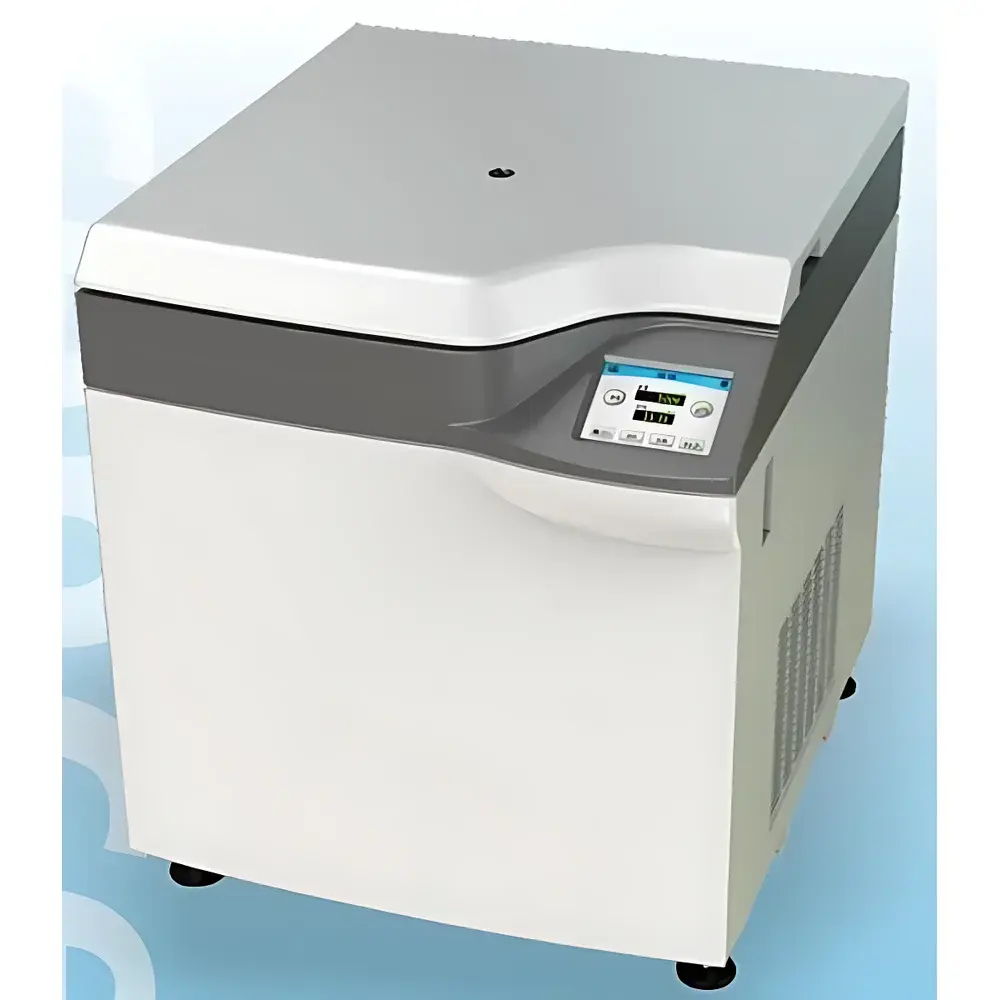
Xiangyi CH160R High-Capacity High-Speed Refrigerated Centrifuge
| Brand | Xiangyi |
|---|---|
| Origin | Hunan, China |
| Manufacturer Type | Direct Manufacturer |
| Product Category | Domestic |
| Model | CH160R |
| Instrument Type | Floor-Standing Centrifuge |
| Speed Range | 10,000–30,000 rpm (Max. 16,000 rpm) |
| RCF Max | 27,648 × g |
| Max. Capacity | 4 × 1000 mL (horizontal rotor) |
| Dimensions (W×D×H) | 590 × 730 × 850 mm |
| Cooling System | Dual-Channel Frequency-Controlled Refrigeration |
| Safety Certifications | Compliant with IEC 61010-2-020 (Laboratory Equipment Safety), ISO 13485 (Medical Device QMS), and GLP-relevant operational traceability requirements |
| Rotor Material | 7075-T6 Forged Aluminum Alloy (certified mechanical & chemical test reports available) |
| Chamber Material | 316L Stainless Steel (2 mm thickness, material certification provided) |
| Interface | Standard Ethernet (TCP/IP), Modbus TCP support for SCADA integration |
| Data Logging | Audit-trail enabled event logging (run parameters, faults, user actions), compliant with FDA 21 CFR Part 11 principles for electronic records |
Overview
The Xiangyi CH160R is a floor-standing, high-capacity refrigerated centrifuge engineered for demanding routine and research applications in clinical diagnostics, biopharmaceutical production, and academic laboratories. It operates on the principle of sedimentation under controlled gravitational force (RCF), enabling efficient separation of heterogeneous mixtures—including whole blood, cell suspensions, bacterial cultures, and subcellular fractions—based on particle density, size, and shape. Its dual-channel frequency-controlled refrigeration system maintains precise temperature stability (–20 °C to +40 °C) during extended high-speed runs, minimizing thermal degradation of thermolabile biomolecules. Designed for reproducible, high-throughput processing, the CH160R accommodates up to 4 × 1000 mL in its standard horizontal rotor, delivering maximum RCF of 27,648 × g at 16,000 rpm—sufficient for pelleting mammalian cells, concentrating viruses, and clarifying lysates without compromising sample integrity.
Key Features
- High-capacity horizontal rotor configuration supporting simultaneous processing of 40 × 50 mL conical tubes, 148 × 10 mL vacuum blood collection tubes, or 196 × 5/7 mL microtubes—eliminating need for rotor interchange in multi-assay workflows.
- Nine interchangeable angular rotors available, including 6 × 250 mL, 8 × 50 mL, and 48 × 1.5 mL configurations, enabling optimized acceleration profiles for molecular biology, nucleic acid purification, and small-volume high-RCF applications.
- Dual-channel variable-frequency refrigeration delivers energy-efficient thermal management; programmable standby mode activates after user-defined idle duration, reducing power consumption without compromising chamber readiness.
- Comprehensive safety architecture includes automatic rotor identification, real-time imbalance detection, overspeed cutoff, overtemperature shutdown, motor overheat protection, and interlocked lid sensing—all independently validated per IEC 61010-2-020.
- Structural integrity assured by 7075-T6 forged aluminum alloy rotors (hard-anodized, corrosion-resistant) and a 2 mm-thick 316L stainless steel centrifuge chamber—both accompanied by full material traceability documentation (chemical composition, tensile testing, ultrasonic flaw detection).
Sample Compatibility & Compliance
The CH160R supports a broad range of biological and clinical sample formats, including but not limited to: whole blood, serum/plasma, PBMCs, E. coli and yeast cultures, tissue homogenates, and enzyme-linked immunosorbent assay (ELISA) plates (up to 20 microtiter plates per run). All rotor configurations are validated for use with standard polypropylene, polycarbonate, and glass centrifuge vessels meeting ISO 8573-1 purity class 4 and USP compatibility criteria. The instrument’s operational firmware enforces parameter constraints based on selected rotor ID, preventing unsafe speed/RCF combinations. Full compliance with ISO 13485 quality management systems enables integration into regulated environments requiring documented validation protocols (IQ/OQ/PQ), while audit-trail data logging aligns with FDA 21 CFR Part 11 expectations for electronic record integrity.
Software & Data Management
A dedicated embedded control interface supports up to 100 user-programmable methods, each assignable via alphanumeric or pinyin-based naming for rapid recall across shift changes or multi-user labs. Each method stores speed (rpm or ×g), time, temperature, acceleration/deceleration profiles (10 ramp-up and 11 ramp-down curves), and rotor-specific calibration offsets. Critical operational events—including start/stop timestamps, fault codes, parameter modifications, and login/logout actions—are logged with ISO 8601 timestamps and user IDs. Ethernet connectivity (10/100BASE-TX) enables seamless integration into centralized laboratory information management systems (LIMS) or supervisory control and data acquisition (SCADA) platforms via Modbus TCP or custom API endpoints. Raw log files export in CSV format, supporting retrospective analysis and regulatory reporting.
Applications
- Clinical laboratories: High-volume blood fractionation (serum/plasma separation), urine sediment concentration, and microbiological specimen preparation prior to culture or PCR.
- Bioprocessing: Harvesting CHO or HEK293 cells, clarifying monoclonal antibody harvests, and recovering viral vectors from transfection supernatants.
- Academic research: Subcellular organelle isolation (mitochondria, nuclei), ribosome purification, and exosome enrichment from conditioned media using differential centrifugation protocols.
- Quality control: Particle removal from pharmaceutical buffers, endotoxin-free reagent preparation, and stability testing of protein formulations under accelerated conditions.
- Industrial diagnostics: High-throughput ELISA plate centrifugation for residual liquid removal prior to optical reading, minimizing edge effects and improving assay precision.
FAQ
What is the maximum RCF achievable with the CH160R, and under what conditions?
The CH160R achieves a maximum relative centrifugal force of 27,648 × g when operating at 16,000 rpm with the 4 × 1000 mL horizontal rotor at maximum radius (332 mm). RCF values vary with rotor type and tube position; all rotors include factory-calibrated RCF lookup tables accessible via the front panel interface.
Does the CH160R support GLP-compliant data archiving?
Yes—the system logs all critical operational events with timestamped, user-attributed entries. Exportable CSV logs meet foundational requirements for GLP audit trails; optional third-party software can extend functionality to include digital signatures and electronic record retention per 21 CFR Part 11 Annex 11 guidelines.
Can the CH160R be integrated into an existing LIMS or MES environment?
Yes—its standard Ethernet port supports TCP/IP communication and Modbus TCP register mapping. A publicly documented point list (including real-time RPM, temperature, elapsed time, and status flags) is provided for integration engineers.
Are rotor certifications and material test reports available upon request?
Yes—Xiangyi provides full traceability packages for all rotors, including chemical composition analysis, tensile strength verification, ultrasonic non-destructive testing (NDT) reports, and hard-anodizing thickness certification.
What maintenance intervals are recommended for optimal performance?
Routine inspection of door seal integrity, refrigerant pressure monitoring, and calibration verification are recommended every 6 months. Annual preventive maintenance includes bearing vibration analysis, refrigeration loop efficiency testing, and firmware version validation against current release notes.



