
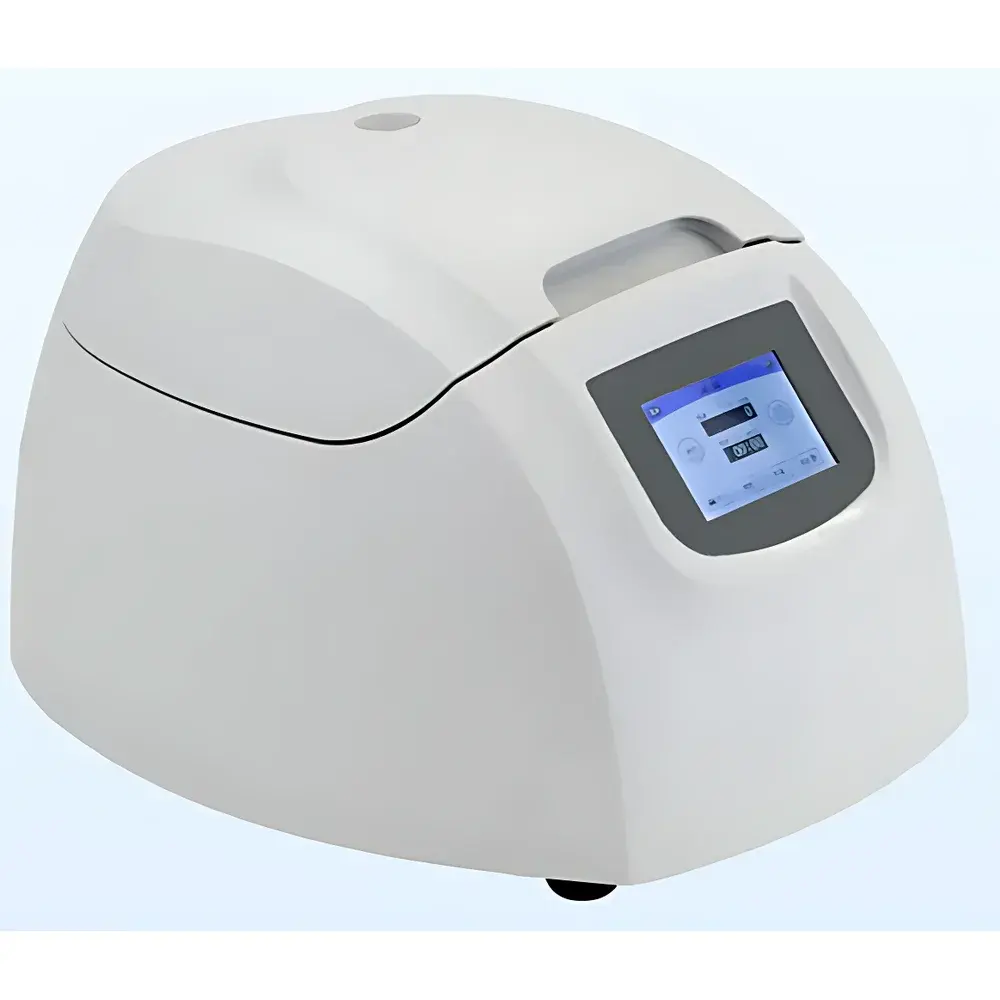
Xiangyi TG12M Capillary Blood Centrifuge
| Brand | Xiangyi |
|---|---|
| Origin | Hunan, China |
| Manufacturer Type | Direct Manufacturer |
| Product Category | Domestic |
| Model | TG12M |
| Instrument Type | Benchtop Centrifuge |
| Speed Class | High-Speed Centrifuge (up to 12,000 rpm) |
| Function | General-Purpose Centrifuge |
| Configuration | Fixed-Angle Rotor |
| Maximum Capacity | 36 capillary tubes |
| Maximum Speed | 12,000 rpm |
| Maximum RCF | 14,800 × g |
| Dimensions (W×D×H) | 320 × 370 × 235 mm |
| Drive System | Microprocessor-Controlled Brushless DC Motor |
| Display | 5-inch HD Touchscreen |
| RCF Calculation | Real-time auto-computation with dedicated RCF key |
| Timer Display | Count-down shown in seconds when <60 s remaining |
| Safety Features | Self-diagnostic system for overspeed, rotor imbalance, and speed loss detection |
| Operational Flexibility | Parameter adjustment during active run without stopping |
Overview
The Xiangyi TG12M Capillary Blood Centrifuge is a microprocessor-controlled, benchtop high-speed centrifuge engineered specifically for hematological applications requiring precise capillary tube processing. It operates on the principle of sedimentation under controlled centrifugal force, enabling rapid and reproducible separation of whole blood into packed red blood cells (RBCs) and plasma within standardized capillary tubes—critical for hematocrit (Hct) determination per CLSI H26-A3 and ISO 15189–compliant workflows. Designed for clinical laboratories, blood banks, and point-of-care testing environments, the TG12M delivers consistent 14,800 × g at its maximum rotational speed of 12,000 rpm, ensuring full sedimentation of erythrocytes within clinically validated timeframes (typically 3–5 minutes at ≥10,000 rpm). Its compact footprint (320 × 370 × 235 mm) and quiet brushless DC motor architecture support integration into space-constrained lab benches without compromising thermal or mechanical stability.
Key Features
- Brushless DC motor drive ensures extended service life, minimal maintenance, and vibration-damped operation—essential for capillary tube integrity and operator comfort.
- Real-time RCF (Relative Centrifugal Force) calculation and display via dedicated RCF key; eliminates manual conversion errors and supports method transfer across instruments with differing rotor radii.
- 5-inch HD capacitive touchscreen interface provides intuitive parameter entry, simultaneous display of setpoints and real-time operational values (speed, time, RCF), and responsive haptic feedback.
- Dynamic parameter modification: Users may adjust speed, time, or acceleration/deceleration profiles mid-run without halting the cycle—enabling protocol optimization and troubleshooting without sample disturbance.
- Integrated self-diagnostic system continuously monitors rotor speed accuracy, detects overspeed conditions, identifies rotational instability (e.g., imbalance-induced vibration), and logs fault codes for traceable maintenance records.
- Intelligent countdown timer switches from minutes to seconds when remaining time falls below 60 seconds—enhancing precision for short-duration hematocrit protocols.
Sample Compatibility & Compliance
The TG12M accommodates up to 36 standard 75 mm or 100 mm capillary tubes (diameter: 1.0–1.2 mm), including heparinized, EDTA-coated, and plain glass or plastic variants. Rotor geometry is optimized for uniform radial distribution and minimal meniscus distortion during deceleration. The instrument meets IEC 61010-1:2010 safety requirements for laboratory electrical equipment and conforms to electromagnetic compatibility standards EN 61326-1. While not certified under FDA 21 CFR Part 11, its audit-ready operational log (accessible via USB export) supports GLP/GMP-aligned documentation practices where electronic record retention is required. Method validation data for hematocrit measurement align with CLSI EP05-A3 and ISO 5725-2 repeatability criteria.
Software & Data Management
The TG12M operates via embedded firmware with no external PC dependency. All run parameters—including date/time stamp, rotor ID (if encoded), speed, time, RCF, and fault events—are stored in non-volatile memory for up to 1,000 cycles. Data export is supported via USB flash drive in CSV format, enabling integration with LIMS or Excel-based QC tracking. No proprietary software installation is required; exported files are human-readable and compatible with common statistical analysis platforms (e.g., Minitab, JMP). Firmware updates are delivered as signed binary packages via secure download portal, with version history and checksum verification included.
Applications
- Routine hematocrit (Hct) determination in clinical chemistry and hematology labs using capillary tube centrifugation per WHO and CLSI guidelines.
- Micro-volume plasma isolation from fingerstick or heelstick samples for glucose, electrolyte, or coagulation testing.
- Sedimentation rate screening (e.g., modified Westergren analogs) where low-volume, rapid separation is prioritized.
- Research applications involving small-volume cell pellet recovery (e.g., isolated PBMCs, platelet-rich plasma) when paired with compatible capillary-compatible adapters.
- Quality control in diagnostic reagent manufacturing where batch-wise capillary separation consistency must be verified.
FAQ
What capillary tube dimensions are supported by the TG12M?
Standard 75 mm and 100 mm length capillary tubes with outer diameters of 1.0–1.2 mm are compatible. Tubes must be loaded symmetrically in the fixed-angle rotor to ensure balance.
Does the TG12M support rotor identification or automatic speed limitation based on rotor type?
No. The TG12M uses a single fixed-angle rotor optimized for capillary tubes; speed and RCF limits are preconfigured in firmware and do not require rotor recognition.
Can run logs be exported in a format compliant with internal audit requirements?
Yes—CSV exports include timestamp, parameters, and fault codes, supporting retrospective review and CAP/ISO 15189 documentation needs.
Is the instrument suitable for use in ISO Class 5 cleanrooms?
While not rated for cleanroom operation, its brushless motor generates no carbon dust, and the sealed chassis minimizes particulate shedding—making it suitable for adjacent support areas with appropriate environmental controls.
What is the mean time between failures (MTBF) for the brushless motor assembly?
Based on accelerated life testing per IEC 60068-2, the motor assembly demonstrates an MTBF exceeding 25,000 hours under continuous nominal load conditions.



