
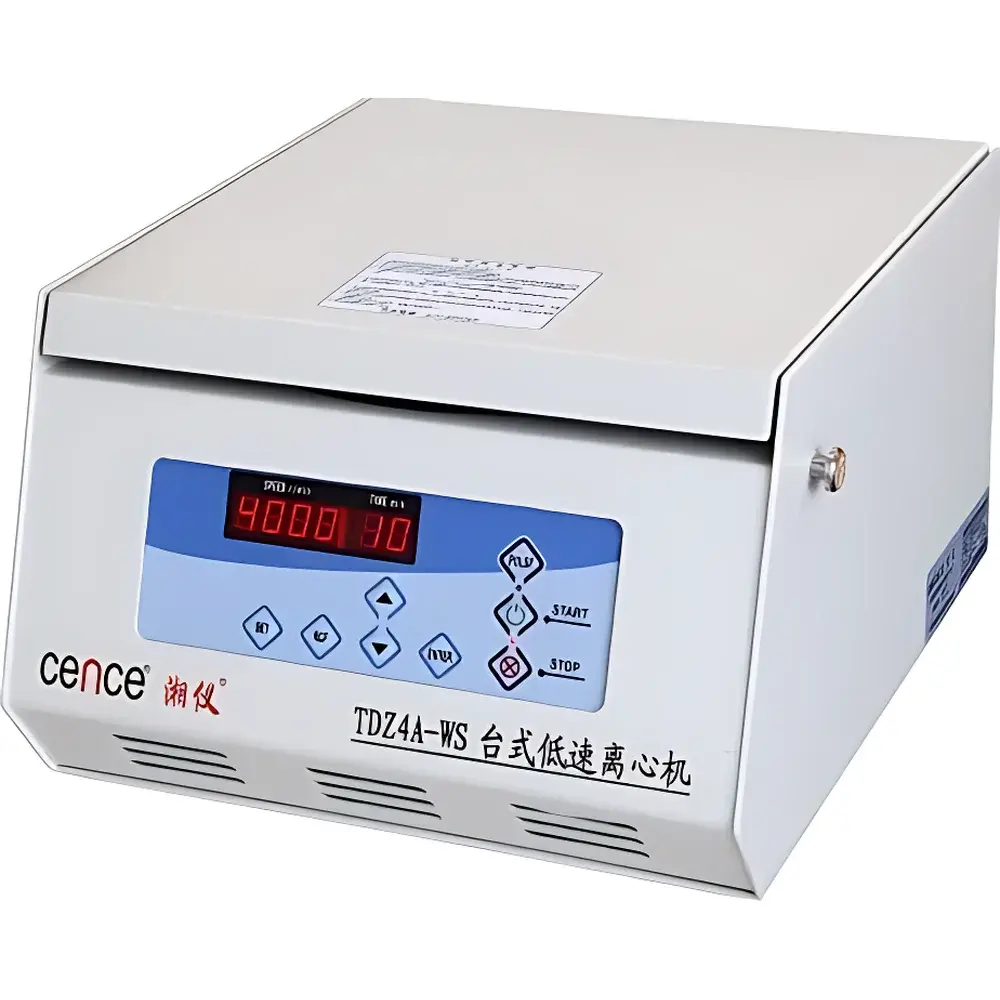
Xiangyi TDZ4A-WS Benchtop Low-Speed Centrifuge
| Brand | Xiangyi |
|---|---|
| Origin | Hunan, China |
| Manufacturer Type | Direct Manufacturer |
| Product Category | Domestic |
| Model | TDZ4A-WS |
| Instrument Type | Benchtop Centrifuge |
| Speed Range | Up to 4000 rpm |
| Max RCF | 2580 ×g |
| Max Capacity | 24 × 10 mL |
| Dimensions (L×W×H) | 350 × 400 × 240 mm |
| Noise Level | <62 dB(A) |
| Power Supply | AC 220 V ±22 V, 50/60 Hz, 3 A |
| Power Consumption | 250 W |
| Weight | 18 kg |
| Speed Accuracy | ±30 rpm |
| Timer Range | 1–99 min |
Overview
The Xiangyi TDZ4A-WS is a benchtop low-speed centrifuge engineered for routine separation tasks in clinical laboratories, academic research facilities, and quality control environments. It operates on the principle of sedimentation under controlled gravitational force—utilizing rotational motion to separate components of heterogeneous mixtures based on density differentials. With a maximum speed of 4000 rpm and a corresponding relative centrifugal force (RCF) of 2580 ×g, this instrument is optimized for applications requiring gentle yet effective pelleting of cells, precipitates, or suspended particles without compromising structural integrity. Its robust all-steel construction and stainless-steel centrifuge chamber ensure long-term corrosion resistance and compliance with basic laboratory hygiene standards. Designed for reliability in high-throughput workflows, the TDZ4A-WS supports uninterrupted operation through real-time parameter adjustment and intuitive digital control.
Key Features
- Microprocessor-controlled system with brushless DC motor drive—ensuring stable rotation, extended service life, and minimal mechanical wear.
- Full stainless-steel centrifuge chamber and reinforced steel housing—meeting durability requirements for daily use in regulated lab settings.
- Touch-sensitive control panel with LED numeric display—providing clear visibility of speed, RCF, time, and operational status.
- Real-time parameter modification during active runs—eliminating the need for rotor deceleration or full shutdown when adjusting time or speed.
- Dedicated RCF key for instant conversion between rpm and ×g values—supporting method standardization across protocols referencing centrifugal force rather than rotational speed.
- Precision timer with second-resolution countdown for intervals under 60 seconds—enhancing reproducibility in time-critical protocols such as serum separation or bacterial pellet harvesting.
- Low-noise operation (<62 dB[A]) achieved via balanced rotor dynamics and vibration-damping chassis design—suitable for shared laboratory spaces.
Sample Compatibility & Compliance
The TDZ4A-WS accommodates a range of sample formats through interchangeable rotors and adapters, including fixed-angle and horizontal configurations. Standard configurations support up to 24 × 10 mL tubes (No.1 angle rotor), while the No.2 horizontal rotor enables flexible loading of 4 × 50 mL conical tubes or multiple adapter sets for smaller volumes (e.g., 12 × 1.5 mL, 12 × 5 mL, or 12 × 7 mL). All rotors are certified for safe operation at rated speeds and RCFs per ISO 15195:2019 guidelines for centrifuge safety in medical laboratories. While not classified as GLP/GMP-compliant out-of-the-box, the device’s traceable speed accuracy (±30 rpm), consistent RCF output, and stable thermal profile support alignment with internal SOPs required for ISO/IEC 17025-accredited testing labs.
Software & Data Management
The TDZ4A-WS operates as a standalone instrument without proprietary software integration; however, its digital interface logs essential operational parameters—including run time, final speed, and elapsed duration—for manual recordkeeping. The absence of network connectivity or electronic audit trail functionality means it does not meet FDA 21 CFR Part 11 requirements for electronic records and signatures. Users implementing this centrifuge in regulated environments should supplement operation with paper-based logbooks or integrate usage data into validated LIMS platforms via external timestamped entries. Firmware updates are not supported remotely; calibration verification must be performed periodically using NIST-traceable tachometers.
Applications
- Clinical specimen processing: Serum/plasma separation from whole blood (e.g., CLSI H18-A3 compliant protocols).
- Cell culture workflows: Harvesting adherent or suspension cells prior to lysis or cryopreservation.
- Environmental microbiology: Concentration of waterborne pathogens or particulate matter from large-volume samples.
- Food & beverage QA/QC: Clarification of extracts, sediment analysis, or fat separation in dairy emulsions.
- Educational laboratories: Demonstrating sedimentation kinetics and centrifugation principles in undergraduate biophysics or biochemistry courses.
FAQ
What is the maximum tube capacity for the standard angle rotor?
The No.1 fixed-angle rotor accepts up to 24 × 10 mL centrifuge tubes at full-rated speed.
Can I switch between rpm and ×g display during a run?
Yes—the dedicated RCF key allows instantaneous toggling between rotational speed and relative centrifugal force without interrupting operation.
Is the centrifuge compatible with 50 mL conical tubes?
Yes—using the optional No.2 horizontal rotor with appropriate adapters, the unit supports up to 4 × 50 mL conical tubes.
Does the TDZ4A-WS include automatic imbalance detection?
It features mechanical auto-balancing capability within specified load tolerances but lacks electronic imbalance sensing or automatic shutdown logic beyond standard over-vibration cutoff.
What electrical specifications must my lab outlet meet?
The unit requires a grounded AC 220 V ±22 V, 50/60 Hz supply with minimum 3 A circuit rating and total power draw of 250 W.



