
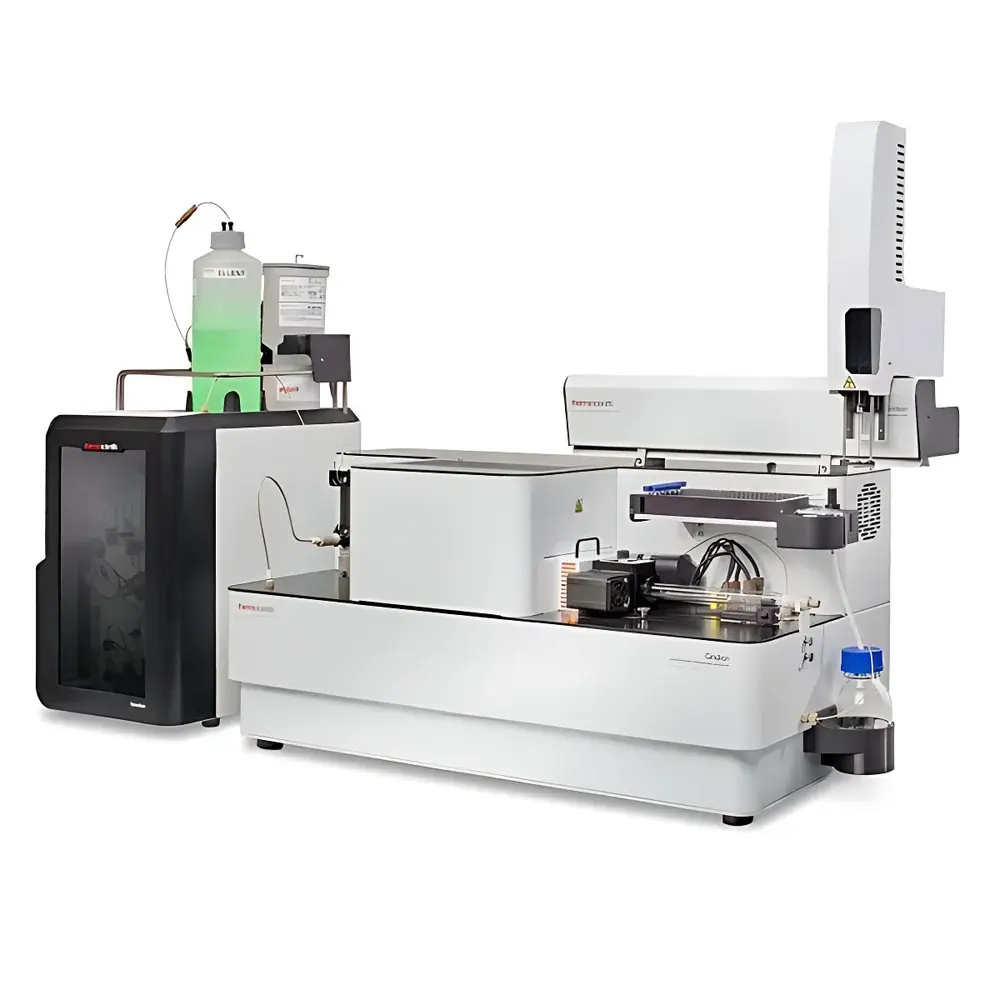
Cindion C-IC System for Liquid Sample Analysis
| Brand | Thermo Fisher |
|---|---|
| Origin | USA |
| Manufacturer Type | Authorized Distributor |
| Origin Category | Imported |
| Model | CINDION-03 |
| Pricing | Available Upon Request |
Overview
The Cindion C-IC System for Liquid Sample Analysis is a fully integrated combustion ion chromatography (C-IC) platform engineered for the quantitative determination of total halogens (F⁻, Cl⁻, Br⁻, I⁻) and sulfur species (SO₄²⁻, SO₃²⁻) in liquid matrices. Unlike conventional ion chromatography, this system couples high-temperature catalytic combustion (950–1100 °C) with post-combustion absorption and suppressed conductivity detection to convert organically bound halogens and sulfur into their respective inorganic ionic forms—enabling accurate, matrix-independent quantification. Designed specifically for laboratories performing regulatory screening, environmental monitoring, and materials safety testing, the Cindion C-IC delivers trace-level sensitivity (<10 ng X per injection), high reproducibility (RSD < 5% at 100 ng level), and compliance-ready operation across diverse liquid sample types—including aqueous extracts, solvents, pharmaceutical formulations, and industrial process streams.
Key Features
- Compact combustion module featuring a novel short-path quartz combustion tube with integrated Pt/Pd catalyst, enabling >99.8% conversion efficiency for refractory organohalogens and organosulfur compounds
- Integrated autosampler and absorption unit co-located within the combustion/absorption module—reducing footprint to under 0.5 m² while minimizing dead volume and analyte loss
- PFAS-optimized fluidic pathway: all wetted components certified PFAS-free (per EPA Method 1621 verification protocols), with background F⁻ levels consistently <0.5 ng/mL
- Automated, software-controlled sequence including combustion, absorption, IC injection, separation, and data processing—eliminating manual transfer steps and operator variability
- Modular architecture supporting future expansion to solid- and gas-phase analysis via optional accessories (e.g., solid sample boat loader, gas sampling interface)
Sample Compatibility & Compliance
The Cindion C-IC System for Liquid Sample Analysis accepts direct injection of clarified liquid samples up to 2 mL volume, with compatibility extended to emulsions, viscous solvents (e.g., DMSO, NMP), and high-salinity brines via dilution or matrix-matched calibration. It supports ASTM D7359 (total fluorine in petroleum products), ISO 17403 (halogen content in polymers), and US EPA Method 1621 (adsorbable organic fluorine, AOF) when configured with the Cindion Liquids Kit and Dionex Inuvion IC System. All hardware and firmware comply with IEC 61000-6-3 (EMC), UL 61010-1 (safety), and support 21 CFR Part 11–compliant audit trails, electronic signatures, and secure user role management through Thermo Scientific Chromeleon Chromatography Data System (CDS).
Software & Data Management
Controlled exclusively via Chromeleon CDS v7.3 or later, the system implements method-driven workflows with embedded validation checks, real-time combustion efficiency monitoring (via O₂/CO₂ sensor feedback), and automatic correction for absorption efficiency drift. Raw chromatograms, combustion logs, and calibration reports are stored in a relational database with immutable timestamps and full revision history. Data export formats include .cdf (NetCDF), .csv, and PDF analytical reports compliant with GLP/GMP documentation requirements. Optional integration with LIMS via ASTM E1578-compliant API enables automated result routing and chain-of-custody tracking.
Applications
- Regulatory screening of PFAS precursors and total organic fluorine (TOF) in drinking water, wastewater, and leachates per EPA Draft Method 1633
- Quality control of halogenated solvents and reagents in pharmaceutical synthesis (ICH Q5C, Q7)
- Determination of total chlorine in recycled plastics and polymer additives per ISO 17403
- Corrosivity assessment of jet fuels and lubricants via total sulfur and chloride content (ASTM D7359, D4294)
- Adsorbable organic fluorine (AOF) quantification in surface coatings and electronic cleaning agents
FAQ
What sample preparation is required for liquid samples?
Minimal preparation is needed: samples must be filtered (0.45 µm PTFE membrane) and optionally diluted to fall within the linear dynamic range (1–500 ng X per injection). No derivatization or extraction is required.
Can the system quantify individual PFAS compounds?
No—the Cindion C-IC measures total extractable fluorine (as F⁻) after combustion; compound-specific identification requires coupling to LC-MS/MS or HRMS downstream.
Is method validation support available?
Yes—Thermo Fisher provides IQ/OQ documentation packages, system suitability test protocols aligned with EPA 1621, and application notes covering LOD/LOQ, precision, spike recovery (85–115%), and matrix interference studies.
How is combustion efficiency monitored during analysis?
Real-time CO₂ and O₂ sensors in the exhaust stream continuously verify complete oxidation; deviations trigger automatic method interruption and alert logging in Chromeleon.
What consumables require regular replacement?
Combustion tube (recommended every 500 injections), absorption coil (every 200 runs), and Dionex IonPac columns (per manufacturer specifications); all are cataloged and tracked via Chromeleon’s consumables manager.
Related Products







