
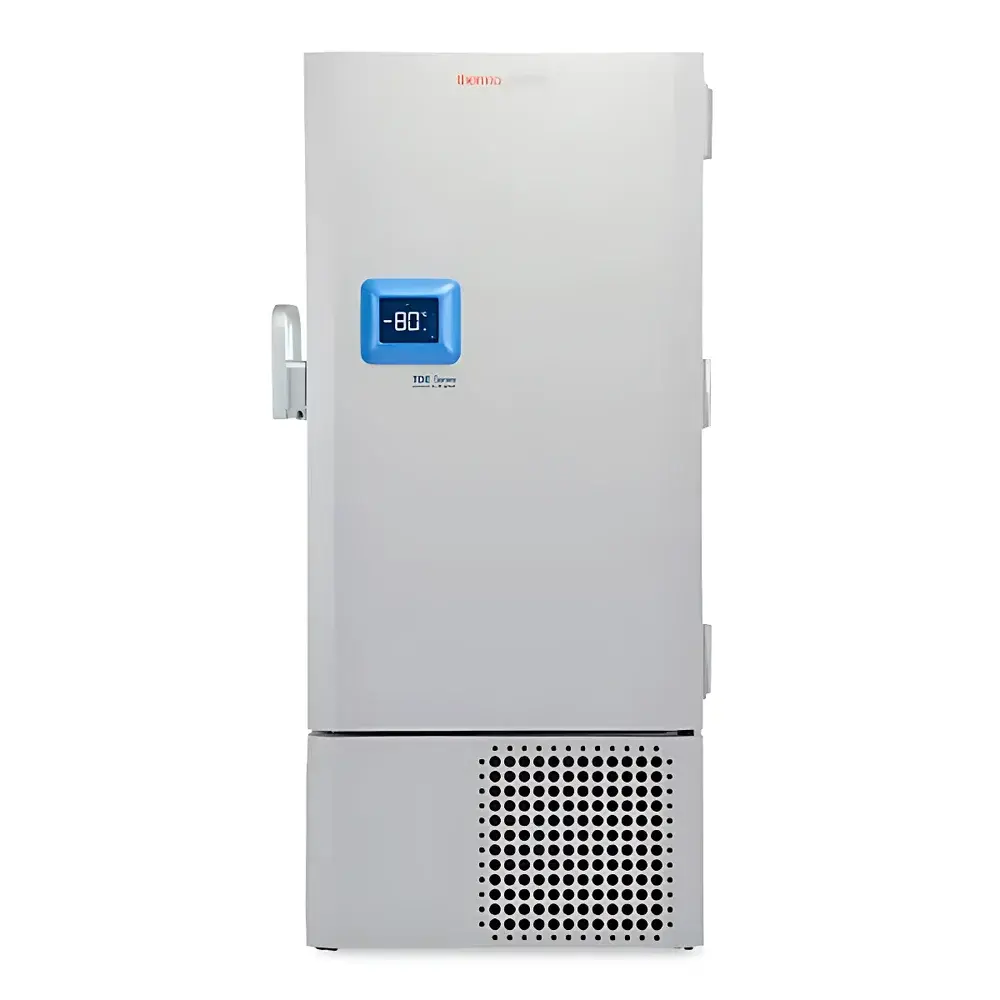
Thermo Scientific™ STP Series Ultra-Low Temperature Freezer
| Brand | Thermo Fisher |
|---|---|
| Origin | Shanghai, China |
| Manufacturer Type | Authorized Distributor |
| Country of Origin | China |
| Model | Thermo Scientific™ STP Series Ultra-Low Temperature Freezer |
| Configuration | Upright |
| Effective Volume | 682 L |
| Voltage | 230 V AC, 50 Hz, Single Phase |
| Energy Consumption | 10.3 kWh/day |
| Refrigerant | R290/R170 + R290 Hydrocarbon Blend |
| Temperature Range | –50°C to –86°C |
| Acoustic Noise Level | <53 dBA |
| Recovery Time (after door opening) | 16 min |
| Peak Temp Deviation at –80°C | +4.2/–3.8°C |
| Steady-State Uniformity | ±10°C (per validated protocol) |
| Internal Dimensions (W×D×H) | 732 × 719 × 1300 mm |
| External Dimensions (W×D×H) | 864 × 977 × 1981 mm |
| Net Weight | 290 kg |
| Gross Weight | 333 kg |
| Door Type | Single outward-swinging latch door with 4 internal hinged doors |
| Shelving | 20 adjustable powder-coated steel shelves (5 per kit) |
| Certification | CE, cULus, ISO 13485 |
| Warranty | 5 years parts, 10-year design life |
Overview
The Thermo Scientific™ STP Series Ultra-Low Temperature Freezer represents a rigorously engineered evolution in laboratory-grade cryogenic storage—designed specifically for long-term preservation of sensitive biological specimens, including primary cells, stem cell lines, genomic DNA, RNA, proteins, and clinical biospecimens. Operating within a validated temperature range of –50°C to –86°C, the STP series employs an H-Drive hydrocarbon-based refrigeration system that eliminates high-global-warming-potential (GWP) fluorocarbons while delivering enhanced thermodynamic efficiency and mechanical reliability. Unlike conventional cascade or single-stage compressors, the H-Drive architecture utilizes a proprietary blend of R290 (propane) and R170 (ethane), resulting in lower system operating pressures, reduced thermal stress on components, and improved resistance to ambient temperature fluctuations. This refrigerant strategy aligns with global regulatory frameworks—including EPA SNAP, EU F-Gas Regulation, and IEC 60335-2-89—ensuring compliance across North America, EMEA, and APAC markets. The freezer’s vacuum-insulated polyurethane foam core (foamed with non-HFC blowing agents) achieves zero-GWP insulation performance, contributing directly to HVAC load reduction and overall facility energy optimization.
Key Features
- H-Drive hydrocarbon refrigeration system enabling up to 25% lower daily energy consumption (10.3 kWh/day) versus legacy ultra-low freezers—verified against internal benchmarking (e.g., UXF600: 14.9 kWh/day)
- Validated thermal stability: ±10°C uniformity across full volume under steady-state conditions at –80°C; peak deviation limited to +4.2/–3.8°C during dynamic recovery
- H-Drive Information Center (HIC): 5.6-inch capacitive touchscreen interface with intuitive navigation, real-time temperature logging, and configurable alarm thresholds
- Four internal hinged doors minimize cold air loss during sample access—reducing thermal load impact and supporting rapid temperature recovery (≤16 minutes post-door-open)
- Ergonomic design elements: low-effort latch mechanism, high-contrast display, optimized shelf height spacing (≥130 mm vertical clearance), and integrated handle geometry compliant with ISO 11228-3 lifting ergonomics guidelines
- Robust structural architecture: cold-rolled steel outer cabinet with electrostatic powder coating; interior chamber constructed from electropolished stainless steel (optional upgrade) for corrosion resistance and cleanability
- Comprehensive safety suite: independent high/low temperature alarms, door-open alert with audible/visual indicators, key-lockable main door, and optional CO2/LN2 backup integration
Sample Compatibility & Compliance
The STP series is validated for storage of standard cryogenic containers used across biobanking, clinical diagnostics, and preclinical research workflows—including 2 mL cryovials (Nunc CryoBank™, Matrix™), 96-well plates, cryoboxes (300–600 capacity configurations), and stackable rack systems. Its internal dimensions (732 × 719 × 1300 mm) accommodate up to 50,000 2 mL vials using Thermo Scientific™ standardized rack layouts. All models conform to IEC 61010-1 (Safety Requirements for Electrical Equipment for Measurement, Control, and Laboratory Use) and carry CE marking under the EU Medical Device Regulation (MDR) Annex II Class I, as well as cULus listing per UL 61010-1 and CSA C22.2 No. 61010-1. Manufacturing adheres to ISO 13485:2016 quality management requirements for medical device production, supporting GLP/GMP-aligned biorepository operations. Thermal validation documentation—including IQ/OQ/PQ protocols—is available upon request to support FDA 21 CFR Part 11-compliant electronic record retention.
Software & Data Management
Remote monitoring and data integrity are enabled via Thermo Scientific™ DeviceLink™ Connect—a secure, cloud-based telemetry platform hosted on the Thermo Fisher Connect infrastructure. DeviceLink Connect supports both direct serial (RS-485) integration and standalone sensor deployment (e.g., PT100 temperature probes, current monitors, door switch sensors). All event logs—including temperature excursions, door openings, power interruptions, and alarm triggers—are timestamped, digitally signed, and stored with audit-trail capability meeting ALCOA+ principles (Attributable, Legible, Contemporaneous, Original, Accurate, Complete, Consistent, Enduring, Available). InstrumentConnect web and mobile applications provide 24/7 access to real-time metrics, customizable alert notifications (SMS/email), and historical trend analysis. Data export formats include CSV and PDF reports compatible with LIMS integration. Optional RS-485/4–20 mA analog outputs and dry-contact relays facilitate connection to building management systems (BMS) or centralized lab monitoring dashboards.
Applications
- Long-term archiving of human biospecimens in biobanks accredited to ISO 20387:2018
- Cryopreservation of induced pluripotent stem cells (iPSCs) and primary tissue cultures requiring strict thermal fidelity
- Storage of mRNA vaccines, viral vectors, and other temperature-sensitive biologics during clinical trial material handling
- Supporting CAP-accredited pathology labs for frozen section tissue storage prior to molecular testing
- Facilitating GMP-compliant raw material cold chain storage in pharmaceutical development laboratories
- Enabling reproducible sample integrity across multi-site translational research consortia
FAQ
What is the recommended ambient temperature range for optimal operation?
The STP series is validated for continuous operation in ambient environments between 10°C and 30°C. For installations exceeding 25°C, minimum rear clearance must be maintained at ≥30 cm to ensure adequate condenser airflow and thermal dissipation.
Is the freezer compatible with automated sample retrieval systems?
Yes—the standardized internal footprint and modular shelving architecture support integration with third-party robotic handlers and track-and-trace inventory platforms via optional RS-485 communication or external sensor interfacing.
Can the unit be validated for use in regulated GxP environments?
Absolutely. Full IQ/OQ/PQ documentation packages—including temperature mapping protocols, alarm response verification, and recovery time validation—are available through Thermo Fisher Scientific’s Global Validation Services group and comply with FDA, EMA, and PMDA expectations.
What maintenance intervals are recommended to sustain performance over the 10-year design life?
Routine preventive maintenance includes quarterly condenser coil cleaning, annual refrigerant pressure verification, biannual calibration of the 1000 Ω platinum RTD probe, and semi-annual functional testing of all alarm circuits per ISO/IEC 17025 traceable procedures.
Does the STP series support redundant cooling or emergency backup?
While not internally redundant, the system features dual-port connectivity for optional integration with external CO2 or liquid nitrogen (LN2) emergency holdover systems—enabling uninterrupted storage during extended power outages or compressor failure scenarios.





