
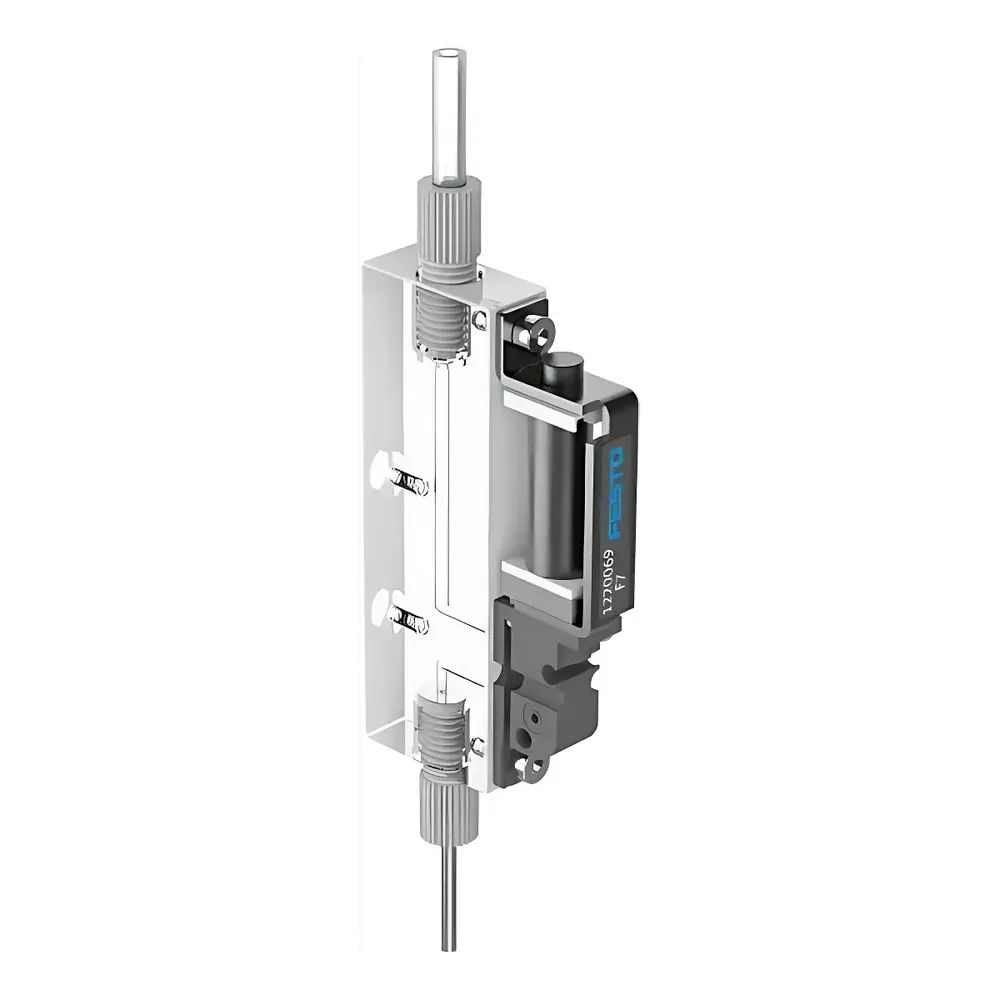
Festo VTOE-D9-T3-M22C-08-F-P-P-S Precision Dispensing Valve Head
| Brand | Festo |
|---|---|
| Origin | Germany |
| Manufacturer Type | Authorized Distributor |
| Origin Category | Imported |
| Model | VTOE-D9-T3-M22C-08-F-P-P-S |
| Nominal Orifice Diameter | 0.8 mm |
| Dispensing Needle ID | 1 mm |
| Needle Length | 30 mm |
| Grid Pitch | 9 mm |
| Valve Function | 2/2-way, normally closed, monostable |
| Operating Pressure Range | 0–0.05 MPa (0–7.25 psi) |
| Internal Volume (incl. fluid interface) | 113 µL |
| Minimum Dispense Volume | 5 µL |
| Typical Volume Accuracy | <1% CV for volumes >5 µL |
| Max. Switching Frequency | 4 Hz |
| Opening Time | 7 ms |
| Closing Time | 2 ms |
| Continuous Duty Cycle | 100% (standalone), 50% (modular installation, max. on-time 1 s) |
| Electrical Power Consumption | 1.8 W |
| Nominal Voltage | DC 24 V ±10% |
| Ambient Temperature (operating) | 5–40 °C |
| Medium Temperature | 5–50 °C |
| Storage Temperature | −20–70 °C |
| Protection Class | IP30 |
| Weight | 18 g |
| Electrical Interface | 2-pin open cable, 150 mm length, AWG28, stripped ends |
| Fluid Interface | UNF 1/4-28 |
| Needle Material | High-alloy stainless steel (1.4301) |
| Corrosion Resistance Class | CRC0 |
| Shock & Vibration | EN 60068-2-27 / EN 60068-2-6, Severity Level 2 |
| Max. Altitude | ≤2000 m NHN |
| Pollution Degree | 2 |
| Relative Humidity | 0–95% non-condensing |
Overview
The Festo VTOE-D9-T3-M22C-08-F-P-P-S is a high-precision, electrically actuated dispensing valve head engineered for integration into automated liquid handling platforms used in life science laboratories, pharmaceutical QC workflows, and microfluidic assay development. Based on direct-acting solenoid actuation with spring return, this 2/2-way normally closed valve delivers deterministic, repeatable micro-dispensing of aqueous and low-viscosity reagents with minimal dead volume and fast dynamic response. Its core design adheres to the functional safety and material compatibility requirements of regulated laboratory automation—supporting traceable, GLP-compliant liquid transfer where volumetric fidelity, contamination control, and mechanical robustness are critical. The valve operates within a narrow pressure envelope (0–0.05 MPa), making it ideal for gravity-fed or low-pressure pneumatic systems common in benchtop analyzers, ELISA workstations, and modular diagnostic instruments.
Key Features
- High Reproducibility: Achieves typical coefficient of variation (CV) <1% for dispense volumes >5 µL, validated under controlled environmental conditions per ISO 8573-1 and ASTM D1298 protocols.
- Minimal Dead Volume Architecture: Total internal fluid path volume—including integrated UNF 1/4-28 fluid interface and 30 mm stainless steel dispensing needle—is precisely 113 µL, reducing carryover and enabling efficient reagent conservation in low-volume assays.
- Fast Actuation Dynamics: 7 ms opening time and 2 ms closing time enable precise temporal control over dispensing events—critical for synchronized multi-step protocols in automated immunoassays or nucleic acid extraction systems.
- Material Compliance: Wetted parts consist exclusively of high-alloy stainless steel (1.4301 / AISI 304), certified RoHS-compliant and compatible with common biological buffers, saline solutions, and mild organic solvents per manufacturer’s chemical resistance guidelines.
- Modular Integration Readiness: Compact form factor (18 g), M22 threaded mounting interface, and standardized 2-pin DC24 V electrical connection simplify OEM integration into robotic liquid handlers, microplate dispensers, and IVD instrument platforms.
- Environmental Resilience: Validated for shock (EN 60068-2-27) and vibration (EN 60068-2-6), severity level 2—suitable for transport and operation in shared lab environments without performance degradation.
Sample Compatibility & Compliance
This valve head is intended for use with non-aggressive, low-viscosity liquids (e.g., PBS, Tris-HCl, ethanol/water mixtures, enzyme conjugates) at medium temperatures between 5–50 °C. It is not rated for abrasive suspensions, high-viscosity oils (>50 mPa·s), or corrosive media requiring CRC1+ protection. All wetted materials comply with VDMA 24364-B2-L for paint-wetting impairment substance (PWIS) control—ensuring compatibility with cleanroom assembly processes. While the device itself carries no CE marking for medical devices, its construction and documentation support integration into Class I or IIa IVD instruments subject to MDR 2017/746 and FDA 21 CFR Part 820. For applications requiring electronic audit trails, the valve must be operated via a controller supporting FDA 21 CFR Part 11-compliant event logging.
Software & Data Management
The VTOE-D9-T3-M22C-08-F-P-P-S is a hardware-level component and does not include embedded firmware or onboard intelligence. It requires external control via TTL-compatible or PWM-driven DC24 V signals from a programmable logic controller (PLC), motion controller, or laboratory automation software stack (e.g., Beckhoff TwinCAT, National Instruments LabVIEW, or custom Python-based sequencing engines). Valve timing parameters—including pulse width, frequency, and dwell intervals—are configured at the system level. To ensure data integrity in regulated environments, users must implement application-layer timestamping, cycle counting, and error-state reporting in their host software. Festo provides comprehensive electrical schematics, pinout diagrams, and mechanical CAD models (STEP/IGES) via its online support portal (festo.com), facilitating traceable design history and mechanical integration verification.
Applications
- Automated reagent dispensing in ELISA, lateral flow assay development, and PCR setup workstations
- Micro-volume calibration standards delivery in metrology-grade pipette verification systems
- On-chip liquid routing in cartridge-based molecular diagnostics platforms
- Low-pressure sample introduction in capillary electrophoresis and micro-CE systems
- Modular add-on for open-source liquid handlers (e.g., Opentrons Flex, Chemyx Fusion) requiring sub-10 µL precision
- QC sampling modules in continuous bioprocess monitoring systems (e.g., inline pH or conductivity probe calibration)
FAQ
What is the maximum recommended operating pressure for this valve?
The absolute maximum operating pressure is 0.05 MPa (7.25 psi); exceeding this may compromise seal integrity and volumetric accuracy.
Can this valve dispense viscous solutions such as glycerol or serum?
It is optimized for low-viscosity fluids (<20 mPa·s); viscosity >50 mPa·s significantly increases dispersion variability and may cause incomplete closure.
Is the valve suitable for sterile applications?
The stainless steel needle and housing are autoclavable (121 °C, 20 min), but the solenoid coil and electrical insulation are not rated for repeated sterilization cycles—sterile barrier integration is required.
Does Festo provide validation documentation for GMP environments?
Festo supplies material declarations, RoHS/REACH certificates, and mechanical test reports; full IQ/OQ/PQ documentation must be generated by the end-user’s qualified engineering team.
How does ambient temperature affect switching frequency?
At ambient temperatures >35 °C, the maximum sustainable switching frequency reduces to ≤2.5 Hz to prevent thermal derating of the coil’s duty cycle.
Related Products





