
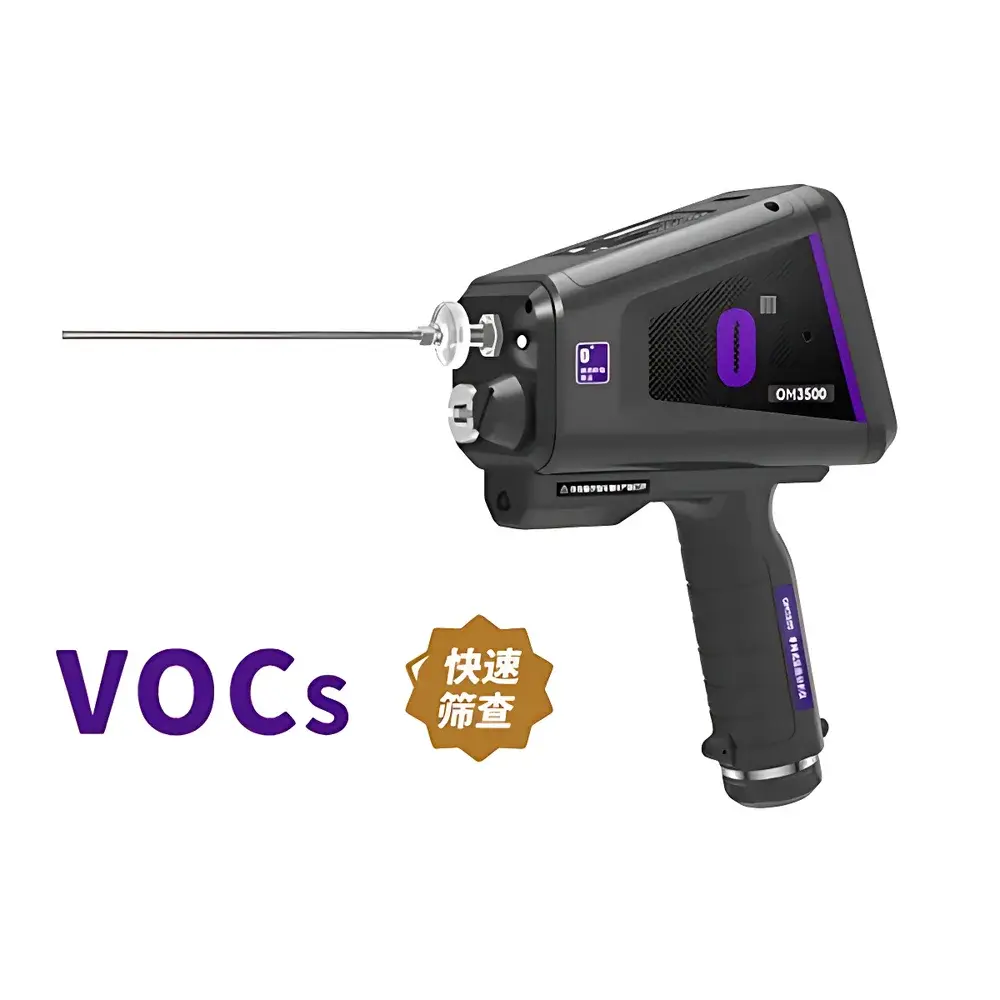
Aoma OM3500 Handheld Total Hydrocarbon Analyzer
| Key | Brand: Aoma |
|---|---|
| Model | OM3500 |
| Detection Principle | Flame Ionization Detection (FID) and optional Photoionization Detection (PID) |
| Detection Limit | FID: 0.5 ppm methane |
| PID | 0.5 ppm isobutylene |
| Detector Options | FID (standard), PID (optional) |
| Measurement Range | FID: 0–50,000 ppm methane |
| PID | 0.5–2,000 ppm isobutylene |
| Response Time (90%) | ≤3.5 s (FID @ 10,000 ppm CH₄ |
| Repeatability & Accuracy | ≤2% RSD for both FID (methane) and PID (isobutylene) |
| Preheat Time | ≤20 min |
| Operating Temperature | −10 °C to +50 °C |
| Relative Humidity | 0–95% RH (non-condensing) |
| Sample Flow Rate | 0.1–3.0 L/min (adjustable, nominal 1.0 L/min at probe inlet) |
| Hydrogen Supply | 20 L solid-state metal hydride cartridge (≥12 h runtime at ambient temp) |
| Battery | 6400 mAh Li-ion (≥8 h runtime at ambient temp) |
| Data Storage | 4 GB internal |
| Display | 3.5-inch capacitive touchscreen |
| Communication | Bluetooth 5.0, Wi-Fi 802.11 b/g/n, USB 2.0 |
| Explosion Protection | Ex db ib IIC T4 Gb |
| Weight | ≤1.6 kg |
Overview
The Aoma OM3500 Handheld Total Hydrocarbon Analyzer is a field-deployable, intrinsically safe instrument engineered for rapid, quantitative detection of total hydrocarbons (THC) and volatile organic compounds (VOCs) in ambient air, stack emissions, and fugitive sources. It operates primarily on flame ionization detection (FID), a well-established, linear, and highly reproducible technique standardized under ISO 8573-5, ASTM D6348, and EPA Method 25A for hydrocarbon quantification. The FID provides near-universal response to organic compounds with ionization potentials below ~16 eV—covering aliphatic, aromatic, and oxygenated VOCs—while delivering robust performance across variable environmental conditions. An optional photoionization detector (PID) extends capability to select inorganic odorants (e.g., H₂S, NH₃) and low-ionization-potential VOCs, enabling dual-mode screening in regulatory leak detection and repair (LDAR) programs. Designed for compliance with HJ 1012–2018 (China’s technical specification for portable THC/CH₄/NMHC analyzers) and HJ 733–2014 (VOC leakage detection guidance), the OM3500 meets the operational rigor required by industrial QA/QC teams, third-party environmental auditors, and regulatory inspectors conducting real-time, point-of-source measurements.
Key Features
- Explosion-proof architecture compliant with Ex db ib IIC T4 Gb, certified for use in Zone 1 hazardous areas without external purging or ventilation requirements.
- Integrated solid-state hydrogen generation via electrolytic water splitting, eliminating high-pressure gas cylinders; paired with a replaceable 20 L metal hydride hydrogen storage cartridge rated for ≥12 hours of continuous operation at ambient temperature.
- Dual-ignition FID system with automatic flame monitoring and re-ignition—ensuring stable combustion and measurement continuity even during cold-start or transient flow events.
- Independent FID reaction chamber with active thermal shielding and optimized gas flow path, minimizing cross-interference from moisture, particulates, or background CO₂.
- Micro-electronic pressure control (EPC) for precise, drift-free hydrogen fuel flow regulation—critical for maintaining stoichiometric combustion and long-term baseline stability.
- 3.5-inch capacitive touchscreen interface supporting full instrument control: zero/span calibration, data review, alarm threshold configuration, and firmware updates—no PC dependency required for routine operation.
- Onboard 4 GB flash memory with timestamped, GPS-tagged (via optional module) measurement logs; exportable via USB 2.0, Wi-Fi, or Bluetooth to LIMS or cloud-based environmental data platforms.
- Intelligent diagnostics engine providing proactive alerts for battery level, hydrogen depletion, filter saturation, sensor drift, and scheduled maintenance intervals—supporting GLP-aligned field documentation practices.
Sample Compatibility & Compliance
The OM3500 is validated for direct sampling of ambient air, duct effluents, and surface-emitted vapors across diverse industrial settings—including petrochemical facilities, pharmaceutical manufacturing suites, coating operations, and wastewater treatment plants. Its adjustable sample flow (0.1–3.0 L/min) accommodates both high-velocity stack sampling and low-flow soil-gas or headspace analysis. The instrument conforms to key regulatory frameworks governing VOC monitoring: HJ 1012–2018 (portable analyzer performance criteria), HJ 733–2014 (LDAR methodology), HJ 1230–2021 (industrial LDAR implementation guidelines), and GB 37822–2019 (uncontrolled VOC emission control). While not FDA 21 CFR Part 11–certified out-of-the-box, audit-trail functionality (including user login, calibration history, and event logging) supports validation pathways for GMP-aligned environmental monitoring programs.
Software & Data Management
Data acquisition and reporting are managed through embedded firmware supporting CSV and PDF report generation directly on-device. Synchronized timestamps, operator ID tagging, and configurable alarm triggers (e.g., >100 ppm THC threshold) ensure traceability per ISO/IEC 17025 requirements. Wireless connectivity enables remote firmware updates and real-time telemetry integration with enterprise EHS platforms via MQTT or HTTP REST APIs. Optional camera module captures georeferenced still images or video clips synchronized with each measurement—providing evidentiary support for LDAR compliance audits. All stored data retain immutable metadata (sensor ID, calibration date, environmental conditions), facilitating retrospective QA review and regulatory submission readiness.
Applications
- Rapid screening of organized emissions from stacks and vents per HJ 1012–2018 verification protocols.
- Unorganized emission surveys at facility boundaries, workshop perimeters (1 m offset), and indoor production zones to assess worker exposure risk.
- Fugitive source identification during LDAR campaigns—detecting leaks from valves, flanges, pumps, and connectors in accordance with HJ 1230–2021 workflows.
- Pre-commissioning and post-maintenance verification of abatement systems (e.g., RTOs, carbon adsorbers) using THC as a surrogate indicator.
- Third-party environmental due diligence assessments, including pre-acquisition site evaluations and sustainability reporting (e.g., CDP, GHG Protocol Scope 1).
- Emergency response scenarios requiring immediate VOC plume mapping and source localization under variable meteorological conditions.
FAQ
What detection technologies does the OM3500 employ?
It uses flame ionization detection (FID) as standard, with an optional photoionization detector (PID) for expanded compound coverage.
Is the OM3500 suitable for use in classified hazardous locations?
Yes—it carries Ex db ib IIC T4 Gb certification, permitting safe deployment in Zone 1 gas hazard areas without additional safety infrastructure.
How is hydrogen supplied to the FID, and what is its operational duration?
Hydrogen is generated on-demand via onboard electrolysis and stored in a 20 L solid-state metal hydride cartridge, supporting ≥12 hours of continuous operation at ambient temperature.
Does the instrument support regulatory data integrity requirements?
It maintains full audit trails (user actions, calibrations, alarms) and allows export of time-stamped, tamper-evident datasets compatible with ISO/IEC 17025 and GLP documentation standards.
Can measurement data be integrated into existing environmental management systems?
Yes—via Wi-Fi, Bluetooth, or USB, the OM3500 exports structured data (CSV/PDF) and supports API-driven integration with LIMS, EHS platforms, and cloud dashboards.




