
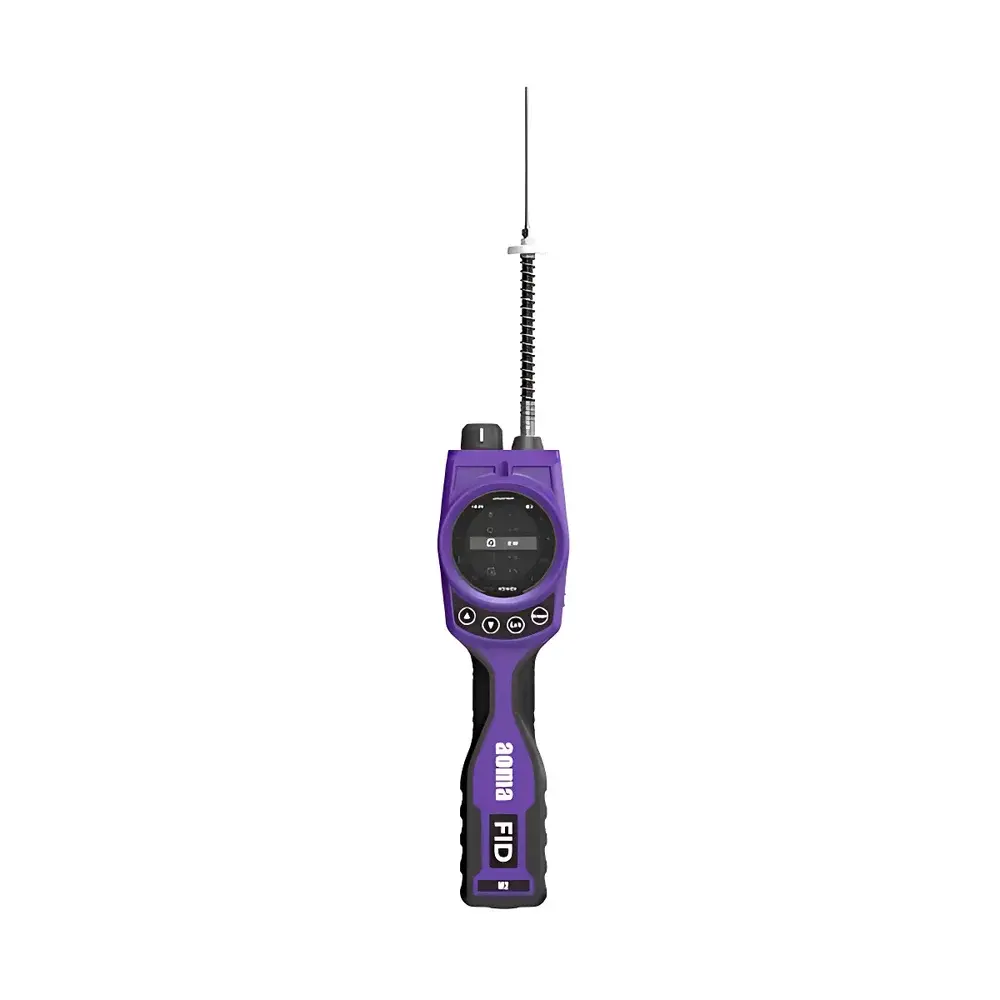
Aoma MINI FID M2 Portable Total Hydrocarbon & VOC Analyzer
| Brand | Aoma |
|---|---|
| Origin | Anhui, China |
| Manufacturer Type | Authorized Distributor |
| Country of Origin | Domestic (China) |
| Model | MINI FID M2 |
| Detection Principle | Flame Ionization Detection (FID) |
| Detection Target | Total Hydrocarbons (THC), Methane (CH₄), and Volatile Organic Compounds (VOCs) |
| Detection Limit | 0.5 ppm methane (defined as 7× baseline noise SD) |
| Measurement Accuracy | ±2% of reading (1.0–10,000 ppm CH₄) |
| Detector Type | Micro-FID with Low-Temperature Co-fired Ceramic (LTCC) Core |
| Calibration | Auto-zero & multi-point manual calibration (≥2 points) |
| Response Time (T90) | <2.0 s (10,000 ppm CH₄) |
| Preheat Time | ≤5 min |
| Operating Temperature | −25°C to +50°C |
| Relative Humidity | 0–95% RH (non-condensing) |
| Ingress Protection | IP66 (GB/T 4208) |
| Explosion Protection | Ex db ia IIC T4 Gb (GB/T 3836.1–4:2021) |
| Power Supply | 7.4 V Li-ion battery (5000 mAh) |
| Weight | 0.9 ± 0.05 kg |
| Dimensions | 320 × 92 × 66 mm |
| Data Storage | 8 GB internal flash |
| Connectivity | Bluetooth 5.0, Wi-Fi 2.4 GHz, USB 2.0 |
| Hydrogen Source | Solid-state metal hydride cartridge (0.1–1.0 MPa operating pressure |
| Sampling Flow | 0.1–1.0 L/min (nominal 0.7 L/min) |
| Linearity Error | ±2% full scale |
| Repeatability | ±2% (500 ppm CH₄) |
| Drift | ≤±5% over 8 h continuous operation |
| Resolution | 0.01 μmol/mol |
| Units | ppm, ppb, mg/m³, μmol/mol (user-selectable & export-consistent) |
| Regulatory Compliance | HJ 1012–2018, HJ 1230–2021, HJ 733–2014, GB 37822–2019 |
| Functional Safety | SIL-certified architecture |
| Optional Sensors | PID, O₂, CO, SO₂, H₂S, CO₂ |
| Software Integration | LDAR Management APP, VOCs Inspection APP, Cloud-based LDAR Platform (with audit trail), RFID-enabled instrument lifecycle management |
Overview
The Aoma MINI FID M2 is a certified intrinsically safe, portable total hydrocarbon and volatile organic compound (VOC) analyzer engineered for high-precision field measurement in demanding industrial environments. It employs flame ionization detection (FID) — a well-established, quantitative technique standardized under ASTM D1945, ISO 8573-5, and EPA Method 25A — to deliver reliable, linear response across a wide dynamic range of hydrocarbon species. Unlike photoionization detectors (PID), the FID provides uniform sensitivity to nearly all organic compounds containing C–H bonds, including alkanes (e.g., methane, ethane), aromatics (e.g., benzene, xylene), olefins (e.g., ethylene), halogenated hydrocarbons (e.g., chloroform), ketones (e.g., acetone), aldehydes (e.g., formaldehyde), and esters (e.g., ethyl acetate). The M2 integrates a proprietary low-temperature co-fired ceramic (LTCC) micro-FID detector core, enabling rapid thermal stabilization (6,000 hours). Its solid-state hydrogen storage system eliminates reliance on high-pressure gas cylinders, satisfying both safety requirements for Zone 1 hazardous locations and logistical constraints of mobile LDAR (Leak Detection and Repair) programs.
Key Features
- Ultra-compact design: Weighing only 0.9 ± 0.05 kg and measuring 320 × 92 × 66 mm, it is the lightest handheld FID analyzer commercially available — comparable in mass to standard PID instruments.
- Intrinsically safe & explosion-proof architecture: Certified to Ex db ia IIC T4 Gb (GB/T 3836.1–4:2021), enabling deployment in Class I, Division 1 / Zone 1 areas including refineries, chemical processing units, and pharmaceutical cleanrooms.
- Integrated solid-state hydrogen generation: Uses rechargeable metal hydride cartridges (0.1–1.0 MPa working pressure; 99.995% H₂ purity) with >2,000 cycle durability — eliminating cylinder handling, regulatory burden, and supply-chain dependency.
- Real-time quantitative analysis: Delivers calibrated concentration values (ppm/ppb/μmol/mol/mg/m³) with ±2% accuracy (1–10,000 ppm CH₄) and ≤±5% error across −20°C to +50°C operating range.
- Embedded intelligent calibration: Supports both manual multi-point calibration (≥2 points) and automated zero/reference-based calibration using internal signal stabilization algorithms — reducing field calibration frequency and operator dependency.
- Dual communication ecosystem: Native Bluetooth 5.0 and Wi-Fi 2.4 GHz enable seamless integration with Aoma’s LDAR Management APP, VOCs Inspection APP, and cloud-based platform — supporting FDA 21 CFR Part 11–compliant audit trails, electronic signatures, and role-based access control.
- Ruggedized field readiness: IP66-rated enclosure; 1 m drop resistance (IEC 60068-2-32); vibration tolerance per IEC 60068-2-6 (2 g); and −30°C to +60°C storage capability.
Sample Compatibility & Compliance
The M2 detects >95% of regulated VOCs listed in HJ 733–2014 and GB 37822–2019, including but not limited to methane, ethane, propane, butane, benzene, toluene, xylene, styrene, vinyl chloride, trichloroethylene, tetrachloroethylene, methanol, ethanol, acetone, methyl ethyl ketone, ethyl acetate, and formaldehyde. It meets or exceeds all performance criteria specified in HJ 1012–2018 (portable THC analyzers) and HJ 1230–2021 (LDAR technical guidelines), including linearity error (≤±2%), repeatability (≤±2%), stability (≤±5% over 8 h), response time (T90 < 2 s), and detection limit (0.5 ppm CH₄). Its measurement traceability is maintained through NIST-traceable calibration gases and documented uncertainty budgets aligned with ISO/IEC 17025 requirements. The device supports GLP/GMP-compliant data integrity via encrypted local storage, timestamped records, and immutable cloud synchronization with version-controlled metadata.
Software & Data Management
Data acquisition, visualization, and reporting are managed through Aoma’s cloud-native LDAR platform — accessible via web browser or native mobile applications. All measurements include mandatory metadata: GPS coordinates, operator ID, instrument serial number, sensor status flags, environmental conditions (T, RH, pressure), calibration history, and real-time diagnostic parameters (flame temperature, H₂ pressure, pump vacuum, battery level). Export formats include CSV and Excel (.xlsx) with configurable column mapping and unit consistency. Audit logs record every user action (login, calibration, configuration change, data deletion) with digital signature and timestamp — fulfilling FDA 21 CFR Part 11 electronic record/electronic signature (ER/ES) requirements. Optional RFID tagging enables automatic check-in/check-out logging integrated with enterprise asset management systems.
Applications
The M2 is validated for routine and emergency applications across regulated industrial sectors:
- LDAR program execution per EPA 40 CFR Part 60/63 and China’s HJ 1230–2021 — including valve, flange, pump, compressor, and open-ended line screening.
- Fixed source stack monitoring for THC compliance verification against GB 16297–1996 and local emission permits.
- VOC abatement system efficiency assessment (e.g., RTO, carbon adsorption, biofilter inlet/outlet differentials).
- Workplace exposure assessment in pharma manufacturing, coating facilities, and printing operations per GBZ 2.1–2019.
- Uncontrolled emission source identification — e.g., wastewater treatment lagoons, tank vent stacks, loading rack vapors, and fugitive leaks in oil & gas infrastructure.
- Emergency response during VOC spills or process upsets, leveraging rapid T90 response and onboard alarm thresholds with visual/audible alerts.
FAQ
What certification standards does the M2 comply with?
It meets GB/T 3836.1–4:2021 (Ex db ia IIC T4 Gb), IP66 (GB/T 4208), HJ 1012–2018, HJ 1230–2021, HJ 733–2014, and GB 37822–2019. Functional safety architecture is SIL-certified.
Can the M2 operate in sub-zero temperatures?
Yes — it functions continuously from −25°C to +50°C. At −20°C, hydrogen delivery and battery runtime are maintained via thermal management; minimum runtime is ≥4 hours.
How is hydrogen replenishment performed in the field?
Two methods: (1) On-site recharging using Aoma’s electrolytic water-based hydrogen generator (no external gas supply required); or (2) Swapping pre-charged metal hydride cartridges (85 mm × φ22 mm, ≤0.1 kg) — completed in <30 seconds.
Is remote firmware update supported?
Yes — over-the-air (OTA) updates are delivered via Wi-Fi or USB, with cryptographic signature verification and rollback capability to ensure system integrity.
Does the M2 support third-party data integration?
Yes — RESTful API and secure SFTP endpoints enable bidirectional data exchange with EAM, CMMS, and environmental data management systems (EDMS) using ISO 15143-3–aligned schemas.





